
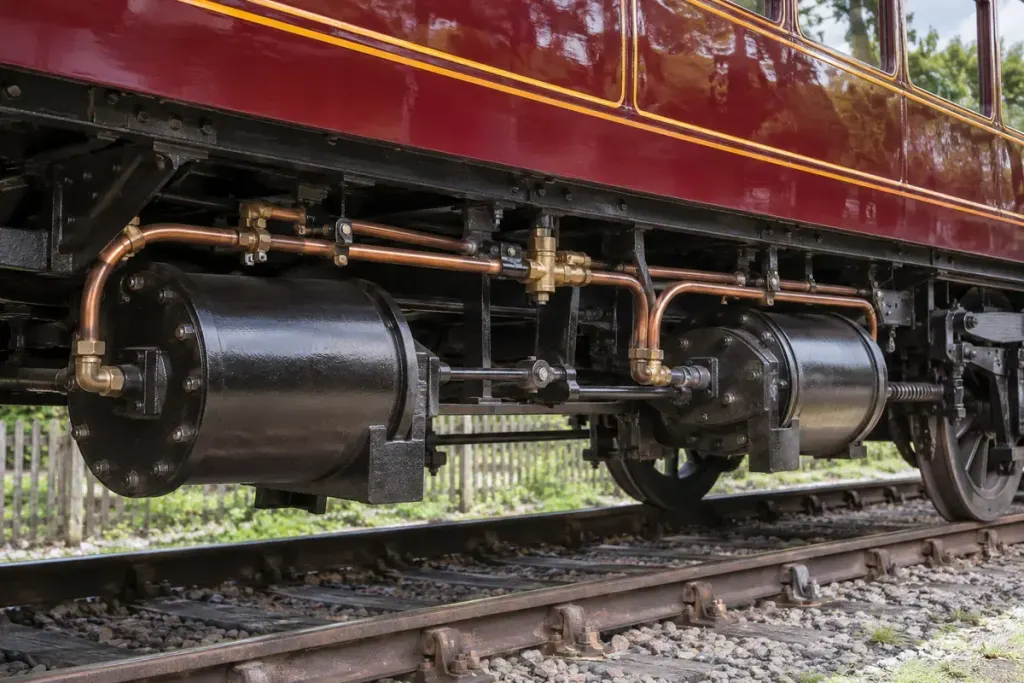
A brake system that works by admitting air can sound backwards. The key is the pressure difference already established inside it. Automatic vacuum brakes used reduced air pressure in a connected system, with changes in that condition controlling the brakes along the train.
The university-led Railway Work, Life & Death explanation of vacuum brakes describes air being pumped out to release the brakes and admitted again to apply them. The arrangement also allowed a loss of vacuum caused by a compromised pipe to apply the brakes.
Read “vacuum” as a pressure condition
The system does not need a mysterious pulling force. Atmospheric pressure and reduced pressure act across the brake mechanism. The useful question is which pressure exists on each side of the working piston or diaphragm and how that changes when the driver operates the control.
Detailed arrangements varied. Railcar’s technical account of vacuum-brake operation shows how valves, reservoirs and cylinders belong to the system. A simplified explanation is a starting point for reading that equipment, not a maintenance instruction.
Compare the principle, not just the hose
An automatic air-brake system also uses pressure changes to control braking, but its operating arrangement differs. Seeing a pipe and a flexible connection on a museum vehicle is not enough to identify the system reliably.
Read the vehicle label, its service history and any diagram provided. A restored vehicle may have modifications from different periods. Ask whether the displayed equipment represents its original condition or a later working arrangement.
Make a useful museum note
Record the vehicle, railway, approximate period and the source of the brake identification. Sketch where the visible pipe runs without reaching under equipment or entering restricted areas. If a component is inaccessible, leave the description incomplete rather than guessing.
A good question for a guide is: “What change in this system applies the brake, and where is that change created?” It invites an explanation of the complete arrangement instead of a list of part names.
The counterintuitive detail becomes understandable once the initial pressure condition is clear. Air entering the system was not necessarily a fault; in a controlled form, it was how the train was told to stop.