
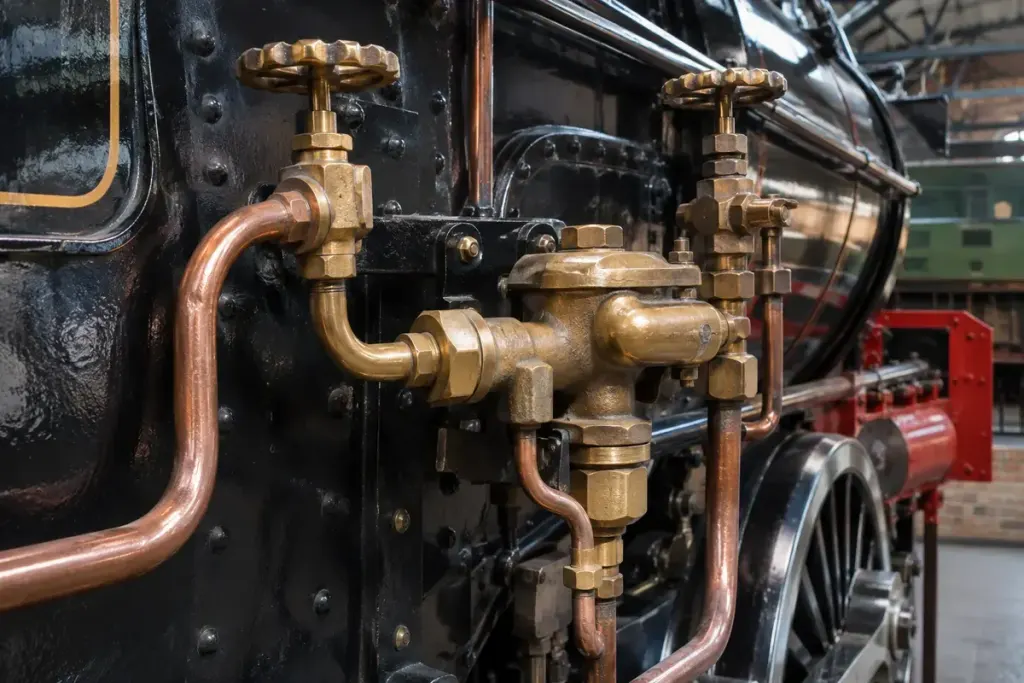
A steam locomotive must replace the water it turns into steam. That sounds straightforward until you remember that the boiler is already under pressure. Simply connecting an open tank to it is not enough.
The injector solves this problem using steam flow. In a conventional steam injector, a fast steam jet meets feedwater; the steam condenses and transfers momentum, and the resulting flow is directed through a delivery passage that develops sufficient pressure to enter the boiler. It is an ingenious arrangement, but not a device that creates energy from nothing: it uses energy supplied by the locomotive’s steam.
Trace water, steam and delivery
The Smithsonian’s Sellers injector exhibit uses a sectioned example to distinguish the feedwater inlet, steam inlet, combining tubes, boiler delivery and overflow. Those labelled routes are easier to understand than an outside photograph of several similar-looking pipes.
On a museum visit, begin by finding which connection comes from the water supply and which comes from the boiler’s steam space. Then follow the delivery route back toward the boiler. If the installation is enclosed or the labels are unclear, ask a guide rather than guessing from the pipe’s height.
Why the small fittings deserve attention
The National Park Service’s locomotive technology tour description highlights water delivery as part of understanding a steam engine from the inside. It is a reminder that the visible wheels and cylinders are only part of the machine.
For an original note-taking exercise, sketch three arrows beside the exhibit name: energy entering, water entering and water delivered. Add a question mark wherever the display leaves a connection uncertain. This produces a useful record without pretending your sketch is an operating diagram.
Historic injectors vary in arrangement, including whether they lift water and whether they use live or exhaust steam. Identify the actual example before generalising. A photograph of a preserved Montana locomotive can suggest what to investigate, but its specific equipment needs documentation.
Do not operate preserved valves or fittings. The rewarding task for a visitor is to understand how the water circuit supports steam production—and why a seemingly modest brass component belongs in the story of the whole locomotive.