
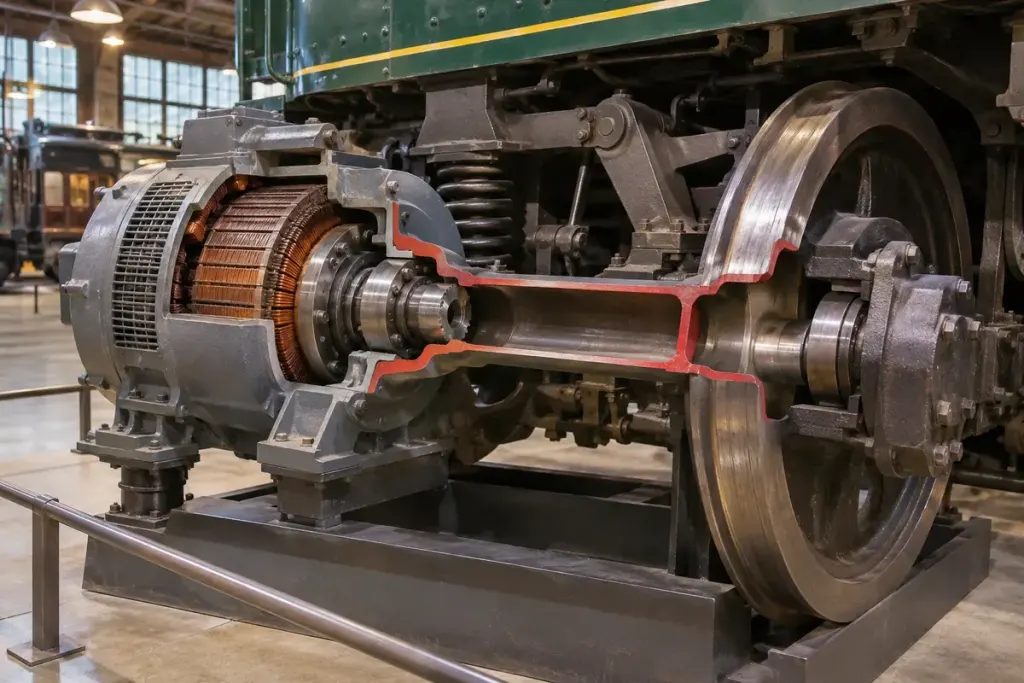
A locomotive wheel can be driven without fastening the whole traction motor rigidly to its axle. In a quill-drive arrangement, a hollow shaft surrounds the axle and transfers rotation through a connection that allows relative movement. The empty space around the axle is part of the design, not a missing component.
Follow the path of the turning force
Start with the motor, then identify the quill, the coupling and the wheel. A historical Milwaukee Road electrification brochure describes its quill spring-drive passenger locomotive and shows the hollow shaft arrangement. The brochure is a period primary source, useful for its machinery description but also written to promote the railway’s electrification.
A Federal Railroad Administration equipment review distinguishes early gearless quill arrangements from geared developments. That distinction matters: “quill drive” does not identify one identical mechanism used everywhere.
Why leave room for movement?
The axle and wheels must respond to the track while the locomotive’s suspension supports other parts of the vehicle. A flexible connection can transmit rotation while accommodating some relative movement. How the motor is supported affects how much mass follows the axle directly over track irregularities.
In a drawing, look for springs or links at the connection rather than assuming the quill itself is simply a solid sleeve gripping the axle. Also locate the motor’s mounting points. Those details explain more than the overall silhouette of the locomotive.
Keep the historical identification specific
If you find an archive photograph, record the locomotive class, date and source caption before describing its drive. A photograph of a wheel alone may not reveal enough to distinguish arrangements. Compare it with a drawing or maintenance document for that class.
For a museum notebook, sketch just four labelled shapes: motor, quill, axle and wheel. Add arrows for rotation and mark the flexible connection. This small exercise turns an unfamiliar term into a mechanical question you can follow through a period document, without assuming that every electric locomotive used the same solution.