
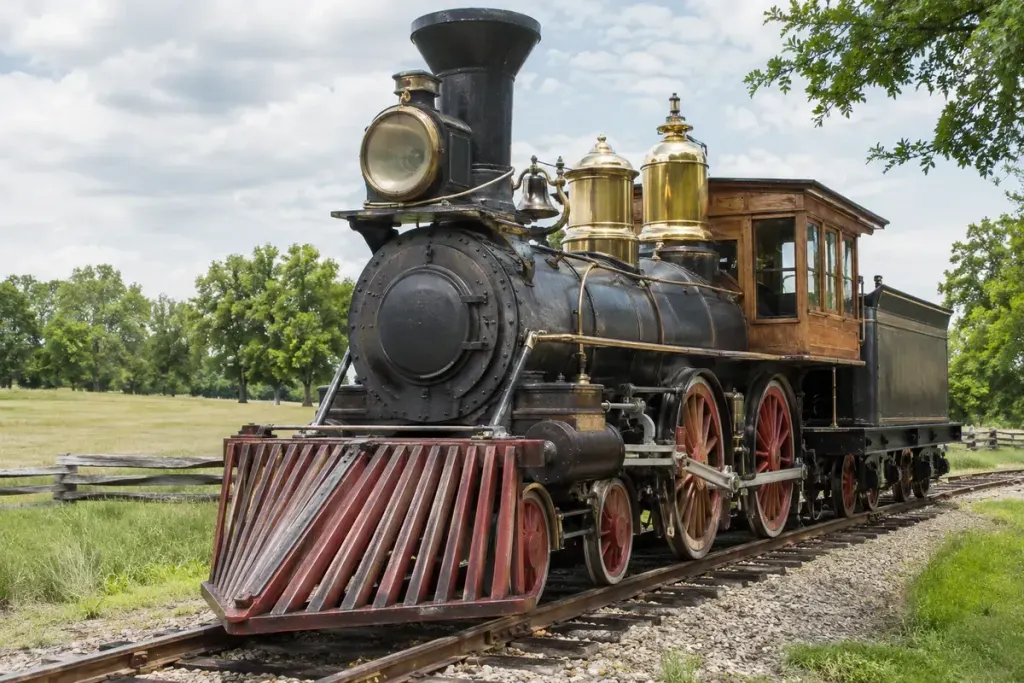
The broad, sloping structure at the front of many nineteenth-century locomotives is often called a cowcatcher. “Pilot” is the more useful term when reading a technical description. Its location and shape were connected to the problem of obstructions ahead of the wheels.
A United States National Museum account of early railroad equipment discusses the addition of a pilot to the John Bull locomotive and compares the preserved engine with a model. That comparison is valuable: a familiar feature on an old locomotive may belong to an alteration rather than its first construction.
Look at the attachment, not only the outline
In a museum photograph, trace how the pilot meets the front frame. Note the materials, the spaces between members and the relationship to the coupler. Do not treat every triangular front structure as identical merely because a drawing gives it the same silhouette.
Record what you can actually see. “Sloping members below the smokebox” is an observation. “Original wooden pilot from the year the engine was built” needs a collection record or other evidence. Paint and restoration can make a replacement look as visually settled as a surviving early component.
The National Museum example also shows why comparing a model, a historic photograph and a present-day exhibit can be more informative than looking at only one. Differences may document change rather than prove that one image is wrong.
A useful museum question
Ask which operating period the locomotive is presented to represent. Then ask whether the pilot is original, reconstructed or adapted from a later arrangement. A restoration may deliberately return an engine to a selected date rather than preserve every modification it ever carried.
A pilot was never a promise that a train could safely meet anything on the line. Its historical purpose should not be confused with a general collision guarantee.
On the next visit, take one wider photograph showing the front assembly and one permitted detail view of its attachment. Add the museum’s identification and restoration date to your note. That turns an iconic shape into a small piece of railway evidence.