
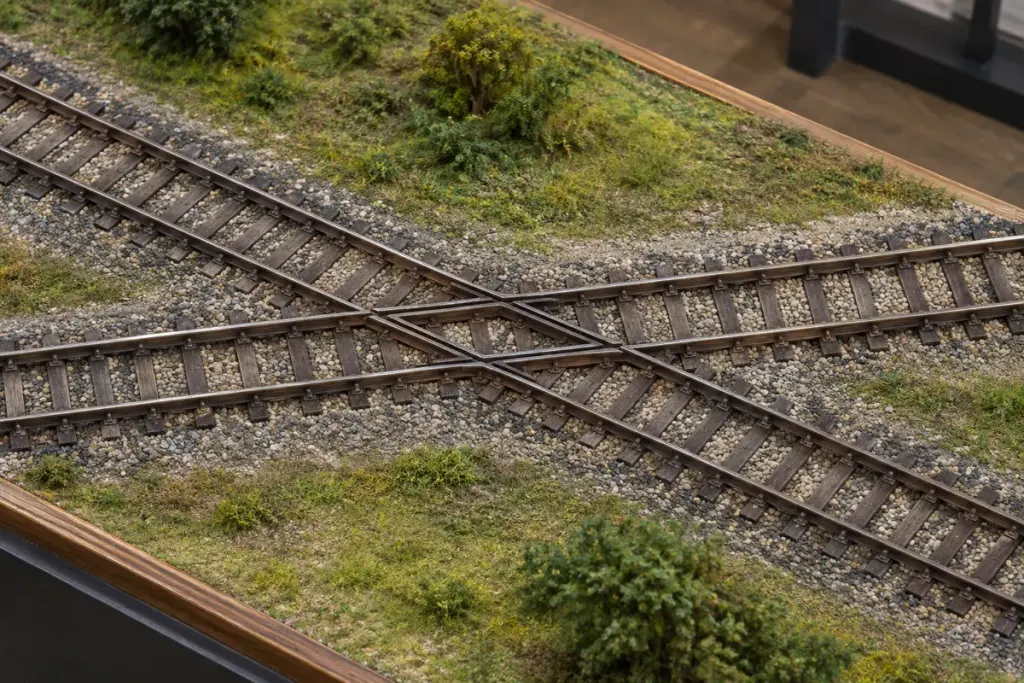
On a track diagram, two railway routes can cross like the strokes of an X. On the ground, that simple symbol becomes carefully arranged railwork that lets wheel paths intersect at the same level. This is the setting for a diamond crossing.
A plain diamond allows routes to cross; it does not by itself let a train transfer from one route to the other. Slip arrangements add connections and make the layout more complex. The distinction is useful when reading a historic yard plan, where several symbols may be crowded into a small space.
The Indian Railways track manual discusses diamond crossings and slip arrangements. Its terminology and engineering context should be kept with the source rather than assumed to describe every railway system identically.
Trace a route before naming every component
Use a museum plan or a photograph taken from an authorised public position. Start with one pair of rails and follow it across the other route. Then repeat with the second pair. Ask whether either route can change direction within the arrangement, or whether they simply continue through the crossing.
This exercise prevents a common reading error: assuming that every visible intersection is a switch that can send a train either way. Route selection and crossing geometry are different functions, even when they occur close together.
Keep the historical setting attached
The National Trust’s Penrhyn Quarry railway trackwork record lists a diamond crossing alongside other preserved track sections. A collection entry like this provides provenance that an uncaptioned photograph lacks.
For your own notes, record the railway, gauge if documented, date of the plan or object, and the source’s wording. If a layout was rebuilt, distinguish the period shown from the arrangement present today.
Never enter a track area to check the geometry or stand on rails for a better photograph. Active railways and preserved sites both require respect for access rules. A well-labelled diagram can teach the route relationship without bringing the observer close to moving equipment.