
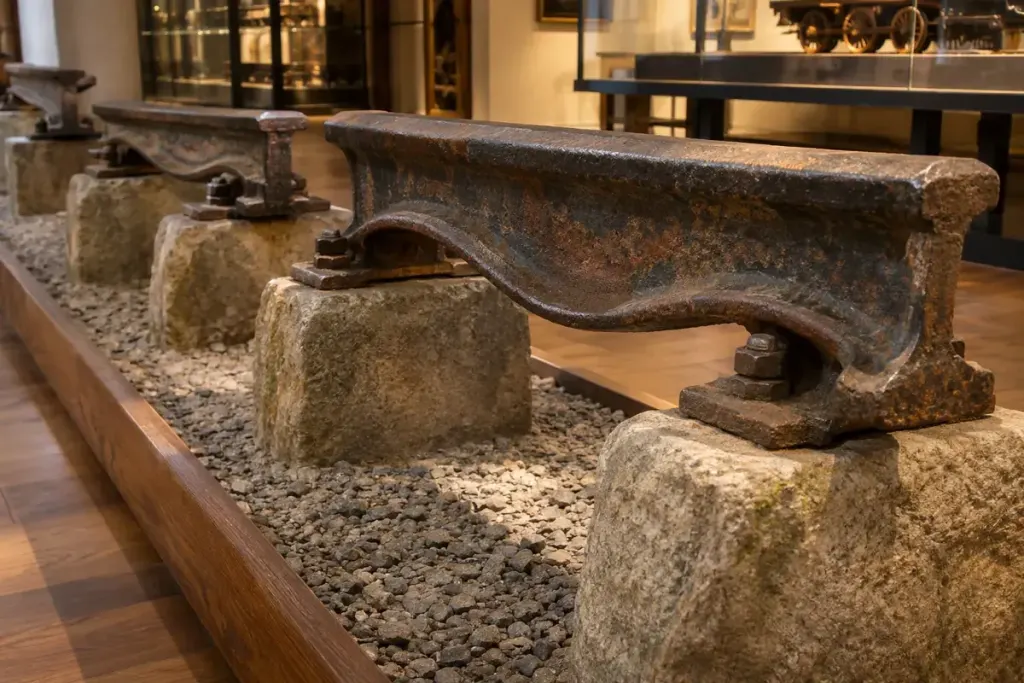
An early rail can look surprisingly unlike the long, even section beside a modern platform. Viewed from the side, a fishbelly rail becomes deeper between its supports, then shallower towards the ends. Its name describes that outline, not a separate fitting attached to a rail joint.
The shape is worth studying because a rail carries a moving wheel load across gaps between supports. Extra depth in the span helps the section resist bending. This is the same broad structural idea that makes the depth of a beam important; it does not mean every surviving rail used identical dimensions or manufacturing methods.
The Science Museum Group holds wrought-iron fishbelly rails with projections that fit their chairs. The chair is the supporting fitting beneath the rail. Looking only at an isolated length misses how its end was located and held.
Another collection record identifies a long piece from the Liverpool and Manchester Railway, dated 1829. That provenance belongs to the recorded object. It should not be transferred to an unlabelled rail simply because the profile looks similar.
At a railway museum, try reading the exhibit in three passes:
- Follow the top running surface, then compare it with the changing underside.
- Find the support positions and the connections between neighbouring lengths.
- Read the material and date in the catalogue rather than identifying cast or wrought iron from colour alone.
A sketch from the side can be more informative than a close photograph of the rust. Mark where the rail deepens and where it meets a support. If the original arrangement is incomplete, record that uncertainty instead of filling the gaps with a modern track layout.
For a Montana railway-history notebook, an early British specimen offers useful comparative engineering history. It is not evidence that the same rail was laid on a particular Montana line. That separate claim needs a local photograph, specification, excavation record or documented surviving piece.