
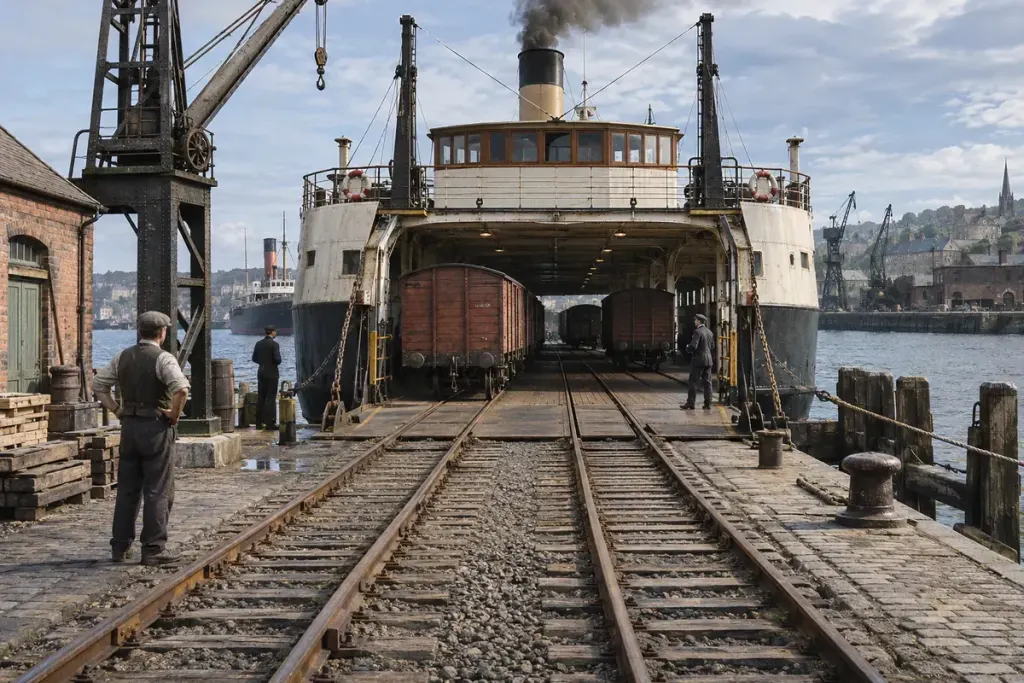
A railway line reaching the water did not always end at a bridge. A train ferry carried railway vehicles on tracks laid aboard a vessel, connecting the rails on one shore with those on the other. The crossing was part of the railway journey itself.
A western example: the Solano
The Benicia Historical Society’s account of the Solano describes the Central Pacific ferry commissioned in 1879 to cross between Benicia and Port Costa, California. The service ended in 1930 after completion of the Benicia-Martinez railway bridge. This is a California example of a wider railway practice, rather than a claim about a Montana ferry.
The story is more than an unusually large boat. Shore tracks, loading arrangements, the vessel and the railway timetable had to work together. A continuous route on a passenger map could contain a substantial transfer operation.
Read the shore as carefully as the vessel
When examining an archival photograph, follow the rails toward the water. Look for the connection between land and deck, the number of parallel tracks and any points where vehicles could be sorted. Then identify what the photograph actually shows: a loading moment, a vessel underway, or a staged view.
A track disappearing behind another object is not evidence that it ended there. Equally, a locomotive visible on shore does not establish that the same locomotive crossed aboard. Use a dated operating account or plan to answer questions that the photograph cannot settle.
Three records make a stronger reading
- A route map establishes which places the crossing connected.
- A plan or clear photograph helps explain the physical arrangement.
- An operating description can show how trains were divided, moved and reassembled.
For a museum notebook, record the archive’s caption separately from your own interpretation. A useful observation might be “three deck tracks visible in this view”; a stronger claim such as the vessel’s full capacity needs documentary support.
Train ferries reveal why railway history extends beyond locomotives and permanent track. Water crossings brought marine engineering and railway operations into the same journey. Following that connection can make an otherwise puzzling break in an old railway map much easier to understand.