
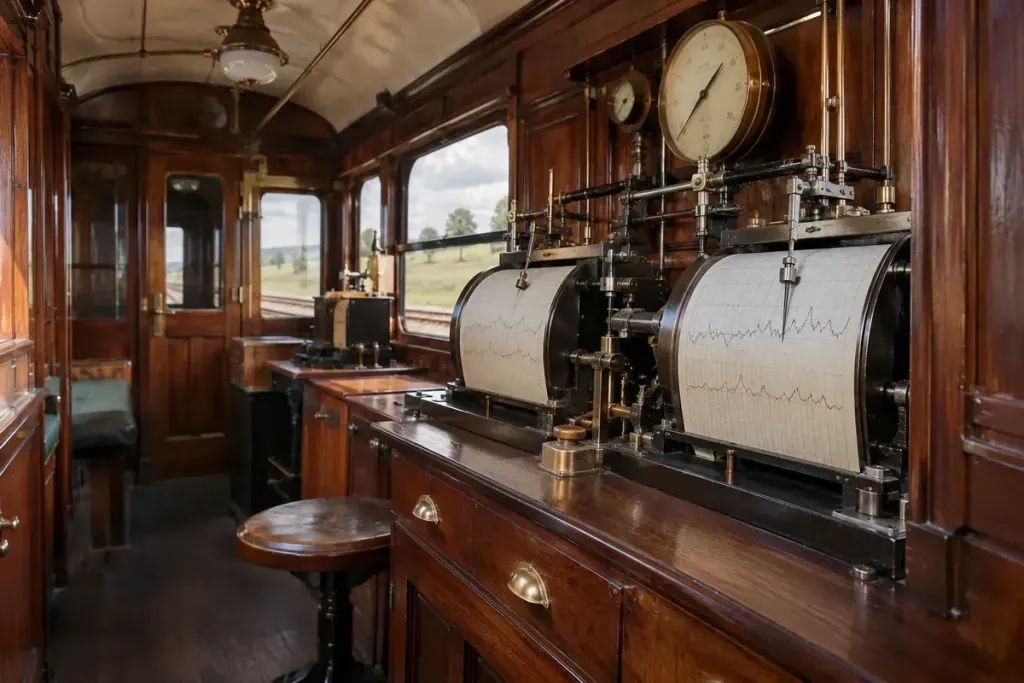
A locomotive’s performance story is easier to assess when you know how the measurements were made. A dynamometer car brought instruments onto the railway itself, turning a journey into a moving test rather than relying only on an observer beside the track.
Different cars carried different equipment. Depending on their design and purpose, they could record quantities such as speed and drawbar pull. The important historical question is which instruments were fitted for the particular test, not what a generic laboratory coach might have measured.
The Science Museum Group’s account of Mallard identifies the LNER dynamometer car as the source of the paper-roll speed record for the locomotive’s 1938 run. That example belongs to British railway history; it should not be transferred to a Montana railway simply because both used steam locomotives.
Read the record as an instrument output
A line on a paper roll needs a scale, a time or distance reference and an explanation of what the recorder was connected to. Without those, a dramatic peak is only a shape.
When looking at a museum reproduction, find the labels before trying to read the maximum value. Ask whether the image shows the original record, a later tracing or an explanatory graphic. Each can be useful, but they are different kinds of evidence.
Drawbar pull also needs its measurement location and test conditions. It should not be casually substituted for engine power, and a single high reading does not describe every part of a journey.
Questions for a collection visit
- Which railway built or operated this car?
- What was the test intended to investigate?
- Which quantities were recorded, and how were the instruments checked?
- Where are the associated logs, route details and interpretation?
Photograph the catalogue label as well as the instrument panel, where photography is permitted. A notebook entry with the car’s identity and record reference remains useful long after a close-up of an unexplained dial becomes difficult to place.
The dynamometer car adds a valuable second character to a locomotive story: the equipment that made the claim measurable.