
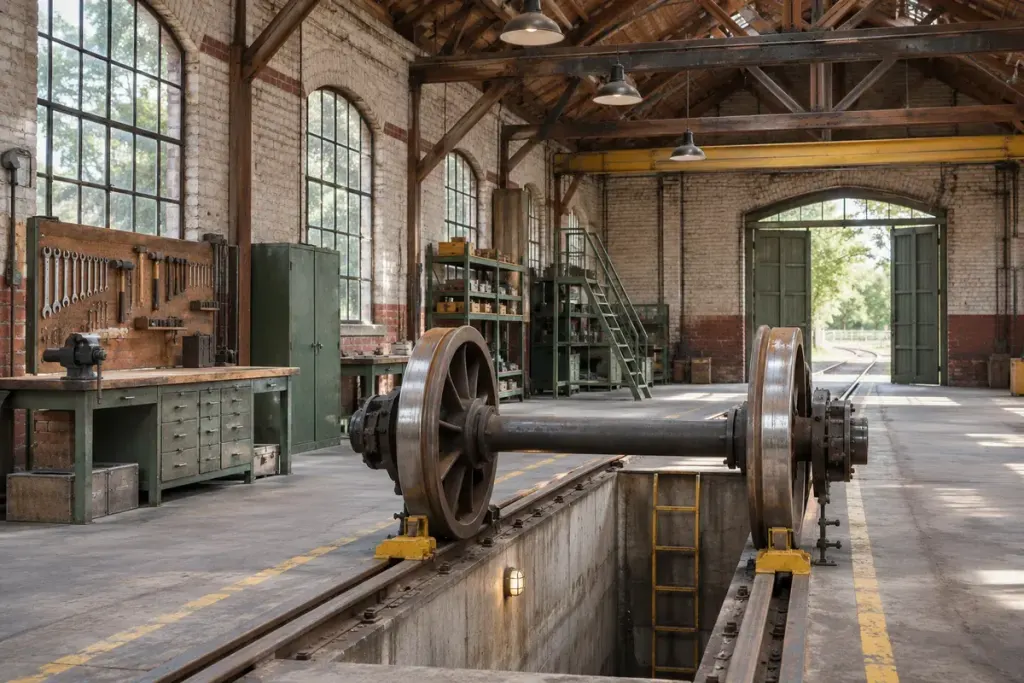
Inside an old locomotive workshop, a deep opening beneath the rails may look like an unusually large inspection pit. A wheel-drop installation had a more specific purpose: it allowed a wheelset or related assembly to be lowered beneath a suitably supported vehicle for maintenance.
The National Railway Museum’s account of the former workshop now occupied by Wonderlab identifies the wheel-drop pit and crane as surviving evidence of the building’s earlier function. Even when machinery is no longer operating, the floor can preserve the sequence of work.
Look for movement in more than one direction
The vehicle arrived along the rails. The component then needed a route down and away, while the rest of the vehicle remained safely supported. Different installations solved that handling problem in different ways. An opening alone does not tell you the capacity, lifting mechanism or precise operating procedure.
At a museum, compare the visible pit with a labelled drawing or archival photograph. Look for rail sections, platforms, adjacent working space and the relationship to overhead handling equipment. These details help distinguish a drop installation from a pit intended mainly to give staff access underneath a vehicle.
Ask what remained in place
A useful interpretation question is what the workshop could service without dismantling or lifting the entire locomotive. That shifts attention from the impressive size of the machine to the practical organisation of repair work.
Do not assume every locomotive depot used the same equipment. Available space, vehicle design, workload and the period of construction influenced the facilities. A site guide or maintenance drawing is better evidence than transferring the story of one preserved workshop to another.
Keep to the visitor route: a historic pit is still a fall hazard, and a barrier is not an invitation to inspect beneath it. The rewarding observation can be made from above. Follow the paths a vehicle, its wheelset and the workers would have taken, and the empty space in the floor begins to explain the workshop around it.