
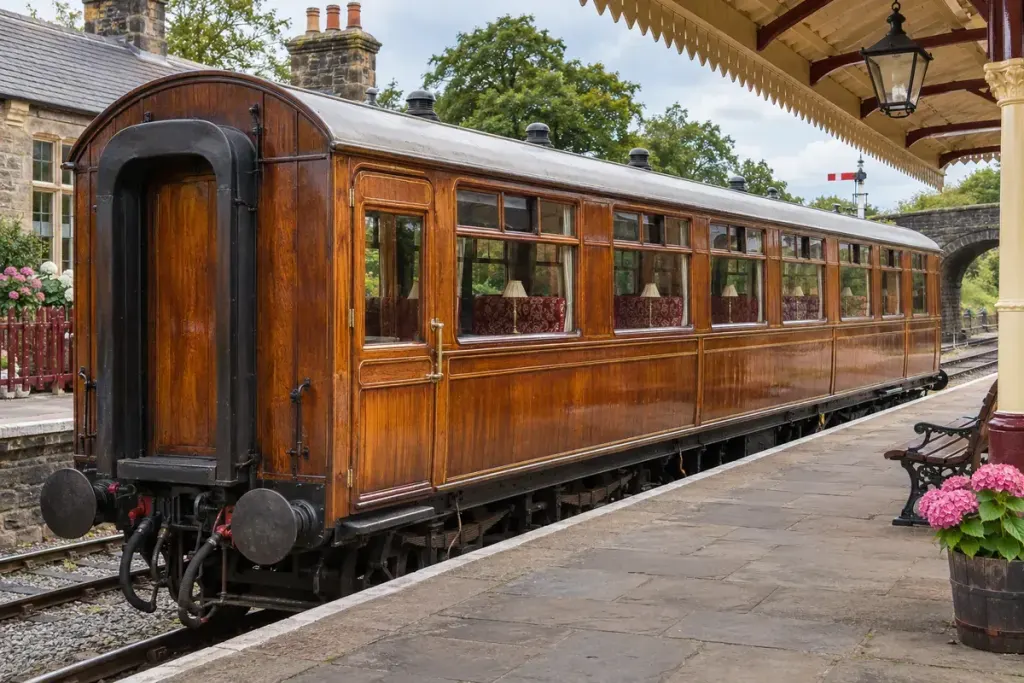
A passenger train usually arrives at a station as a connected whole. A historical slip-coach service could do something more surprising: release a specially equipped rear portion while moving, allowing it to stop under its own guard’s control as the main train continued.
Didcot Railway Centre’s account of slip coaches describes the specialised coupling and operating history. This was a designed railway procedure involving dedicated equipment and staff, not passengers casually uncoupling an ordinary carriage. It belongs to the history of particular services and must not be treated as a modern operating suggestion.
Two journeys hidden inside one departure
The arrangement separated the needs of an express from those of passengers for an intermediate stop. The main train avoided that stop; the detached coach or portion still delivered its passengers locally. To understand a timetable, therefore, you need to know both where the through train went and what happened to its slipped vehicles.
Didcot’s February 2024 archive feature discusses a Cornish Riviera formation with portions slipped at Westbury, Taunton and Exeter. The example shows why a long departure formation and a later photograph of a shorter train need not contradict each other.
Questions for a museum visit
Look for a formation diagram, the guard’s compartment and an explanation of the braking arrangements. Ask which exact coach and period the display represents. A preserved vehicle may have been modified during its working life, so the features visible today do not necessarily describe every earlier use.
When reading an old timetable, distinguish a slip from an ordinary station division of a train. Both can send portions towards different destinations, but the operating sequence is different. Record the terminology used in the original source rather than quietly replacing it with a familiar modern term.
A good collection note links the vehicle to a service, date and source. “This type of coach supported a particular non-stop working” is more informative than “old trains dropped carriages anywhere”. The fascination lies in the carefully organised solution to a transport problem, including the extra complexity needed to make that solution work.