
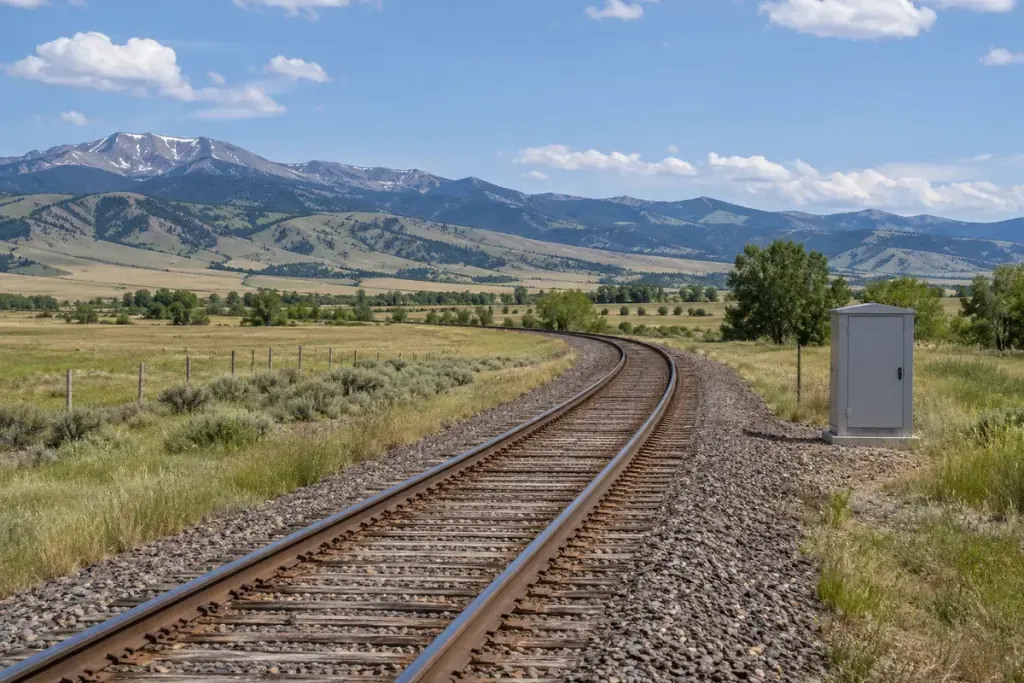
A railway signal does not need to see the front of a locomotive to know that a section of track is occupied. In a track circuit, the rails themselves form part of an electrical detection system. That makes an ordinary-looking stretch of line part of the signalling equipment.
Network Rail’s explanation of track circuits describes the basic arrangement: a small electrical current travels through a section of rail, and a train’s wheels and axle change the path of that current. The signalling system can use the resulting change to register the section as occupied.
What the circuit knows
Think of the information as “this section is clear or occupied,” rather than “this is the afternoon passenger service.” A conventional track circuit does not identify a train by name, count its passengers, or report its destination. Other parts of railway operation supply those meanings.
The design also matters when something goes wrong. A fault can cause a section to indicate occupied even when no train is present, preventing it from being treated as clear. This helps explain why a signalling failure may stop traffic on apparently empty track. It does not mean every possible rail defect is automatically detected by every installation.
Reading evidence in a railway photograph
For someone studying Montana railway history, this is a useful way to notice details beyond locomotives. An insulated joint, a cable connection, or an equipment case may be evidence worth investigating. None of those details alone establishes the exact circuit arrangement or the date when a particular line adopted it.
Start a research note with the photograph’s location, date range, and visible equipment. Then look for a contemporary signalling plan, railway engineering report, or maintenance record. A caption such as “possible track-circuit connection” keeps an observation separate from a confirmed identification.
That distinction avoids projecting a modern network’s practice onto every historical railroad. The electrical principle is a helpful starting point; the local documentary record tells you how, where, and when it was actually used.