
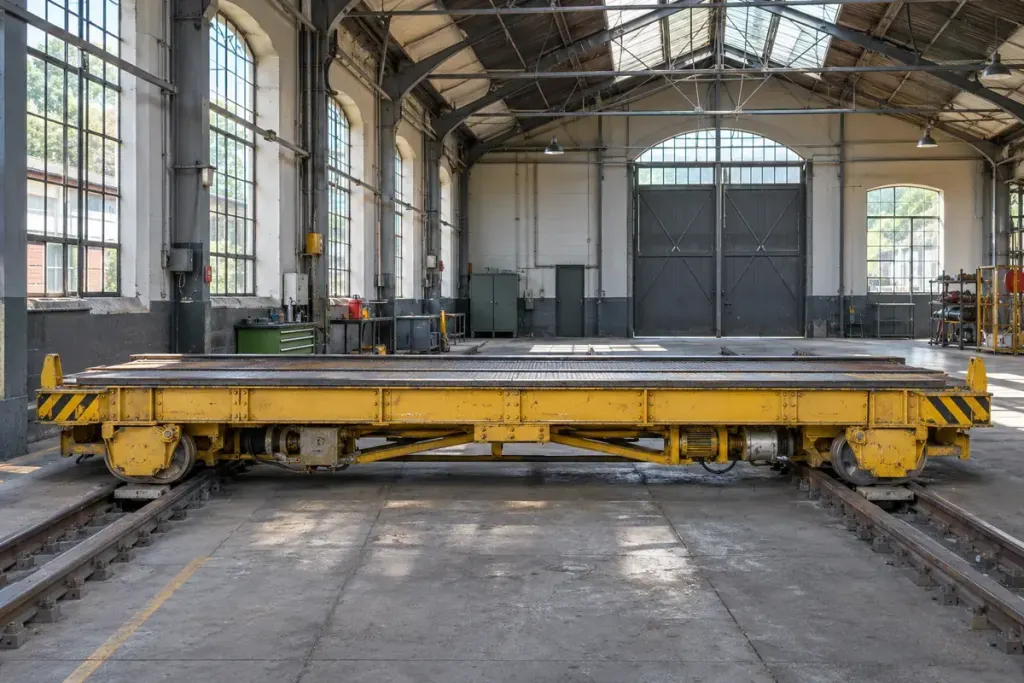
A railway vehicle can change tracks without following a turnout. In a workshop equipped with a traverser, it rolls onto a short length of track carried by a moving platform. The platform then travels sideways until it lines up with another road.
Historic England’s archive photograph of the traverser at Didcot Railway Centre provides a documented example and a concise description of this sideways transfer. In North American records, the equipment may be called a transfer table.
Look at the tracks underneath
In a photograph, the rails that carry the vehicle and the rails that guide the platform serve different purposes. First identify the short track on the platform. Then look for the transverse route beneath it and the parallel workshop roads it can connect.
This reading exercise helps distinguish a traverser from a turntable. A basic traverser changes a vehicle’s lateral position while keeping its orientation. A turntable rotates its carried track. Some installations combine functions, so the actual arrangement matters more than an isolated caption.
Read a workshop as a working layout
Imagine several parallel repair bays. A sideways-moving table can align a vehicle with one bay, then another, without requiring a long fan of approach points. On a site plan, follow the route from the entrance to the table and from the table to each bay. You can then ask which movements the layout made possible.
Do not infer the whole operating sequence from a still image. A photograph might show a display arrangement, a disconnected vehicle or machinery no longer in service. Check the date, location and whether the description concerns working equipment or a museum reconstruction.
For a research notebook, record the platform’s visible length, the number of roads served and any evidence of a pit, drive or operator position. Mark uncertain details as questions. The Didcot example is in Britain; it does not establish that the same arrangement existed at a particular Montana site. That claim would need a local plan, photograph or engineering record.