
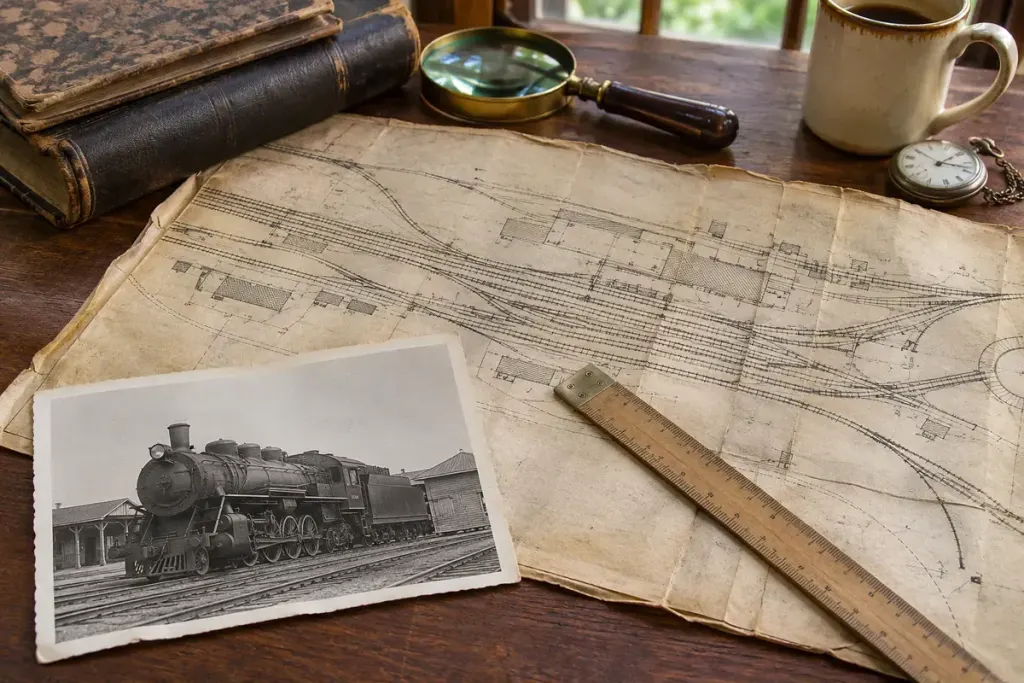
A small terminus could need a locomotive to change tracks without having room for a conventional arrangement of points. A sector table offered a compact moving connection: a length of track pivoted through a limited arc to line up with adjoining tracks.
Its purpose should not be confused with turning an engine through a half-circle. A layout that lets a locomotive reach another track does not necessarily reverse the direction it faces. The useful question is what movement the particular installation allowed.
A small structure could limit a whole service
The Railway and Canal Historical Society’s July 1991 journal discusses locomotive changes on the Isle of Wight and notes the size restriction of the sector table at Bembridge. This British example illustrates how infrastructure could constrain a locomotive choice even when the engine otherwise suited a route.
It is a comparison for railway-history readers, not evidence that an identical installation existed in Montana. A local claim needs its own plan, photograph or operating record.
Read the movement from the plan
When examining a station drawing, locate the pivot, the moving track and the fixed tracks it could meet. Look for a dated scale and any later alterations. A line on a simplified tourist map may omit the details needed to understand the mechanism.
Then compare a photograph taken from a different angle. Can you identify where the fixed rail ends? Does the image show the full length of the moving section, or only one end? Keep uncertain dimensions out of a confident description.
Separate capacity from appearance
An engine that looks small in a distant photograph may still have a wheelbase or loading requirement unsuitable for an installation. Avoid estimating compatibility from the body silhouette alone. Seek a stated restriction or a documented account of actual use.
A good archive note records the site, date, source reference and the movement the evidence supports. That turns an unusual piece of track into a useful explanation of how a station worked, while preserving the distinction between what the drawing shows and what the historian has inferred.