
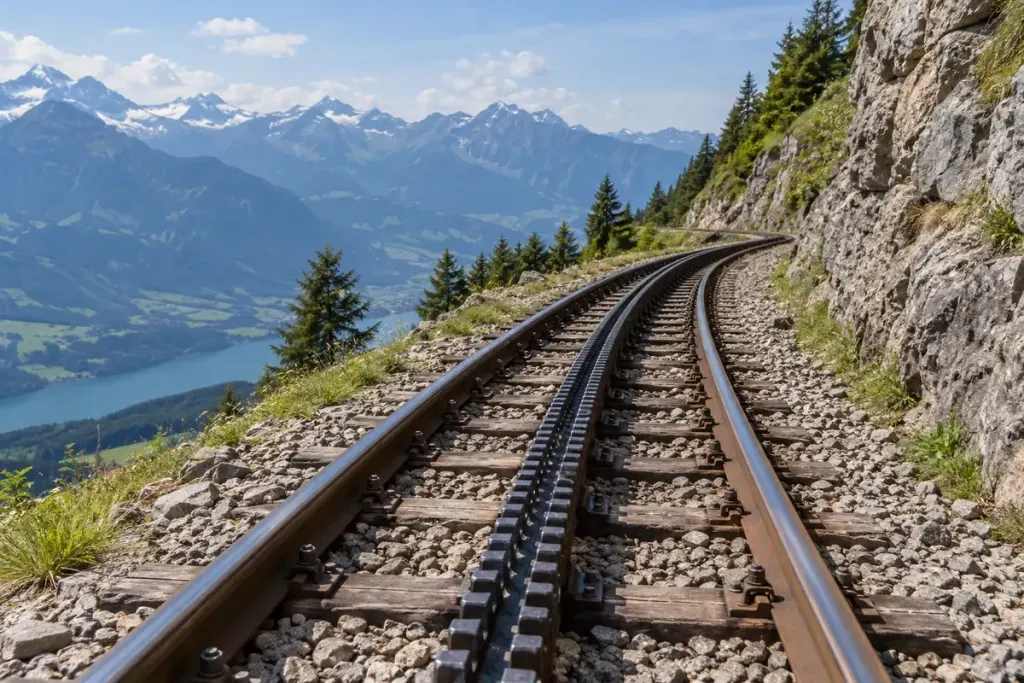
Look between the two running rails in a photograph of a steep mountain railway. A third structure with regular teeth may reveal that the train is using a rack system. The wheels still run on rails, but traction is assisted by a toothed mechanism engaging that central rack.
The extra rail has a different job
A cog on the vehicle engages the rack so that rotation produces movement along the track. The Mount Washington Cog Railway’s account of its early locomotive describes this mechanism on its New Hampshire line. It is a useful example of a mountain railway outside Montana, rather than evidence that every western mountain route used the same technology.
The rack and its matching gear must work as a system. It is not simply an ordinary rail placed in the middle for extra support. Different rack designs exist, so avoid naming a design from a distant photograph unless the visible detail or accompanying record supports it.
Read a photograph in layers
First identify what is actually visible: running rails, the central rack, vehicle wheels and any exposed mechanism. Then inspect the caption for a location, operator and date. Finally, compare it with an operator history or technical collection record.
If the centre of the track is hidden by snow or a vehicle, write “rack not visible” in your notes. That is different from concluding that no rack exists. Similarly, a steep-looking photograph may exaggerate or obscure the gradient through camera position.
Do not confuse it with a funicular
A funicular’s characteristic hauling system uses a cable; a rack railway’s defining feature is the toothed engagement described above. Both can serve steep terrain, but that shared purpose does not make the mechanisms interchangeable.
For a history notebook, place the image beside a small evidence list: visible feature, caption claim and confirmed source. This keeps an interesting mechanical observation from expanding into an unsupported story about the line’s construction or operation.