
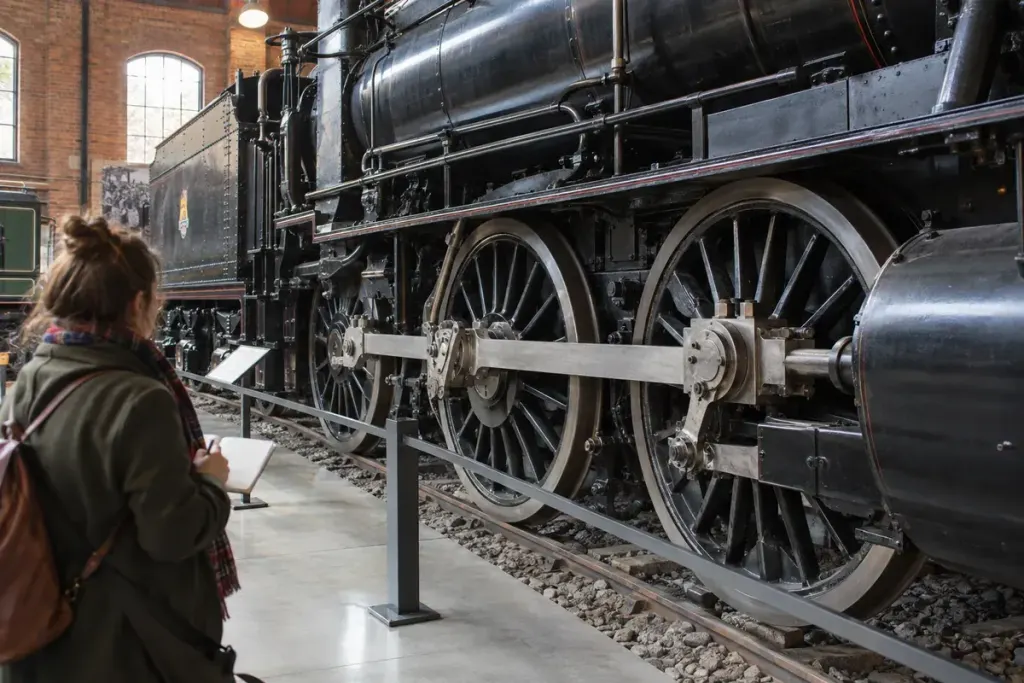
You leave a railway museum with dozens of photographs and realise that the most interesting object has no readable label in any of them. You remember a large wheel, a builder’s plate and a story about a route, but not how they fit together.
A short notebook entry can preserve more useful context than another wide photograph. Choose one object that interests you and spend a little time connecting what you see with what the museum actually says.
Begin with the label, not a guess
Record the object’s name, identifier if provided, maker, date and the museum’s own description. Distinguish an original vehicle from a model, reconstruction or display component. If the label does not answer a question, leave the answer open.
The National Railway Museum’s objects and stories offers examples of how collection objects can be connected with wider railway history. A collection record or curator’s explanation is a useful companion to your visual impression, especially when a display has been restored or altered.
Choose one detail to describe carefully
Instead of attempting to explain an entire locomotive, pick something you can observe: the relationship between wheel and rod, the position of a cab control, a carriage doorway or the wording on a luggage label. Describe size, placement and material without assuming a function you cannot verify.
An illustrative note might read: “A large driving wheel is linked to another by a rod; I want to understand how this arrangement transfers motion.” That is a useful research question. It does not require you to identify an unfamiliar mechanism on the spot.
Separate three kinds of notes
Use three headings: observed, stated by the museum, and questions. Under observed, write what is visible. Under stated, paraphrase the label and identify it. Under questions, record what you want to investigate after the visit.
This structure prevents a half-heard conversation from becoming a firm historical claim. If a volunteer offers an explanation, note that it came from a conversation and ask where you could read more. Do not silently combine several sources into one supposedly authoritative label.
Make photographs support the notes
Where photography is permitted, pair an overall view with a label and one detail. Follow museum rules on flash, tripods and restricted areas. Stay behind barriers and do not touch or climb on equipment unless the exhibit explicitly allows it.
Give the images a short sequence in your notes so they can be matched later. You do not need a complicated archive system: the visit date, object name and a few numbered photo references are enough to avoid losing the connection.
Leave with one thread to follow
At home, choose a single question rather than trying to research the entire museum. Perhaps the carriage prompts an interest in sleeping arrangements, or a freight label raises a question about how goods moved between towns. Look for a collection record, a railway archive or a well-sourced museum article.
Preserved equipment can tell us about design, work and travel, but its display is also a present-day interpretation. Keeping the object, label and your own questions distinct helps you enjoy the visit while building notes you can trust later.