
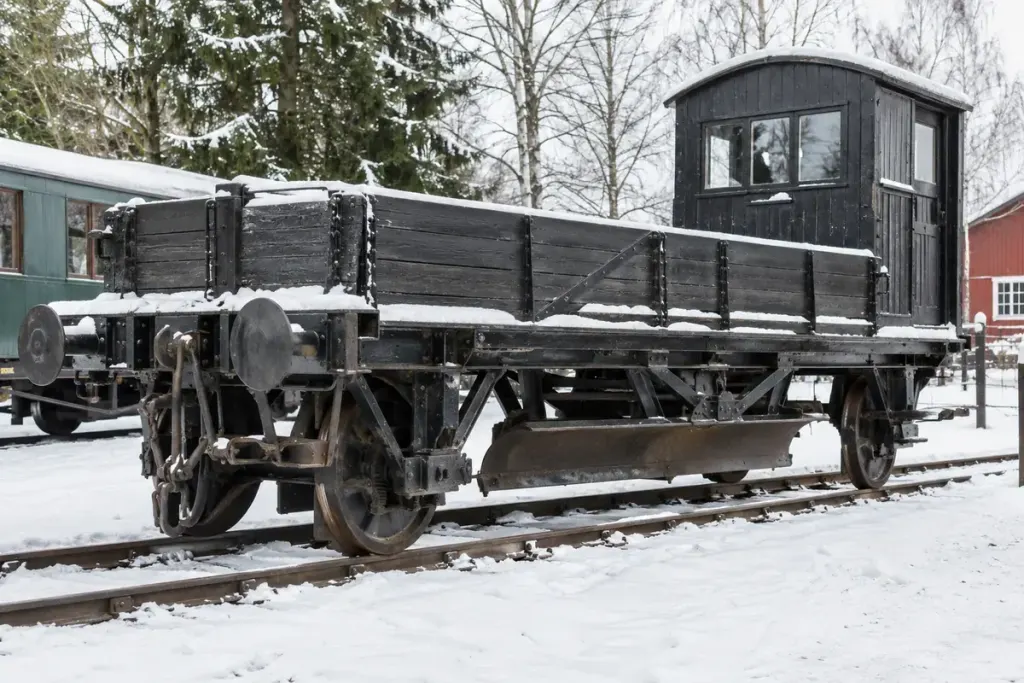
A railway snowplough can push a large drift aside while leaving another problem close to the rails. A flanger addresses snow and ice around the path needed by wheel flanges. Its working blade can extend below the top of the rail, which gives it a specialised job and an important operating constraint.
The Central BC Railway and Forestry Museum’s flanger explanation describes the equipment beneath the vehicle. The Gopher State Railway Museum’s account of its snow flanger also explains why the blade has to be raised at switches and other obstructions. Clearing the rail area is not the same task as indiscriminately scraping everything between the rails.
The blade tells the story
When viewing an exhibit, look for the blade’s position relative to the wheels and rails, and any visible mechanism for lifting it. Ask the museum how that particular example was operated. Designs and operating arrangements differ, so an explanation of one preserved car should not be applied automatically to every flanger photograph.
A body that resembles an ordinary work vehicle may hide the most informative equipment underneath. A useful museum photograph therefore includes enough of the lower frame to show the relationship, taken only from areas visitors are permitted to use.
Read a winter photograph with a question in mind
Suppose an archival image shows a work train after a snowfall. Rather than labelling every unusual vehicle a snowplough, ask what part of the snow problem each machine appears designed to address. Can you see a broad front plough, a rotary mechanism, or a lower blade? If the relevant equipment is obscured, leave the identification tentative.
Record the collection’s caption, date and vehicle number if supplied. A confident identification from a museum record is stronger than a guess based on a distant silhouette.
The flanger is a reminder that winter railway operation involved several related tasks. Moving a drift away and keeping the wheel-flange path clear could require different tools, each coordinated with the track beneath it.