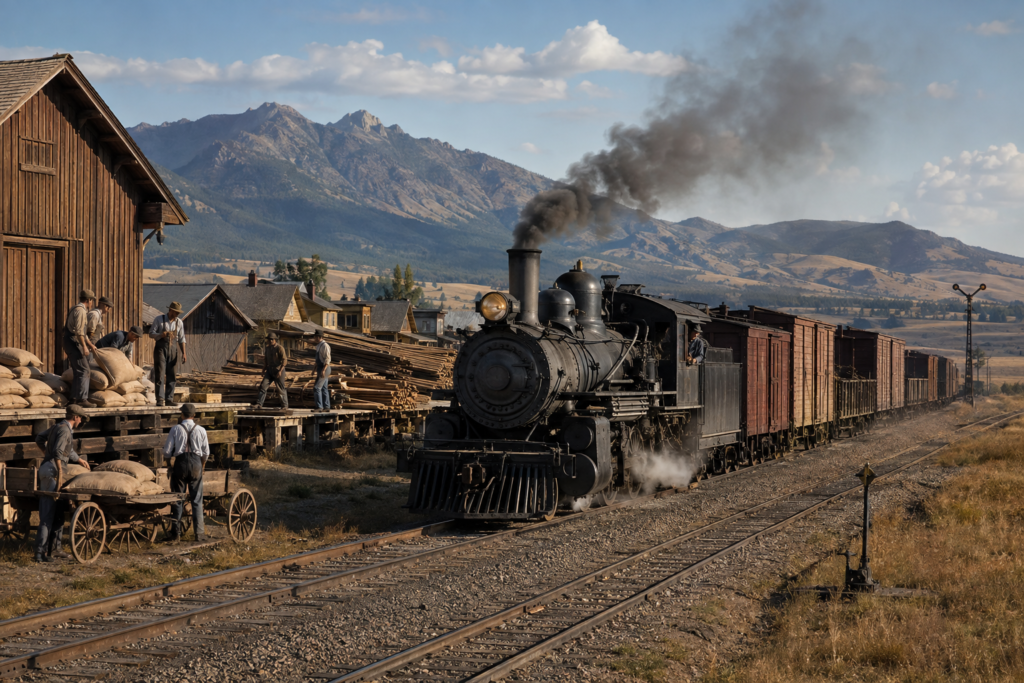
Montana’s railroad expansion transformed a vast frontier of mountains, plains, mining districts, and scattered settlements into an economy connected to national markets. Before steel tracks crossed the territory, transportation depended largely on rivers, wagon roads, stagecoaches, and trails that became difficult or unusable during harsh winters.
The arrival of the railroad changed this pattern dramatically. Mining companies could move machinery and ore more efficiently, ranchers gained access to distant buyers, farmers buyers, farmers found markets beyond their counties, and merchants received manufactured goods at lower transportation costs.
Yet railroad development also brought conflict, speculation, environmental change, and economic dependence on powerful corporations. The story of Montana’s railways is therefore not simply about technological progress. It is a central chapter in the state’s economic and social formation.
Montana Before the Railroad Era
During the early nineteenth century, the region that became Montana remained difficult to cross. Mountain ranges divided river valleys, while long distances separated trading posts, military forts, mining camps, and Indigenous communities.
The Missouri River provided an important transportation corridor into the northern plains. Steamboats carried passengers, tools, food, and commercial goods as far as Fort Benton, which developed into a major inland port. From there, freight continued by wagon toward mining districts in western and southwestern Montana.
This transportation system was costly and seasonal. Low water, ice, storms, and poor road conditions could delay shipments for weeks. Heavy industrial equipment was especially expensive to move, limiting the scale of mining and other commercial activities.
The discovery of gold during the 1860s intensified the demand for better transportation. Camps such as Bannack, Virginia City, and Helena attracted thousands of miners, merchants, and laborers. Their rapid growth exposed the limitations of wagon-based supply networks and created strong economic pressure for railroad construction.
The Northern Pacific Railway Enters Montana
The Northern Pacific Railway became the first major transcontinental company to build extensively across Montana. Construction crews approached from both the east and west, following river valleys whenever possible to reduce gradients and engineering costs.
The company’s progress was repeatedly affected by financial uncertainty. The Panic of 1873 disrupted construction and demonstrated how Montana’s future rail network was connected to distant banks, investors, and national business cycles.
Despite these difficulties, the Northern Pacific pushed across southern Montana in the early 1880s. Its route connected communities near the Yellowstone River before continuing through Bozeman Pass, Helena, and western mountain corridors.
The completion of the line in 1883 marked a turning point in Montana railroad development. The state was no longer isolated from the industrial and commercial centers of the Midwest and Pacific Northwest.
New Towns Along the Tracks
Railroad companies needed stations, water facilities, repair shops, warehouses, and crew accommodations. These requirements encouraged the creation or expansion of towns at carefully selected points along the route.
Billings became one of the clearest examples. Established as a railroad town, it quickly developed into a commercial center for the Yellowstone Valley. Its location allowed merchants to serve ranchers, farmers, and smaller communities across a wide surrounding area.
Other towns benefited from their position as division points or junctions. Livingston grew because of its relationship with Northern Pacific operations and its strategic location near Bozeman Pass. Missoula gained importance as a transportation and commercial center in western Montana.
Communities bypassed by the tracks often struggled. Businesses relocated toward railroad stations, while older wagon-road settlements sometimes lost population and influence. Railways did not simply connect Montana’s existing geography; they reorganized it.
Railroads and the Expansion of Mining
Mining was among the industries most profoundly affected by rail transportation. Early prospectors focused on placer deposits because gold could be recovered with relatively simple equipment. As these deposits declined, mining increasingly required deeper shafts, large machinery, processing plants, and substantial capital.
Railroads made industrial mining more practical. They carried timber, coal, explosives, pumps, smelting equipment, and workers into mining districts. On outbound trains, they transported ore and refined metals toward national and international markets.
This relationship was especially visible in Butte and Anaconda. Butte’s copper deposits became enormously valuable during the expansion of electrical power and telecommunications. Anaconda emerged as a major smelting center connected to Butte by specialized rail services.
The historic mining railways of Montana allowed companies to move large quantities of ore at a speed and cost that wagon transportation could never match. Rail access helped turn local mineral discoveries into a heavily capitalized industrial economy.
Copper, Capital, and Corporate Power
Railroads did more than carry mineral products. They helped consolidate corporate control over Montana’s natural resources.
Large mining companies could negotiate freight rates, acquire branch lines, and coordinate extraction with smelting and distribution. Smaller operators, lacking comparable financial resources, faced greater difficulty competing.
The result was an economy that generated immense wealth but concentrated much of that wealth in a limited number of corporations and investors. Montana workers and communities gained employment and infrastructure, yet they also became vulnerable to decisions made in corporate offices outside the state.
The Great Northern Railway and Northern Montana
The Great Northern Railway brought another powerful transportation network into Montana. Led by James J. Hill, the company constructed a northern transcontinental route without relying on the same federal land-grant model used by several earlier railroads.
Its line crossed northern Montana and reached Marias Pass before continuing toward the Pacific Coast. The route opened new areas to settlement, agriculture, commerce, and tourism.
The Great Northern actively promoted migration. It advertised farmland to settlers and presented northern Montana as a place where determined families could build prosperous agricultural lives. These campaigns attracted migrants from other parts of the United States as well as immigrants from Europe.
The development of the Great Northern route across Montana helped create towns such as Havre and strengthened commercial activity along the Hi-Line. Stations became collection points where grain, livestock, wool, and other products entered the national economy.
Agricultural Growth and Its Risks
Rail access encouraged the cultivation of land that had previously been used primarily for grazing or remained under Indigenous control. Farmers could order machinery, fencing, seed, and household goods by rail. They could also ship grain to milling and distribution centers far beyond Montana.
This expansion contributed to rising land values and the development of grain elevators, banks, stores, hotels, and local newspapers. A railroad station could give a small settlement a realistic chance of becoming a permanent town.
However, railway promotion often presented an overly optimistic picture of dryland farming. Periods of favorable rainfall encouraged rapid settlement, but drought and severe winters exposed the risks of agriculture on the northern plains.
Many homesteaders became dependent on freight rates and distant commodity prices. When harvests failed or prices fell, railroad access could not guarantee prosperity. It connected farmers to opportunity, but it also connected them to national economic instability.
Branch Lines and Local Economic Networks
The large transcontinental routes formed the backbone of Montana transportation, but branch lines extended their economic influence into smaller communities.
These secondary tracks reached mines, timber districts, agricultural valleys, and livestock-loading points. They allowed rural producers to deliver goods to main lines without relying entirely on long wagon journeys.
The growth of old railway lines in Montana encouraged specialized regional economies. Some valleys concentrated on grain production, while other areas became known for cattle, sheep, timber, coal, or mineral extraction.
Railroad schedules also influenced daily business activity. Livestock shipments had to arrive at loading facilities on time. Stores planned inventories around freight deliveries. Hotels and restaurants adapted their operations to passenger train arrivals.
In this way, railroad time became economic time. Communities increasingly organized work and commerce around published timetables rather than seasons and daylight alone.
Tourism and the Marketing of Montana
Railroads helped transform Montana’s landscapes into marketable tourist destinations. Companies understood that passenger travel could produce revenue while strengthening public interest in their routes.
The Great Northern played a particularly important role in promoting Glacier National Park. Railway advertising presented the region as a dramatic American wilderness accessible by comfortable passenger trains.
Stations, lodges, guided excursions, and connecting transportation services created an early tourism economy. Visitors purchased food, accommodation, equipment, and local services, bringing new income into communities near the park.
This chapter of Montana transportation history shows how railways shaped perceptions as well as markets. Promotional images helped define Montana as a land of mountains, open spaces, adventure, and Western authenticity.
The industry also created seasonal employment, although much of the tourism infrastructure was controlled by large companies. Railroads influenced where visitors traveled, what landscapes they saw, and how they understood the state.
Social Costs and Unequal Economic Change
Railroad expansion produced economic growth, but its benefits were not distributed equally. The tracks crossed lands long inhabited and used by Indigenous nations, accelerating military pressure, resource loss, settlement, and the disruption of traditional economies.
Railways also supported the movement of troops, hunters, commercial livestock, and settlers. Their arrival contributed to the destruction of bison-based economies and strengthened federal control over the northern plains.
Construction itself was dangerous. Workers faced explosions, rockfalls, harsh weather, accidents, disease, and exhausting labor. Immigrants and other marginalized workers often performed the most hazardous jobs while receiving limited recognition.
Railroad communities could also be unstable. A change in corporate strategy might relocate repair shops, reduce services, or eliminate jobs. Towns that depended heavily on a single railway employer were especially vulnerable.
These consequences are essential to any balanced account of Montana’s economic railroad history. Railways created wealth and mobility, but they also intensified displacement, inequality, and dependence on corporate decisions.
The Milwaukee Road and Railway Electrification
The Chicago, Milwaukee, St. Paul and Pacific Railroad, commonly known as the Milwaukee Road, added another major route across Montana during the early twentieth century.
Its Pacific Extension crossed difficult terrain and competed with established transcontinental companies. The railroad later electrified substantial portions of its mountain operations, including important sections in Montana.
Electric locomotives offered practical advantages on steep grades. They provided strong pulling power, reduced smoke in tunnels, and allowed energy to be recovered during braking under certain operating conditions.
The electrified rail corridors of Montana represented a remarkable industrial achievement. Power substations, transmission systems, maintenance facilities, and specialized locomotives brought advanced railway technology into remote mountain landscapes.
Although the Milwaukee Road stimulated commerce and employment, competition among several rail systems could not eliminate the structural challenges facing the industry. High maintenance costs, changing traffic patterns, and later competition from highways placed growing pressure on railroad finances.
Decline of Passenger Service and Abandoned Routes
During the twentieth century, automobiles, trucks, buses, and air travel gradually reduced the railroads’ dominance. Government investment in highways improved road transportation, while businesses increasingly valued the flexibility of trucks.
Passenger service declined as families purchased automobiles and airlines connected major cities more quickly. Some branch lines lost traffic as mines closed, timber production shifted, or small farms disappeared.
Railroad companies responded by reducing schedules, closing stations, consolidating facilities, and abandoning unprofitable tracks. Towns that had grown around depots often experienced population decline and the loss of local businesses.
The remains of abandoned Montana railroad routes still reveal the scale of this transition. Old grades, bridge foundations, tunnels, depots, and warehouse districts mark places where trains once structured economic life.
Abandonment did not erase the railroads’ influence. In many cases, highways, industrial areas, and modern communities continued to follow transportation corridors first established by railway surveyors.
The Enduring Economic Legacy
Modern Montana still depends on rail freight for the movement of bulk commodities. Grain, energy products, industrial materials, and manufactured goods continue to travel across the state by rail.
The economic geography created during the nineteenth and early twentieth centuries also remains visible. Billings, Havre, Livingston, Missoula, Whitefish, and other communities retain identities shaped partly by their railroad functions.
Historic depots and railway districts now support preservation, education, and heritage tourism. Former tracks have sometimes become recreational trails, giving obsolete transportation corridors new economic and public uses.
Montana’s railroads connected mines, farms, ranches, forests, towns, and tourist destinations to a much larger commercial system. They lowered transportation costs, attracted investment, encouraged settlement, and enabled industrial production on an unprecedented scale.
At the same time, they concentrated corporate power, disrupted Indigenous societies, exposed local communities to distant market forces, and left some towns vulnerable when service disappeared.
The development of rail lines in Montana was therefore both an engine of growth and a source of lasting economic tension. Its legacy survives not only in locomotives and abandoned tracks, but also in the locations of cities, the movement of commodities, and the structure of the state’s modern economy.


