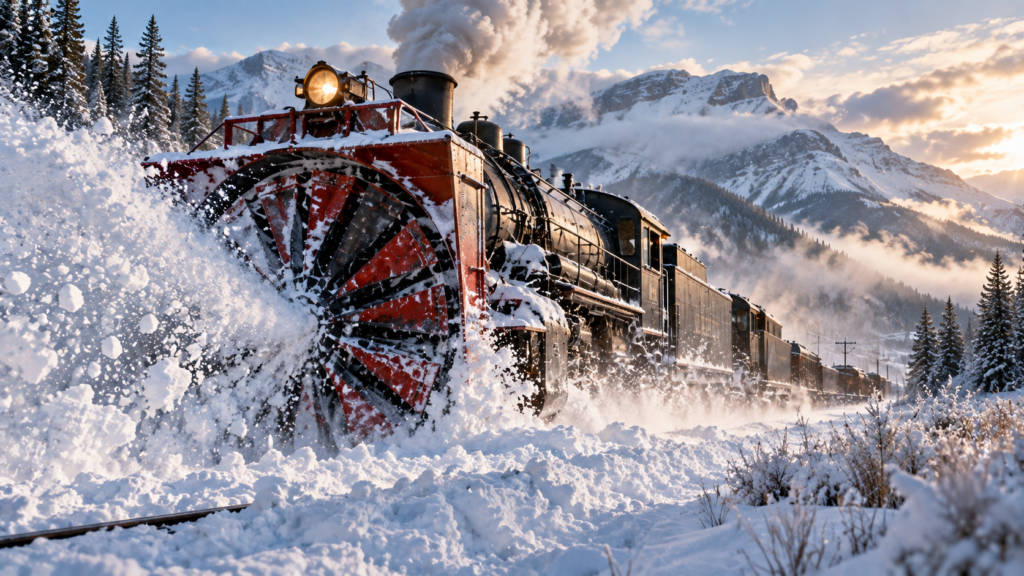
A Montana winter could transform a railroad in a matter of hours.
Tracks that were visible in the afternoon could disappear beneath drifting snow overnight. Switches could freeze. Water systems could become difficult to maintain. Steam locomotives still needed fuel and water, while crews had to work outdoors in temperatures capable of turning routine maintenance into exhausting physical labor.
For early railroads, winter was not simply uncomfortable weather.
It was an operational problem.
Keeping trains moving required people, equipment, planning, and constant attention to the landscape. Railroads could not control the weather, but they gradually learned how to build systems around it.
The history of Montana railroads in winter therefore tells a larger story about railroad engineering itself.
Before modern machinery, weather forecasting, communications, and maintenance equipment, keeping a railroad open depended heavily on preparation—and on crews willing to confront conditions directly.
Montana Created a Difficult Environment for Railroads
Montana contains dramatically different landscapes.
Open plains stretch across large portions of the state.
Mountain ranges create steep terrain and passes.
River valleys provide transportation corridors but can also channel weather.
Elevations change.
Wind conditions vary.
Snowfall differs enormously from one location to another.
A railroad crossing Montana therefore could not prepare for only one type of winter.
It had to operate through multiple environments along the same route.
Snowfall Was Only Part of the Problem
Deep snow is the obvious winter obstacle.
But railroad crews also had to deal with drifting.
Wind could move loose snow across open terrain and deposit it directly onto the tracks.
A relatively modest snowfall could therefore create substantial accumulations in certain locations.
Cuts through terrain were especially vulnerable.
Snow carried by wind could settle inside them, filling the space through which trains needed to pass.
A Track Could Disappear Beneath a Drift
Railroad tracks sit relatively close to the ground.
That makes them vulnerable when snow begins accumulating.
A train does not simply need enough clearance for the wheels.
The locomotive, pilot, running gear, switches, and other infrastructure all need workable conditions.
A large drift could become a dense barrier.
If trains repeatedly compacted snow rather than clearing it effectively, the problem could become even harder to manage.
Railroads needed equipment specifically designed to move snow.
The Snowplow Became Essential Railroad Equipment
One of the most straightforward approaches was mounting a plow on railroad equipment.
The principle was simple.
A wedge-shaped surface pushed snow away from the track as the train moved forward.
For lighter accumulation, this could be highly effective.
Instead of manually clearing miles of track, locomotive power could move substantial quantities of snow.
But wedge plows had limits.
Deep or heavily packed drifts could resist them.
Speed Helped a Plow Move Snow
A wedge plow worked partly by redirecting snow outward.
Momentum mattered.
Crews sometimes needed enough speed for the plow to penetrate a drift and throw snow away from the track.
But that created an obvious challenge.
What exactly was inside the drift?
How deep was it?
Was the track intact beneath it?
Was there an obstruction hidden in the snow?
Snow removal was not simply a matter of attaching a plow and accelerating.
It required judgment.
Some Drifts Were Too Large for Ordinary Plows
Winter storms could create accumulations beyond the practical ability of conventional wedge equipment.
A railroad might clear one section only for wind to refill it.
Snow could become packed.
Multiple storms could build layers.
In severe conditions, more specialized machinery was needed.
One of the most recognizable solutions in North American railroad history was the rotary snowplow.
Rotary Snowplows Changed Heavy Snow Removal
Instead of simply pushing snow aside with a wedge, a rotary snowplow used a large rotating wheel at its front.
Blades cut into snow.
The rotating mechanism then threw snow away from the track.
This made rotary plows useful against deep accumulations that could stop conventional equipment.
They became particularly associated with railroads operating through severe mountain winters.
The machine looked almost like a giant mechanical fan pointed down the track.
Its purpose, however, was to attack snow directly.
Early Rotary Plows Were Not Necessarily Self-Propelled
A rotary snowplow could contain machinery for operating its cutting wheel without being responsible for moving itself along the track.
Locomotives positioned behind it supplied the pushing force.
This created an unusual arrangement.
The machine at the front cleared the route.
Locomotives behind provided movement.
Crews had to coordinate the entire consist carefully.
Heavy snow removal became a railroad operation of its own rather than an ordinary train simply traveling from one destination to another.
Mountain Routes Made Snow Fighting Especially Difficult
In mountainous terrain, railroads often followed constrained corridors.
Cuts.
Curves.
Grades.
Narrow valleys.
Passes.
These locations limited where snow could go.
A plow might clear the track only to create large banks beside it.
Additional snowfall could build on those banks.
Wind could return snow to the right-of-way.
The geography that made railroad construction difficult also complicated winter maintenance.
Grades Added Another Problem
A locomotive already works harder climbing a grade.
Add heavy snow and resistance increases.
Now imagine pushing snow-clearing equipment at the same time.
Traction becomes critical.
Locomotives may need assistance.
The operation becomes slower and more demanding.
Mountain railroading in winter therefore combined two difficult problems: moving trains over grades and keeping the route physically open.
Snow Sheds Offered a Different Strategy
Sometimes the best way to fight snow was not to move it after it arrived.
It was to prevent it from reaching the track.
Railroads in mountainous snow country used protective structures in vulnerable locations.
Snow sheds covered sections of track where snow or avalanche exposure created recurring problems.
Rather than leaving the railroad completely exposed, the structure provided a protected passage.
This represented a fundamentally different approach to winter operations.
Prevention Could Be Better Than Repeated Clearing
A railroad could send crews and plows to the same location after every storm.
Or, where practical, it could modify the infrastructure.
Snow sheds were one example.
Snow fences were another.
Drainage improvements, vegetation management, and changes to trackside infrastructure could also reduce recurring problems.
Railroads gradually learned where winter repeatedly caused trouble.
Those locations became priorities for engineering solutions.
Snow Fences Helped Control Drifting
A snow fence does not simply act as a wall that blocks snow.
Its purpose is to influence wind and encourage drifting to occur in a controlled location.
Properly positioned, the fence can cause blowing snow to accumulate before it reaches the track.
This can reduce the amount deposited directly on the railroad.
The concept is still recognizable today along roads and rail corridors in snowy regions.
For early railroads, it was a relatively simple tool that could reduce enormous amounts of repetitive labor.
Open Prairie Created Its Own Winter Problems
Mountain snow receives much of the attention because the scenery is dramatic.
But open country could be extremely challenging.
Strong winds had few obstacles.
Snow could move across large areas.
Track might remain relatively clear in one section while a nearby cut filled rapidly.
Visibility could also deteriorate during blowing snow.
A train crew did not need to be high in the mountains to face dangerous winter conditions.
Crews Needed to Know Where Snow Usually Accumulated
Railroad operations generated local knowledge.
Workers learned which cuts filled first.
Which slopes produced drifting.
Where wind crossed the track.
Which switches froze repeatedly.
Which water facilities were especially vulnerable.
That knowledge could be as valuable as equipment.
Railroads were long linear systems, and conditions could differ dramatically from one mile to the next.
Experience helped crews anticipate trouble.
Section Crews Were Critical to Keeping the Railroad Open
Railroad history often focuses on locomotives and famous passenger trains.
But the physical railroad required constant human maintenance.
Section crews maintained assigned portions of track.
Their work included inspecting and repairing infrastructure.
Winter added another layer of responsibility.
Snow and ice could affect switches, crossings, track conditions, and access.
Keeping the railroad functioning depended on workers who rarely appeared in glamorous railroad advertising.
A Frozen Switch Could Stop an Entire Movement
Switches allow trains to move between tracks.
Their moving components must operate correctly.
Snow packed around the mechanism could interfere with movement.
Ice could freeze components.
A switch that could not be positioned reliably created an operational problem regardless of how powerful the locomotive was.
Crews therefore needed methods for keeping critical switches functional during winter.
This work could be repetitive and physically demanding.
Switches Required Constant Attention
A storm did not clear itself simply because the main track had been plowed.
Yards contained many switches.
Stations and sidings required access.
Industrial tracks might need to remain usable.
Every important switch represented another location where snow and ice could interfere with operations.
Workers might repeatedly clear the same equipment during continuing snowfall.
Winter maintenance was often a battle against accumulation rather than a single cleanup operation.
Rail Yards Had Different Problems From Open Track
A main line provides a relatively clear direction for a snowplow.
A yard is more complicated.
Multiple parallel tracks.
Switches.
Structures.
Stored equipment.
Platforms.
Workers.
There may be less space for snow to be thrown or pushed.
Keeping a large railroad yard operational during heavy winter weather required continuous organization.
Simply clearing one route through the yard was not enough if trains needed to be assembled, serviced, and dispatched.
Steam Locomotives Needed Water Even in Freezing Weather
Snow removal was only one part of winter railroading.
Steam locomotives depended on water.
That requirement did not disappear when temperatures fell below freezing.
Railroads therefore needed reliable water facilities along their routes.
Pipes, tanks, pumps, and related systems had to function in cold weather.
Frozen infrastructure could disrupt locomotive operations even when the track itself was clear.
Water Tanks Were Essential Infrastructure
Before diesel locomotives eliminated the enormous water requirements of steam operation, railroad routes needed strategically located water supplies.
A steam locomotive could not travel indefinitely without replenishment.
In Montana winter conditions, keeping these systems usable required planning.
Facilities might be designed or protected to reduce freezing problems.
Workers had to monitor them.
A train delayed by snow could also consume resources differently than expected, complicating operations further.
Coal and Fuel Supply Had to Continue
Steam locomotives also needed fuel.
Railroads required systems for supplying coal or other locomotive fuel at appropriate points.
Heavy winter weather could interfere with those operations.
A railroad could have a clear track but still face problems if supporting infrastructure failed.
This is an important point about railroad history.
The railroad was not merely two steel rails.
It was an entire network of facilities.
Locomotives Themselves Faced Harsh Conditions
Cold affected machinery.
Lubricants behaved differently.
Metal components experienced extreme temperatures.
Snow and ice could accumulate around equipment.
Air systems, valves, pipes, and moving parts all needed attention.
Railroad shops and engine facilities therefore became particularly important during winter.
Mechanical reliability had to be maintained while equipment was being asked to perform some of its hardest work.
Steam Created Its Own Winter Environment
A steam locomotive constantly involved heat and water.
In very cold weather, steam could condense and freeze on surrounding surfaces.
Water spilled during servicing could become ice.
Areas around locomotives and facilities could become slippery and difficult to work in.
The same technology that generated enormous heat and power also operated within an environment where exposed water could quickly become a maintenance problem.
Keeping Locomotives Ready Required People Around the Clock
Railroads operated continuously.
Weather did not respect working hours.
A storm could arrive at night.
Temperatures could fall before sunrise.
Equipment needed attention before the next train departed.
Shop workers, hostlers, maintenance crews, dispatchers, operators, and train crews all contributed to winter operations.
The famous locomotive at the head of a train depended on an enormous supporting workforce.
Communication Was Much More Limited Than Today
Modern railroad operations benefit from sophisticated communications, remote monitoring, detailed forecasting, and rapid information exchange.
Earlier railroads operated with far fewer tools.
Telegraph systems became enormously important for coordinating train movements and reporting conditions.
Later, telephone and radio improved communication further.
But crews in earlier periods could not simply look at a digital weather map showing precise conditions across an entire route.
Information moved through the railroad network itself.
Stations Could Become Information Points
Stations and railroad offices were not merely places where passengers boarded trains.
They participated in railroad communication.
Conditions could be reported from one location to another.
Train movements were coordinated.
Delays could be communicated.
When winter disrupted a route, knowing where the obstruction existed was essential.
The communication network was almost as important as the physical track.
Weather Forecasting Was Less Precise
Railroad workers could observe conditions and receive forecasts, but early operations lacked the high-resolution meteorological information available today.
A storm could develop differently than expected.
Mountain weather could change quickly.
Wind could transform ordinary snowfall into severe drifting.
This made preparation especially important.
Railroads could not depend on perfect prediction.
They needed the capacity to respond.
Patrols and Inspection Became Important After Storms
Even after snow stopped falling, crews could not assume the railroad was safe.
Drifts might remain.
Ice could affect infrastructure.
Rockfall or other debris might have reached the track.
Freeze-thaw cycles could influence conditions.
Inspecting the route helped identify problems before regular trains encountered them.
The railroad needed to know not merely that a storm ended, but what the storm left behind.
Avalanches Created a Much More Serious Hazard
In mountainous areas, snow on slopes could become unstable.
An avalanche could deposit enormous quantities of snow and debris across a railroad.
This was far beyond ordinary track drifting.
Avalanches could damage infrastructure, bury equipment, and endanger workers and passengers.
Railroads operating in avalanche country had to understand recurring danger zones and develop protective strategies.
Avalanche Debris Was Not Just Snow
A slide could carry:
ice,
rocks,
trees,
soil,
and other debris.
That made clearing more difficult than simply removing loose powder.
A rotary plow designed for snow could encounter material capable of damaging equipment.
Crews needed to understand what they were facing before aggressively entering a blocked section.
Winter railroad work could be dangerous precisely because the obstruction was not always visible.
Snow Sheds Could Protect Against Slides
In high-risk areas, protective structures could allow avalanche material to pass over the railroad rather than directly striking the track.
These structures represented major infrastructure investments.
They were not built casually.
Their presence reflected the seriousness and recurring nature of the hazard.
Where a railroad repeatedly faced closure or destruction, permanent protection could become economically justified.
Winter Could Isolate Communities
Railroads were vital transportation connections for many Montana communities.
They carried mail.
Passengers.
Food.
Fuel.
Industrial goods.
Livestock-related shipments.
Mining materials.
Other freight.
When a major route became blocked, the impact extended beyond the railroad company.
Communities and businesses depended on those transportation links.
Keeping trains moving therefore had economic and social importance.
A Delayed Passenger Train Was More Than an Inconvenience
Today, a delayed journey is frustrating.
Historically, a train stranded or delayed during severe winter weather could create much more serious logistical concerns.
Passengers needed heat.
Food supplies mattered.
Communication with stations mattered.
Connections were missed.
Crews faced duty and operating challenges.
The longer the obstruction lasted, the more complicated the situation became.
Railroads needed contingency plans even when technology was limited.
Freight Could Not Simply Stop for the Entire Winter
Montana’s economy depended on moving goods throughout the year.
Agricultural products, mining output, fuel, machinery, consumer goods, and other freight could not all wait until spring.
Railroads therefore had a strong economic incentive to maintain winter operations.
A line that repeatedly closed for long periods was less useful to customers.
Winter reliability became part of the value of the railroad itself.
Livestock Shipments Added Time Pressure
When freight involved living animals, delays could create additional problems.
Livestock required care.
Long interruptions increased logistical difficulty.
Railroads and shippers had to consider weather when planning movements.
This illustrates why freight was not simply a collection of interchangeable boxcars.
Different cargo created different operational concerns.
Mail Made Railroad Reliability Visible to Everyone
For many communities, railroads carried communication as well as passengers and freight.
A delayed train could mean delayed mail.
Before instant electronic communication became part of ordinary life, physical mail had enormous importance.
Weather disruptions therefore reached into everyday personal and commercial life.
Winter railroad reliability could affect people who never stepped aboard a train.
Passenger Stations Provided Shelter From the Weather
Stations offered more than ticketing.
In cold conditions, waiting rooms gave travelers protection.
Railroad buildings became points of warmth and information.
A passenger waiting for a delayed train could remain sheltered rather than standing beside the track.
The architecture and operation of railroad stations therefore had practical relationships with climate.
Heating Railroad Buildings Was Another Requirement
Depots.
Offices.
Signal facilities.
Crew buildings.
Shops.
Other structures all required some form of winter management.
Fuel had to be available.
Stoves or heating systems needed maintenance.
Workers stationed in isolated areas still required habitable conditions.
Every building increased the infrastructure the railroad needed to support.
Remote Locations Made Maintenance Harder
A problem inside a major yard could be addressed by nearby workers and equipment.
A problem many miles away in sparsely populated territory was different.
Crews had to reach it.
Tools had to reach it.
Replacement materials had to reach it.
Ironically, the railroad itself might be the primary means of reaching the section that needed repair.
If the line was blocked, access became more difficult precisely when it was most necessary.
Work Trains Supported Maintenance Operations
Railroads used dedicated equipment and trains for maintenance purposes.
These movements could carry workers, tools, supplies, and specialized machinery.
During winter emergencies, maintenance trains became part of the response.
Railroads were capable of deploying their own mobile workforce along the line.
The track was both the infrastructure being repaired and the transportation system used to reach it.
Snow Clearing Could Require Multiple Locomotives
A severe drift could demand significant power.
A plow at the front might be pushed by one or more locomotives.
Additional equipment could follow.
The operation needed enough power to move through resistance while maintaining control.
This was particularly important on grades.
Snow fighting could consume locomotives and crews that would otherwise have been available for normal service.
Clearing the Track Once Was Not Always Enough
Imagine a line reopened at noon.
Wind continues blowing.
By evening, the same cut begins filling again.
The railroad has not permanently solved the problem.
This is why winter operations could consume enormous resources.
Crews might repeatedly patrol and clear vulnerable locations.
The battle continued as long as the weather did.
Plowing Could Create Bigger Snowbanks
Every clearing operation had consequences.
Push snow away from the track and it accumulates beside the right-of-way.
Repeated storms add more.
Eventually, banks can become high.
Wind-blown snow may interact with those banks and create new drifting patterns.
Snow management therefore becomes increasingly complicated over a long winter.
There is only so much space immediately beside the railroad.
Manual Labor Remained Important
Specialized machinery did not eliminate human work.
Crews still used shovels.
Switches needed clearing.
Equipment needed inspection.
Snow around buildings and facilities had to be moved.
Ice needed attention.
Areas inaccessible to large plows required direct labor.
The image of workers physically shoveling snow around railroad infrastructure was not an exception.
It was part of winter operations.
Working Beside Active Railroad Equipment Was Dangerous
Winter reduced visibility.
Snow created slippery footing.
Heavy clothing could restrict movement.
Machinery was loud.
Steam and smoke reduced visibility around locomotives.
Workers might be near moving trains and snow-clearing equipment.
The environment combined industrial hazards with severe weather.
Railroad work was already dangerous, and winter added another layer.
Frostbite and Exposure Were Real Occupational Risks
Workers could spend long periods outdoors.
Wind dramatically increased the experience of cold.
Gloves were necessary but could make detailed work harder.
Wet clothing created additional problems.
Modern cold-weather clothing technology was not always available.
Keeping the railroad operating sometimes required people to remain exposed to conditions most passengers experienced only briefly.
Darkness Complicated Winter Work
Montana winter days are short.
A storm could require work after sunset.
Crews might need to inspect, shovel, repair, or operate equipment in darkness.
Artificial lighting existed, but historical lighting technology was far less capable than modern portable illumination.
Visibility around snow, steam, and machinery could be difficult.
Winter maintenance did not simply stop because daylight ended.
Railroad Experience Produced Specialized Winter Practices
Over decades, railroads learned from repeated exposure.
Equipment improved.
Infrastructure changed.
Problem areas became known.
Operating rules developed.
Crews accumulated local knowledge.
Winter preparation became institutional rather than improvised.
The ability to operate through harsh weather was itself a form of railroad expertise.
Summer Was the Time to Prepare for Winter
Winter reliability depended heavily on work performed before snow arrived.
Track maintenance.
Drainage.
Structure repairs.
Fuel preparation.
Equipment servicing.
Snow-fighting machinery inspection.
Stockpiling materials.
Repairing buildings.
Identifying recurring trouble spots.
Once severe weather arrived, it was too late to discover that essential equipment had been neglected.
Snow Equipment Needed Maintenance Too
A snowplow spends part of the year waiting.
Then suddenly it may become one of the most important pieces of equipment on the railroad.
That means seasonal equipment has to be inspected before it is urgently needed.
Mechanical components must function.
Blades and structures must be sound.
Associated locomotives need to be available.
Emergency equipment that fails during the emergency provides little value.
Railroads Learned From Previous Winters
A difficult winter exposed weaknesses.
A particular cut repeatedly filled.
A facility froze.
A structure failed.
A route remained closed too long.
Those experiences influenced later decisions.
Perhaps a snow fence was installed.
A building was modified.
Equipment was reassigned.
Procedures changed.
Infrastructure history often develops through this cycle of failure, observation, and improvement.
The Landscape Still Shaped the Railroad
Railroads represented powerful industrial technology.
They could blast cuts through rock.
Build bridges across rivers.
Move enormous quantities of freight.
But winter demonstrated the limits of that power.
A storm could stop trains.
A drift could block expensive infrastructure.
An avalanche could overwhelm engineering.
Railroads did not conquer Montana’s landscape in an absolute sense.
They continuously negotiated with it.
Technology Gradually Changed Winter Operations
Over time, locomotives became more powerful.
Snow-removal equipment improved.
Dieselization changed many cold-weather operating requirements.
Communications improved.
Weather forecasting became more sophisticated.
Maintenance equipment became more specialized.
Infrastructure and operating practices evolved.
Modern railroads still deal with snow and extreme cold, but they do so with tools early railroad workers could not have imagined.
Diesel Locomotives Removed the Steam Water Problem
The transition away from steam dramatically changed railroad infrastructure.
Diesel locomotives did not require the frequent water stops that steam locomotives needed.
Many water towers and associated facilities eventually became unnecessary.
That eliminated one major winter maintenance challenge.
But diesel locomotives introduced their own mechanical requirements.
Technology changes problems more often than it eliminates every problem.
Modern Forecasting Allows Earlier Preparation
Today, weather systems can be monitored far more effectively.
Railroads can receive detailed forecasts.
Crews and equipment can be positioned before major storms.
Temperature trends can be tracked.
Communication across the network is vastly faster.
This does not prevent severe weather.
It improves the ability to prepare for it.
Early railroad workers often had much less warning and information.
Modern Equipment Can Move Enormous Amounts of Snow
Contemporary railroads have access to powerful plows, blowers, maintenance machines, and heavy equipment.
Road vehicles can also reach many locations that were once difficult to access.
Excavators and loaders can assist with major accumulations.
Yet some historic concepts remain recognizable.
A wedge still pushes snow.
A rotary mechanism still throws it.
The physics of snow removal has not changed.
Some Historic Snow-Fighting Equipment Survived
Old rotary snowplows and other specialized railroad equipment have been preserved in museums and collections.
Their size tells part of the story.
These were not decorative machines.
They existed because snow could become a major threat to railroad operations.
Standing beside one makes the scale of historical winter maintenance easier to understand.
The equipment represents an era when keeping a line open required substantial mechanical force.
Historic Photographs Reveal the Scale of the Problem
Images of early railroads after major storms can be striking.
Locomotives appear beside walls of snow.
Crews stand in cuts far deeper than a person.
Plows are surrounded by enormous accumulations.
Such photographs help correct a modern misconception that snow removal was merely routine housekeeping.
During severe winters, it could become a major engineering and logistical campaign.
Winter Also Shaped Railroad Culture
Workers who repeatedly faced severe conditions developed shared knowledge and stories.
A particularly difficult storm might be remembered for years.
Crews remembered trains that became stuck.
They remembered long hours clearing switches.
They remembered extreme cold.
Weather became part of occupational identity.
For railroad communities, winter was not simply a season outside the workplace.
It shaped the work itself.
Railroad Towns Felt the Consequences
A town built around railroad activity experienced disruptions directly.
Crews might be called out.
Train schedules changed.
Freight arrived late.
Passengers waited.
Railroad facilities operated under pressure.
Local businesses dependent on rail traffic could be affected.
The relationship between railroad and town became particularly visible when the system struggled.
A Working Railroad Required More Than Locomotive Engineers
Winter history makes the larger railroad workforce impossible to ignore.
Track workers.
Shop crews.
Dispatchers.
Station employees.
Signal maintainers.
Snowplow crews.
Telegraph operators.
Yard workers.
Supervisors.
Many occupations contributed to keeping the system moving.
The locomotive engineer was one visible part of a much larger organization.
Why Railroads Did Not Simply Close Until Spring
From a modern perspective, fighting enormous snowdrifts with early machinery can seem extreme.
Why not suspend service?
Because the railroad existed to provide transportation continuously.
Industries depended on it.
Communities depended on it.
Passengers depended on it.
Mail depended on it.
A railroad unable to operate for months each year would have been economically limited.
Winter operations were therefore fundamental to making the system viable.
Reliability Became a Competitive Advantage
Railroad companies competed for traffic.
Shippers wanted dependable transportation.
Passengers wanted dependable schedules.
Communities wanted dependable connections.
A railroad known for frequent winter closures faced reputational and economic consequences.
Investment in snow equipment and infrastructure was therefore not only about engineering.
It was also about business.
Winter Revealed Weak Points in the Entire System
A severe storm acted almost like a stress test.
Weak communication became obvious.
Poorly maintained equipment failed.
Badly positioned infrastructure caused repeated problems.
Insufficient staffing became visible.
Vulnerable sections of track demanded attention.
The lessons could influence future investment.
Extreme weather exposed the difference between a railroad that merely existed and one capable of operating reliably.
Why This History Still Matters
Many historic railroad sites can be understood differently once winter operations are considered.
An old water tower was not simply a picturesque structure.
It supported steam locomotives in every season.
A wide right-of-way may have helped accommodate maintenance and snow.
A surviving snowplow represents a practical response to environmental conditions.
A depot provided shelter and communication during disruptions.
Railroad artifacts make more sense when placed back into the operating system they once supported.
The Railroad Was an Ecosystem of Infrastructure
Track receives most of the attention.
But a functioning railroad required:
bridges,
signals,
switches,
water facilities,
fuel facilities,
shops,
stations,
communications,
maintenance crews,
locomotives,
rolling stock,
and specialized equipment.
Winter could affect every component.
That is why keeping trains moving was never simply the engineer’s responsibility.
It required the entire railroad organization.
Montana Winter Turned Maintenance Into Survival
In mild weather, a small infrastructure problem might create inconvenience.
In severe winter conditions, the same problem could escalate quickly.
A delayed train could become exposed to worsening weather.
A frozen water facility could disrupt locomotive movement.
A blocked switch could immobilize part of a yard.
A drift could isolate a route.
Railroad maintenance therefore carried enormous operational importance.
The Most Impressive Technology Was Sometimes the System Itself
Rotary snowplows are dramatic.
Steam locomotives are visually impressive.
Snow sheds demonstrate ambitious engineering.
But perhaps the greatest achievement was coordination.
Thousands of miles of railroad had to remain functional through changing conditions.
People needed information.
Equipment needed to be positioned.
Crews needed to be dispatched.
Supplies had to be available.
Problems had to be identified and solved.
The railroad’s strength came from the system connecting all those pieces.
Conclusion
The story of Montana railroads in winter is not simply a story about trains pushing through snow.
It is a story about adaptation.
Railroads faced drifting snow across open plains, deep accumulation in mountain territory, frozen switches, vulnerable water systems, cold-sensitive machinery, limited communications, avalanches, and the constant possibility that cleared track could be buried again within hours.
They responded with wedge plows, rotary snowplows, snow fences, protective structures, maintenance crews, specialized work trains, careful preparation, and generations of local knowledge.
But technology alone did not keep the railroad open.
People did.
Workers cleared switches by hand.
Crews operated snow-fighting equipment in dangerous conditions.
Maintenance employees inspected remote sections.
Shop workers kept locomotives functional.
Station and communication personnel helped coordinate movements across enormous distances.
Modern equipment has made many of these tasks faster and safer, while forecasting and communication provide capabilities early railroaders never possessed.
Yet Montana winter remains a reminder of something fundamental about railroad history.
Building tracks across a landscape was only the beginning.
The greater challenge was keeping them usable every day afterward—including the mornings when the rails had disappeared completely beneath the snow.