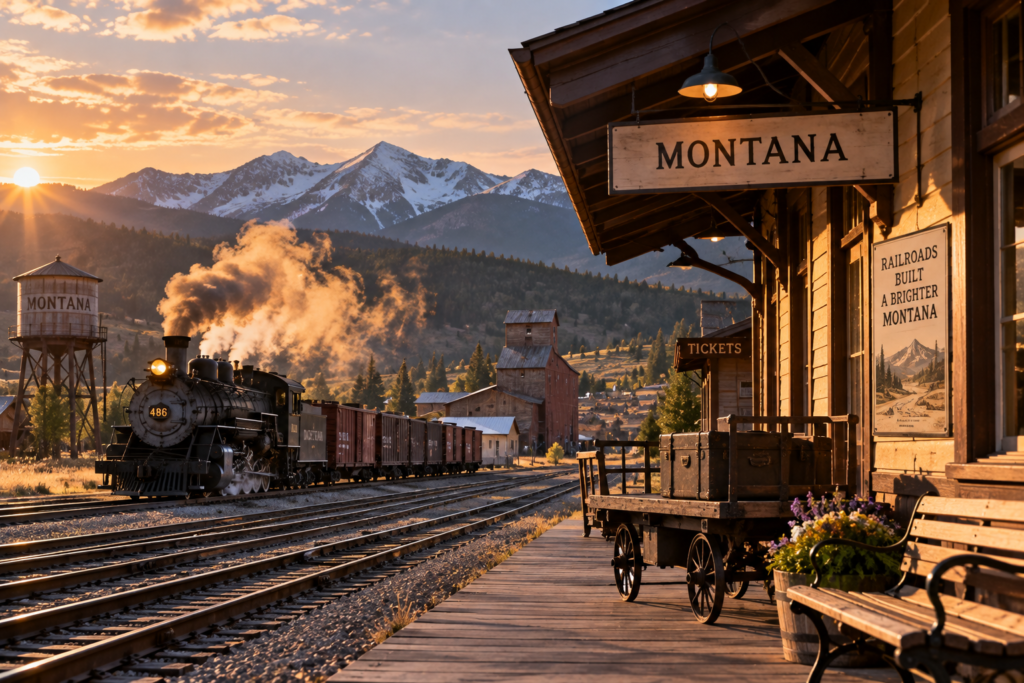
Drive through an old Montana town and the railroad may seem to have disappeared. The passenger trains are gone, some tracks have been removed, and an old depot may now serve an entirely different purpose. In some places, only a raised strip of earth or an unusually straight corridor hints that trains once passed through.
Yet look more carefully and the railroad is often still there.
It survives in the position of Main Street, the location of warehouses, the orientation of old commercial buildings, the empty space dividing neighborhoods, and sometimes even the reason the town exists in the first place.
Understanding Montana railroad towns means looking beyond locomotives and tracks. Railroads did not simply pass through communities. They helped determine where communities developed, how they were organized, what industries survived, and how people remained connected across enormous distances.
Before Highways, Railroads Changed the Meaning of Distance
Montana’s geography has always been defined by distance. Communities were separated by mountains, valleys, plains, and enormous stretches of sparsely populated land.
Before modern highways and widespread automobile ownership, moving people and heavy freight across those distances was difficult and expensive. Railroads fundamentally changed that equation.
Once a rail connection existed, agricultural products could reach distant markets more efficiently. Mining operations gained better access to equipment and transportation. Merchants could receive goods from outside the region, while residents gained connections to communities hundreds or thousands of miles away.
The railroad effectively made remote places more economically connected.
A Railroad Could Put a Town on the Map
Modern travelers often assume towns existed first and transportation infrastructure followed.
Railroad development frequently worked differently.
Railroad companies needed stations, water facilities, maintenance locations, sidings, yards, and division points. Businesses then appeared around those facilities. Hotels served travelers, stores supplied workers and residents, warehouses handled freight, and houses were constructed for growing populations.
Some communities expanded dramatically because they occupied an important point on a railroad.
Others were deliberately promoted alongside new lines.
The tracks were therefore not simply another feature of town.
They could become the organizing feature around which the town developed.
Montana’s Railroad Geography Was Shaped by Competing Networks
No single railroad created Montana’s rail landscape.
Several major systems played important roles, including the Northern Pacific Railway, Great Northern Railway, and Chicago, Milwaukee, St. Paul and Pacific Railroad—better known as the Milwaukee Road.
The Northern Pacific completed its transcontinental route through Montana during the 1880s, while Great Northern subsequently developed a northern route across the state. The Milwaukee Road arrived later with its Pacific Extension, completed across Montana as part of its route toward the Pacific Northwest in the early twentieth century.
These companies were competitors.
Their routes consequently created different corridors of development across the state.
The Track Often Became the Town’s Spine
Railroad towns frequently developed a recognizable physical pattern.
The depot occupied an important position near the tracks.
Commercial buildings appeared nearby.
Warehouses and industrial facilities clustered where freight could easily transfer between railcars and local businesses.
Residential neighborhoods expanded outward.
Roads sometimes ran parallel to the railroad while others crossed it at regular intervals.
Even after tracks disappear, this arrangement can remain surprisingly visible.
The railroad may be gone, but the town continues using a landscape originally organized around it.
Depots Were More Than Places to Catch a Train
Today, a historic depot may be viewed primarily as an architectural landmark.
During the railroad era, its function was much broader.
The depot connected the community to a transportation network. Passengers arrived and departed there, but mail, packages, news, business contacts, and visitors also moved through the same space.
For residents of relatively isolated communities, the depot represented a physical connection with the outside world.
Its importance was practical, commercial, and social at the same time.
That helps explain why surviving depots often remain powerful symbols of local identity even decades after regular passenger service disappeared.
Railroads Could Determine Which Businesses Made Sense
Transportation infrastructure affects economics.
A grain producer located near reliable rail service had opportunities that a producer far from economical transportation did not.
The same principle applied to mines, timber operations, livestock, wholesalers, and manufacturers.
Railroads created places where goods could be accumulated and shipped efficiently. Elevators, warehouses, stock facilities, loading areas, and industrial businesses consequently developed near tracks.
In many Montana communities, understanding the old railroad helps explain why certain industrial districts are located where they are today.
Agriculture and Railroads Became Closely Connected
Railroads were particularly important to agricultural regions because farms could produce far more than nearby communities could consume.
The challenge was reaching larger markets.
Rail connections allowed grain and other agricultural products to move from rural Montana toward regional and national distribution networks. Branch lines extended this transportation system into agricultural areas that were distant from the primary transcontinental routes.
The relationship also worked in the opposite direction.
Railroads had strong incentives to encourage settlement and agricultural production because farms created future freight traffic.
More productive land near the tracks could eventually mean more carloads leaving the region.
Railroads Did Not Simply Discover Communities—They Promoted Them
Railroad expansion and western settlement were deeply connected.
Companies promoted opportunities along their routes because more residents meant more passengers, more freight, and greater economic activity.
The Milwaukee Road’s North Montana Line provides a good example. Historical documentation notes that the railroad promoted agricultural settlement and homesteading in areas served by its branch lines.
This relationship changed the landscape.
A rail line could help transform open agricultural territory into a chain of towns linked economically to the same transportation system.
Harlowton Shows How Closely a Town Could Be Tied to a Railroad
Harlowton is particularly useful for understanding this relationship.
The town’s name came from Richard A. Harlow, the entrepreneur behind the Montana Railroad, commonly known as the Jawbone. That railroad eventually connected central Montana with the broader rail network and was later absorbed into the Milwaukee Road system.
Under the Milwaukee Road, Harlowton became an important railroad location with facilities associated with operations and maintenance.
Its importance increased further because it became connected with one of the most unusual technological chapters in American railroad history.
The railroad did not simply serve Harlowton.
It became deeply embedded in the town’s identity.
The Milwaukee Road Brought Electricity to the Mountain Railroad
Steam locomotives dominated the early railroad era, but the Milwaukee Road eventually electrified substantial portions of its western route.
The electrified mountain territory beginning around Harlowton became one of the defining features of the railroad’s presence in Montana. Electric locomotives handled trains across difficult western terrain for decades.
This required more than locomotives.
Electrification meant overhead wires, substations, power infrastructure, specialized maintenance, and workers who understood the system.
The railroad landscape therefore contained layers of technology that could be easy to miss when viewing an abandoned grade today.
Railroad Employment Could Sustain an Entire Local Economy
A major railroad facility generated many kinds of jobs.
Engine crews were only the most visible.
Railroads required maintenance workers, dispatching and station personnel, mechanical employees, track crews, freight handlers, clerks, signal workers, and numerous supporting occupations.
Those employees spent money locally.
Their families needed homes, food, clothing, schools, entertainment, and services.
A railroad payroll could therefore circulate throughout an entire community.
This is why losing rail operations could affect much more than transportation.
It could remove one of the foundations of the local economy.
Not Every Railroad Town Had the Same Purpose
It is tempting to treat all railroad communities as interchangeable.
They were not.
One town might develop because it was an important division point.
Another existed primarily to serve agricultural traffic.
A mining community might rely on rail service for ore.
A junction town could grow because passengers and freight transferred between routes.
Other settlements were primarily places where trains stopped for operational reasons.
The purpose mattered because it influenced the buildings, industries, and population that developed around the tracks.
Division Points Had a Special Importance
Steam-era railroads required substantial infrastructure.
Locomotives needed fuel and water.
Equipment needed inspection and repair.
Crews had working limits and schedules.
Trains had to be assembled, separated, and redirected.
Strategically located division points therefore became centers of railroad activity.
Roundhouses, shops, yards, water facilities, bunkhouses, offices, and other structures could create a large industrial footprint.
A town fortunate enough to become an important operational center might gain hundreds of jobs connected directly or indirectly to the railroad.
The Depot Was Only One Part of a Much Larger System
Historic railroad tourism naturally emphasizes surviving depots because they are recognizable and often architecturally interesting.
But a functioning railroad required far more.
Look for evidence of freight houses.
Loading platforms.
Water towers.
Coal facilities.
Roundhouse foundations.
Turntables.
Signal equipment.
Telegraph infrastructure.
Bridges.
Cuts and fills.
Sidings.
Even when the structures themselves have disappeared, foundations and changes in the landscape may reveal where they once stood.
Railroad history becomes much richer when the entire operating environment is considered.
Geography Dictated Railroad Engineering
Montana was not an easy landscape through which to build a railroad.
Engineers had to deal with mountain ranges, rivers, steep grades, unstable terrain, severe winters, and enormous distances.
A railroad could not simply draw a straight line between two cities.
Routes were selected according to grades, water crossings, passes, construction costs, and operational practicality.
This created impressive engineering works but also determined which communities would gain direct rail access.
A difference of only a few miles could significantly affect a town’s future.
Sixteen Mile Canyon Tells That Story Clearly
The old Montana Railroad route through Sixteen Mile Canyon became part of the Milwaukee Road system after the smaller railroad was acquired.
The canyon demanded significant railroad engineering, and portions of the route were later rebuilt as the Milwaukee incorporated the corridor into its larger network.
Today, abandoned railroad corridors such as this provide a different way of reading history.
Instead of beginning with a document or photograph, you can begin with geography.
Why does the grade follow this side of the canyon?
Why is there a cut here?
Why was a bridge necessary there?
The landscape itself begins explaining the engineering decisions.
Railroads Changed the Daily Rhythm of Towns
A railroad schedule introduced predictable movement into communities.
Trains arrived.
Mail appeared.
Freight was unloaded.
Passengers stepped onto the platform.
Workers changed shifts.
Local businesses adjusted to railroad activity.
The sound of a locomotive could announce something meaningful long before anyone saw the train.
For communities built around rail operations, the railroad became part of everyday timekeeping.
Its eventual disappearance therefore changed not only transportation but the sensory character of the town.
Passenger Trains Connected Small Communities to Larger Worlds
Passenger rail service made travel possible without requiring personal automobiles or modern highways.
Residents could travel for business, family visits, medical needs, education, or recreation.
Travelers from elsewhere could also arrive directly in communities that might otherwise have been difficult to reach.
The station became a place of departures and reunions.
It was both ordinary infrastructure and the setting for major personal moments.
That human dimension is easy to lose when railroad history focuses exclusively on locomotives and corporate mergers.
Mail and Information Moved Along the Rails Too
Railroads transported more than passengers and physical commodities.
They accelerated communication.
Mail, newspapers, business correspondence, catalogs, and packages could move along the same networks connecting towns with larger cities.
For isolated communities, faster transportation meant faster access to information and goods.
The effect is difficult to appreciate today because instant digital communication has made distance feel much smaller.
In the railroad era, improved transportation could fundamentally change how connected a community felt.
The Arrival of Highways Changed the Balance
Railroads once enjoyed an enormous advantage for long-distance transportation.
Automobiles and improved roads gradually changed that relationship.
People gained more flexibility over when and where they traveled.
Trucks could move freight directly between locations without requiring every business to be positioned near a rail siding.
Air transportation eventually changed long-distance passenger travel as well.
Railroads remained enormously important for freight, but many passenger services and lightly used branch lines became increasingly difficult to justify economically.
The transportation system that helped create many towns was evolving.
When Railroad Jobs Disappeared, Towns Had to Adapt
A railroad reduction could create a chain reaction.
The immediate effect was lost railroad employment.
Then businesses serving railroad workers lost customers.
Families sometimes moved elsewhere for work.
Buildings became vacant.
Industrial facilities lost their original purpose.
Some communities successfully developed new economic roles.
Others became smaller.
This is one reason railroad history and community history are so difficult to separate in Montana.
The rise and decline of a rail line could influence the trajectory of an entire town.
1980 Became a Major Turning Point for the Milwaukee Road in Montana
The Milwaukee Road experienced severe financial problems during the twentieth century.
In 1980, the railroad abandoned its Pacific Extension, including extensive mileage across Montana. Much of the western infrastructure was subsequently removed.
For communities that had lived beside the Milwaukee for generations, the change was profound.
Tracks that had represented permanence suddenly disappeared.
Railroad property became empty land.
Facilities that had once existed because trains arrived every day needed new purposes—or no longer had one.
Removing the Rails Does Not Remove the Railroad
This is one of the most fascinating characteristics of abandoned railroad history.
A track can disappear while its geometry survives.
An old grade remains unusually level across rolling terrain.
A road follows a suspiciously straight alignment.
A bridge abutment stands beside a river with no bridge attached.
A broad empty strip separates two parts of town.
Buildings face a corridor that no longer appears important.
Once you learn what to look for, abandoned railroads become surprisingly visible.
The infrastructure is gone, but its imprint remains.
Old Maps Make Modern Landscapes Easier to Read
Historical maps are especially valuable when exploring Montana railroad towns.
A modern map shows what exists now.
An old railroad map shows what the landscape was organized around.
Compare the two and patterns begin appearing.
A modern trail may follow a former grade.
An industrial property may occupy an old yard.
A strangely shaped parcel may trace former railroad ownership.
A highway may cross the location where a branch line once entered town.
Historical maps turn apparently random features into evidence.
Photographs Reveal What Empty Spaces Used to Contain
An empty field beside a depot may not look historically important.
Then an old photograph shows several tracks, a freight platform, water tower, workers, and locomotives occupying the same location.
Suddenly, the empty space makes sense.
Historic photographs are particularly useful because railroad infrastructure changed repeatedly.
Tracks were added and removed.
Depots were replaced.
Industries expanded.
Steam facilities disappeared after dieselization.
Looking at photographs from different decades can reveal that a railroad landscape was never static.
Surviving Buildings Need Context
Preservation is not only about keeping an old building standing.
Context determines why the building matters.
A depot becomes more meaningful when visitors understand which railroad built it, what trains stopped there, what industries depended on the line, and how the facility related to the surrounding town.
The same applies to warehouses, roundhouses, bridges, and maintenance buildings.
Without context, they are old structures.
With context, they become evidence of how a transportation system shaped daily life.
Abandoned Grades Should Be Explored Responsibly
Old railroad corridors can be tempting places to explore.
But abandonment does not automatically mean public access.
Former railroad property may now belong to ranches, homeowners, businesses, government agencies, or other private owners. Some corridors have legally become trails, while others remain private property.
Historic exploration should respect current ownership and posted restrictions.
A visible railroad grade is historical evidence.
It is not automatically an invitation to enter.
Railroad History Is Really Community History
Locomotives naturally attract attention.
They are large, mechanical, visually impressive, and closely associated with the romance of rail travel.
But the deeper story involves people.
Workers who maintained the tracks.
Families who depended on railroad wages.
Farmers waiting for freight cars.
Merchants receiving goods.
Passengers leaving home.
Children growing up beside the tracks.
Communities celebrating the arrival of service and later confronting its disappearance.
Those experiences turn transportation history into social history.
Look at the Town Differently Next Time
When visiting an old Montana railroad community, do not look only for the depot.
Look at the streets.
Notice which buildings face the former tracks.
Search for unusually wide corridors.
Look for warehouses and elevators.
Observe bridges and embankments.
Compare the current landscape with historical maps and photographs.
Ask why the town occupies this particular location.
Often, the answer begins with the railroad.
Conclusion
The history of Montana railroad towns did not end when passenger trains disappeared or abandoned tracks were removed.
Railroads influenced where communities developed, how streets were arranged, which industries flourished, how residents traveled, and where generations of people found work. Major systems such as the Northern Pacific, Great Northern, and Milwaukee Road created transportation corridors whose effects lasted far longer than individual trains or companies.
That history remains visible today.
It can be found in preserved depots, abandoned grades, industrial buildings, bridges, old photographs, street patterns, and empty spaces that once contained busy railroad facilities.
Sometimes the best way to understand an old Montana town is to find the railroad first—even when the rails themselves are long gone.
