Crossing the mountains by rail was never simply a matter of laying tracks over high ground. Steep gradients, sharp curves, deep snow, unstable slopes, and thin mountain air placed enormous demands on locomotives and their crews.
Railroads responded with increasingly powerful machines. Some were built for slow, muscular freight service, while others combined high speed with enough pulling force to haul passenger trains over major summits.
The locomotives that crossed Montana and other parts of the American West became symbols of mechanical ambition. Their designs reveal how railway engineers adapted steam, electric, and diesel technology to one of the most difficult operating environments in North America.
4-4-0 American: The Pioneer of Early Mountain Railways
The 4-4-0 American was one of the defining locomotives of nineteenth-century railroading. Its wheel arrangement consisted of four leading wheels, four driving wheels, and no trailing wheels.
The swiveling front truck helped the locomotive follow lightly built tracks and negotiate curves. This flexibility was extremely valuable during the early construction of mountain railways, where tracks often followed river valleys and natural contours.
However, the American type was not a heavy mountain hauler. Its relatively small boiler and limited adhesive weight restricted how much freight it could pull on steep grades.
Its historical importance came from versatility rather than raw power. The 4-4-0 hauled passengers, mail, supplies, and construction materials into developing western communities. It helped establish the earliest chapters of Montana railroad history before larger locomotives became necessary.
Many examples featured tall smokestacks, exposed driving wheels, polished brass fittings, and ornate wooden cabs. These visual details made the 4-4-0 one of the most recognizable forms in classic locomotive design.
2-8-0 Consolidation: A Dependable Mountain Freight Engine
The 2-8-0 Consolidation represented a major increase in pulling ability. With eight driving wheels beneath a relatively compact boiler, much of the locomotive’s weight contributed directly to adhesion.
This made the Consolidation suitable for hauling heavy freight over moderate mountain grades. It became common on trains carrying timber, ore, machinery, livestock, and agricultural products.
The 2-8-0 was not especially fast, but speed mattered less than reliability. Its mechanical arrangement was comparatively straightforward, allowing railroad shops to maintain the locomotive in isolated western territories.
On mountain routes, Consolidations frequently worked in pairs. One locomotive pulled from the front while another assisted from the rear or was coupled near the head of the train.
These operations became a familiar part of historic mountain railway service. Crews had to coordinate throttle positions, braking, and whistle signals to prevent excessive forces from damaging couplers or breaking a train apart.
The Consolidation’s long wheelbase offered stability, but it also required carefully engineered curves. Its success encouraged railroads to strengthen bridges, improve roadbeds, and install heavier rail.
2-8-2 Mikado: The Versatile Workhorse of the Steam Era
The 2-8-2 Mikado became one of the most successful freight locomotive types of the twentieth century. Its eight driving wheels provided traction, while the two-wheel trailing truck supported a larger firebox.
That larger firebox was a crucial engineering improvement. It allowed the locomotive to burn more fuel and produce steam at a rate sufficient for sustained heavy work.
A Mikado could haul freight across rolling country and then continue climbing long mountain grades without an immediate locomotive change. This versatility made the type attractive to railroads with diverse operating conditions.
Its balanced proportions also reduced some of the limitations found in earlier freight engines. The design delivered substantial power without reaching the enormous dimensions of articulated locomotives.
Mikados handled mineral trains, general merchandise, and wartime traffic. Their service demonstrates how steam locomotive development moved toward machines capable of producing continuous power rather than brief bursts of tractive effort.
From a museum perspective, the Mikado is especially valuable because it represents mature steam engineering. Its boiler, valve gear, firebox, and running gear formed a carefully integrated system rather than a collection of oversized components.
2-10-2 Santa Fe: Built for Weight and Steady Climbing
The 2-10-2 Santa Fe type placed ten driving wheels beneath the boiler. This arrangement produced excellent adhesion and allowed the locomotive to move extremely heavy trains at controlled speeds.
The design was well suited to ore, coal, and bulk freight service. On demanding mountain divisions, these locomotives were expected to pull steadily rather than accelerate quickly.
Their long rigid wheelbase could create difficulties on sharp curves. Railroads sometimes used lateral-motion devices that allowed selected axles to shift slightly from side to side.
This mechanical flexibility helped the enormous driving-wheel assembly pass through curves without placing excessive pressure on the rails. Even so, the type performed best on routes that had been rebuilt to heavier engineering standards.
The Santa Fe type illustrates an important stage in the evolution of locomotive engineering. Instead of seeking higher speed, designers concentrated on adhesive weight, boiler capacity, and dependable low-speed pulling force.
For crews, these locomotives demanded careful handling. Too much throttle on wet or icy rail could cause the driving wheels to slip violently, potentially damaging rods and track components.
4-8-4 Northern: Power for Fast Passenger and Freight Service
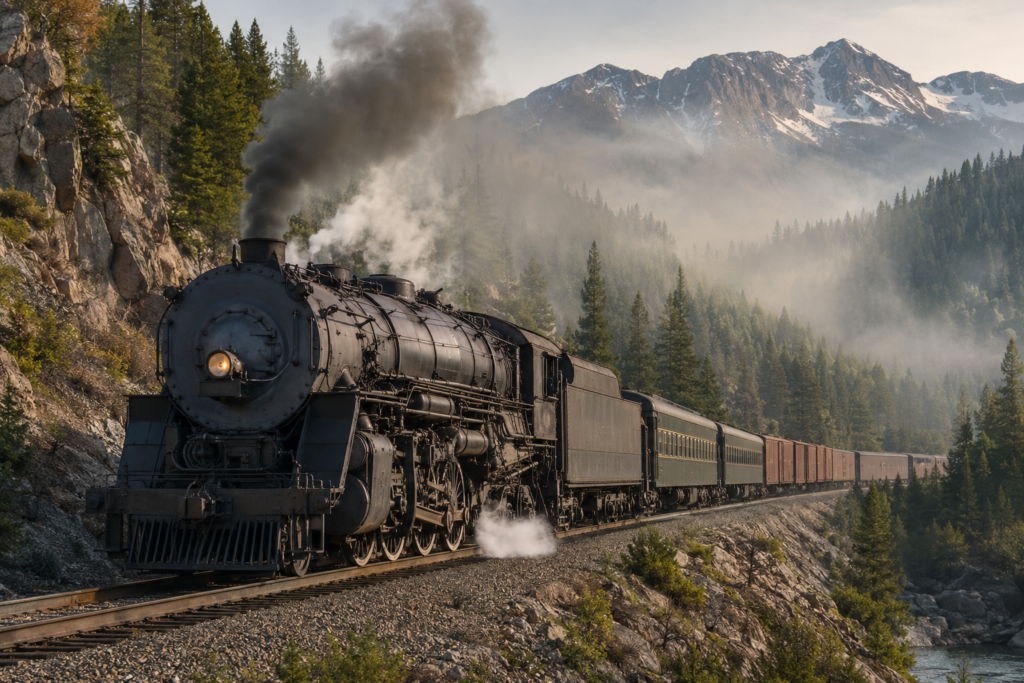
The 4-8-4 Northern combined speed, power, and stability. It had a four-wheel leading truck, eight driving wheels, and a four-wheel trailing truck supporting a wide firebox.
This arrangement allowed the Northern to generate large quantities of steam while remaining stable at passenger-train speeds. It could pull long consists across open plains and then confront mountain grades without surrendering momentum too quickly.
Large driving wheels favored speed, but the eight-driver arrangement still provided substantial traction. Railroads used Northerns for express passenger service, mail trains, and fast freight.
The locomotive’s generous boiler proportions and advanced appliances reflected the height of conventional steam technology. Many examples featured mechanical stokers, feedwater heaters, power reverse systems, and improved valve gear.
Within the history of western passenger trains, the Northern represents an era when railroads competed through speed, comfort, and dramatic visual presentation.
A Northern approaching a mountain station was an unforgettable sight. Its exhaust echoed from valley walls, while steam drifted around the platform and polished side rods flashed beneath the boiler.
4-6-6-4 Challenger: Articulated Power with Greater Speed
The Challenger was an articulated steam locomotive designed to combine enormous pulling force with greater operational speed. Its 4-6-6-4 wheel arrangement included two groups of six driving wheels.
The rear engine unit was rigidly attached to the boiler, while the forward unit pivoted to follow curves. This articulation allowed the locomotive to distribute its size across a flexible running system.
Unlike some earlier articulated engines intended mainly for slow hauling, the Challenger could operate at relatively high speeds. It was equally impressive on heavy freight trains and demanding passenger assignments.
The large boiler supplied steam to four cylinders. Managing that steam efficiently required precise valve timing and careful throttle control, especially while climbing.
Challengers reduced the need for multiple smaller locomotives, although helper service remained necessary on the steepest districts. Their size also required long turntables, reinforced bridges, spacious engine facilities, and substantial maintenance equipment.
These machines stand among the most technically impressive legendary steam locomotives associated with western mountain railroading.
2-8-8-2 Mallet: Slow, Powerful, and Designed for Grades
The 2-8-8-2 Mallet was built for heavy work at low speeds. It used two sets of eight driving wheels, producing tremendous adhesion across a long but articulated frame.
Many traditional Mallets used compound expansion. High-pressure steam first entered smaller rear cylinders before being reused in larger low-pressure cylinders at the front.
Theoretically, this arrangement improved efficiency. In practice, compound systems could be complex to maintain and sometimes delivered uneven performance under changing operating conditions.
On steep grades, however, the Mallet’s purpose was clear. It moved trains that would otherwise require several conventional locomotives.
Its low speed was not necessarily a disadvantage. Mountain freight operations demanded controlled pulling power, particularly where sharp curves, tunnels, and descending trains limited safe speeds.
The Mallet’s appearance communicated its function. Massive cylinders, closely spaced driving wheels, external piping, and a huge boiler made it look less like a passenger locomotive and more like a mobile industrial plant.
Milwaukee Road Boxcab Electrics: Silent Strength Under the Wires
Electric locomotives introduced a radically different approach to mountain railroading. The Milwaukee Road’s boxcab electrics worked across electrified western divisions, including important territory in Montana.
Their rectangular bodies concealed electrical equipment, traction motors, cooling systems, and control gear. Instead of producing steam in a boiler, they received electricity from overhead wires through roof-mounted current collectors.
Electric motors developed strong torque from a standstill. This characteristic made them highly effective when starting heavy trains on grades.
They also avoided the smoke, cinders, and fire risk associated with steam locomotives. Inside long tunnels or enclosed snow sheds, cleaner operation created much better working conditions for crews.
Regenerative braking offered another major advantage. During a descent, traction motors could function as generators, helping control the train while returning electrical energy to the system.
These locomotives became an essential part of Montana’s electrified railroad legacy. Their quiet movement contrasted sharply with the explosive exhaust of steam engines, yet their mountain performance was exceptionally strong.
Milwaukee Road “Little Joe”: A Powerful Electric Legend
The locomotives known as “Little Joes” were among the most distinctive electric engines to operate in the American West. They had originally been constructed for export but entered domestic service after international circumstances prevented their intended delivery.
Their long bodies rode on powerful traction-motor-equipped trucks. Although their appearance was streamlined compared with early boxcabs, their design remained strongly functional.
Little Joes could haul heavy freight trains over mountain grades with smooth, continuous power. Because electric motors did not depend on boiler pressure, crews received an immediate response when adjusting power.
The locomotives were also effective in cold weather, although the electrical infrastructure required constant attention. Overhead wires, substations, insulators, and current-collection equipment all had to survive snow, ice, wind, and extreme temperature changes.
The Little Joe symbolizes both technological success and historical loss. Electrification demonstrated remarkable efficiency, but changing economics eventually led to dieselization and the abandonment of much specialized infrastructure.
EMD F-Units: Diesel Power Arrives in the Mountains
The arrival of EMD F-units transformed the visual and mechanical character of mountain railroading. Their streamlined carbody design concealed a diesel engine, generator, traction motors, and auxiliary equipment.
F-units were commonly operated in multiple-unit sets. One engineer could control several connected locomotives from the leading cab, allowing railroads to adjust power by adding or removing units.
This modular system offered a major advantage over steam. A railroad no longer had to assign a single enormous locomotive to every difficult train.
Diesels also required less daily servicing. They did not need water stops, ash removal, fire cleaning, or hours of preparation before departure.
In mountain territory, early diesels sometimes faced cooling and traction challenges. Nevertheless, their availability and operational flexibility gradually outweighed the dramatic power of steam.
The F-unit’s rounded nose became associated with postwar passenger trains and fast freight service. Its arrival marked one of the most decisive transitions in railroad technology.
EMD GP and SD Road Switchers: Practical Mountain Survivors
Road-switcher locomotives replaced the elegant carbody with a long hood, narrow walkways, and a practical cab. This design allowed crews to access mechanical equipment more easily and provided visibility in both directions.
Four-axle GP locomotives were versatile, but six-axle SD models were often better suited to heavy mountain service. Their additional powered axles spread the locomotive’s weight and improved adhesion.
Later SD-series locomotives included dynamic braking. During descents, traction motors generated resistance that helped control train speed and reduced wear on conventional air brakes.
Dynamic braking became particularly important for long freight trains. It allowed engineers to manage speed more smoothly while preserving brake capacity for emergencies and final stopping.
Modern diesel road switchers may lack the romance of polished steam locomotives, but they are direct descendants of earlier mountain machines. Their design reflects the same fundamental challenge: converting energy into reliable traction on unforgiving terrain.
Why Mountain Locomotives Became Legends
A locomotive became legendary not merely because of its size or appearance. Its reputation emerged from repeated encounters with steep grades, winter storms, heavy trains, and narrow operating margins.
Steam locomotives displayed their effort through sound, smoke, heat, and visible motion. Electric engines demonstrated the power of infrastructure and efficient traction motors. Diesels introduced modular control, simpler servicing, and dependable year-round operation.
Each generation solved mountain railroading differently. Together, these machines preserve a detailed mechanical record of changing technology, economic priorities, and human skill.
For museum visitors, their surviving frames, boilers, traction motors, controls, and driving wheels are more than industrial artifacts. They are physical evidence of the machines that carried communities, commerce, and ambition through some of the most challenging landscapes in the American West.


