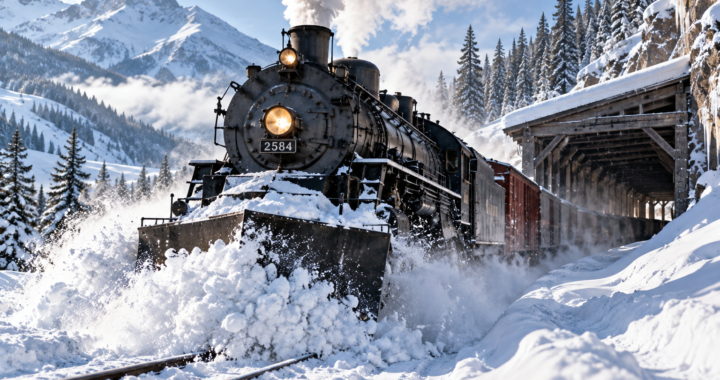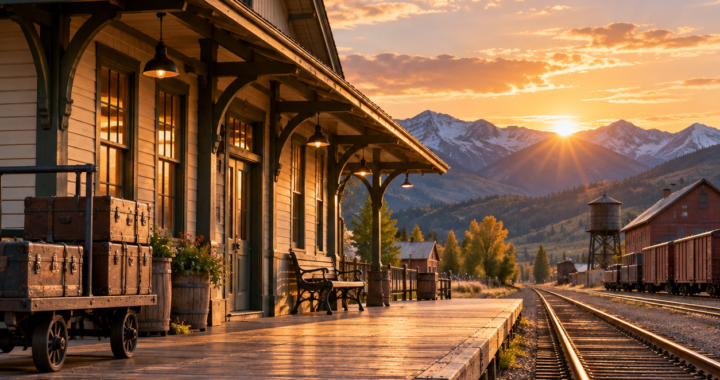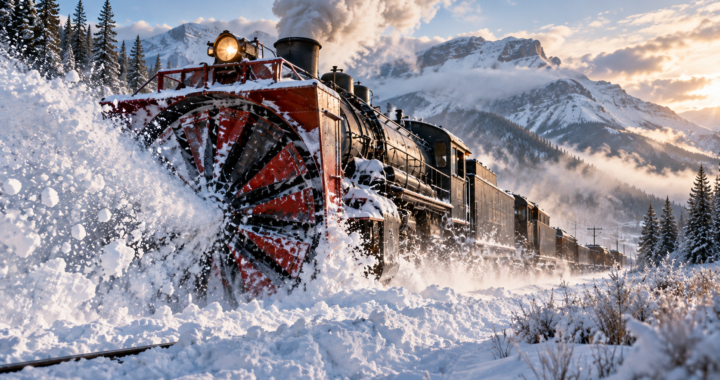
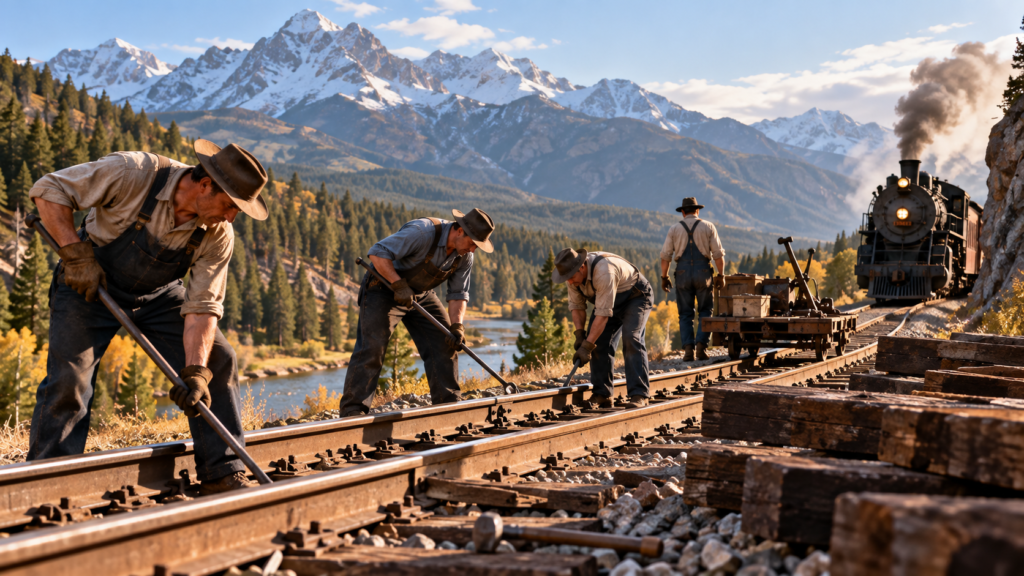
A locomotive could thunder past in a matter of minutes.
Passengers saw mountains through the windows.
Freight cars rolled toward distant towns.
The train disappeared around a curve, leaving only the rails behind.
From the passenger’s perspective, the railroad was the train.
But the train was only the most visible part of a much larger system.
Long before a locomotive reached a particular stretch of track, somebody had to inspect that track. Loose components needed attention. Drainage had to work. Vegetation could not simply be allowed to take over. Snow, washouts, damaged ties, shifting ballast, and countless smaller problems could interfere with operations.
Much of that everyday responsibility fell to railroad section crews.
Their work was repetitive, physical, local, and easy to overlook. Yet railroads crossing a large and demanding state such as Montana could not function simply because locomotives and rails existed.
The railroad had to be maintained mile after mile.
And that required people.
Why Railroads Divided Track Into Sections
A railroad stretching hundreds or thousands of miles was too large to maintain as one continuous piece of infrastructure.
Instead, track was divided into manageable territories.
A crew could be responsible for maintaining a particular section of railroad rather than attempting to cover an entire division.
This created local responsibility.
Workers became familiar with the track they maintained.
They knew where drainage problems tended to develop.
They knew which areas accumulated snow.
They knew where ground conditions could cause trouble.
They could recognize when something looked different from the previous inspection.
That familiarity mattered because track maintenance was not only about repairing obvious failures.
It was also about noticing change before a problem became larger.
The Section Foreman Carried Responsibility
Section crews generally worked under a foreman responsible for organizing the work within the assigned territory.
The foreman needed to understand the condition of the track, decide what required attention, coordinate workers, and operate within railroad procedures.
This was practical knowledge built through experience.
A good foreman did not simply know how to replace a tie or adjust track.
He needed to understand how all the pieces interacted.
Rails.
Ties.
Ballast.
Drainage.
Roadbed.
Switches.
Crossings.
Weather.
Train movements.
The territory itself became something the crew learned over time.
Track Was Not a Static Object
From a distance, railroad track looks permanent.
Two steel rails.
Wooden ties.
Stone underneath.
But track exists in a changing environment.
Temperature changes make materials expand and contract.
Water moves through soil and drainage systems.
Ballast shifts.
Ties deteriorate.
Fasteners loosen or wear.
Vegetation grows.
Heavy trains repeatedly apply enormous loads.
Winter adds snow and ice.
Spring runoff can create entirely different problems.
So maintenance was never truly finished.
The track might be ready today.
Tomorrow still required another inspection.
Walking the Track Was Part of Understanding It
Before modern inspection technologies became common, human observation played an enormous role in identifying problems.
Workers could travel or walk portions of their territory looking for irregularities.
A small change might be significant.
A rail connection that did not look right.
A tie that had deteriorated.
Ballast displaced from where it should be.
Water collecting where the roadbed should remain stable.
Damage near a crossing.
Debris near the track.
The job demanded attention because the railway environment contained countless details that passengers never noticed.
A train could cover the same territory quickly.
Maintenance workers experienced it slowly.
A Tie Was More Important Than It Looked
Railroad ties may appear simple compared with locomotives, bridges, or signals.
But ties help maintain rail spacing and transfer loads into the ballast and roadbed below.
Over time, wooden ties deteriorate.
Some eventually need replacement.
Historically, changing them required demanding physical labor.
Ballast had to be moved.
Fasteners removed.
The old tie extracted.
A replacement positioned.
The track secured again.
Then the surrounding track structure needed to be restored.
Multiply that process across many miles and the scale of maintenance becomes easier to understand.
Ballast Was Part of the Track System
The crushed stone around railroad ties is easy to treat as background scenery.
It performs important work.
Ballast helps support the track, distribute loads, facilitate drainage, and hold the track structure in position.
When ballast shifts or becomes contaminated, track conditions can deteriorate.
Maintaining track therefore involved more than inspecting steel rails.
Workers also needed to pay attention to what was happening underneath and around them.
A railroad was a layered structure.
Problems at the bottom could eventually affect what happened at the top.
Water Was a Constant Enemy
Railroads needed stable ground.
Water could threaten that stability.
Poor drainage could weaken the roadbed.
Heavy rain could damage embankments.
Runoff could carry material away.
Culverts could become blocked.
Flooding could threaten low areas.
This made drainage maintenance one of the less glamorous but essential parts of railroad work.
A ditch beside the track might not appear important in an old photograph.
But if that ditch allowed water to move safely away from the roadbed, it was protecting the railroad.
Montana Made Maintenance a Geographic Problem
Montana railroads crossed environments that could vary dramatically.
Mountain territory.
Open plains.
River valleys.
Remote stretches between communities.
A maintenance challenge in one area might be completely different several dozen miles away.
Mountain grades could involve snow, drainage, rock, and difficult access.
Open country could expose infrastructure to wind and severe winter conditions.
River corridors introduced their own relationships with water and terrain.
The work of railroad section crews was therefore closely connected to geography.
Maintaining track meant understanding the landscape carrying it.
Winter Changed the Railroad
Montana winter could turn ordinary railroad maintenance into a much harder job.
Snow accumulated.
Switches could become obstructed.
Ice created additional problems.
Drifting snow could affect exposed sections of railroad.
Cold weather also made outdoor physical work more difficult.
The railroad could not simply stop needing maintenance because conditions became uncomfortable.
Freight still needed to move.
Communities still depended on transportation.
Passengers still traveled.
Winter therefore became part of railroad operations rather than an exception to them.
Switches Needed Special Attention
A switch contains moving components that allow trains to move from one track to another.
That movement makes the switch operationally important.
A problem there could interfere with train movements in ways that a passenger might never understand.
Snow, ice, debris, wear, or mechanical problems could require attention.
Section workers therefore needed to monitor more than straight stretches of track.
Sidings, yards, switches, crossings, and other infrastructure all created additional maintenance responsibilities.
Grade Crossings Were Shared Spaces
Where roads crossed railroad tracks, two transportation systems met.
Crossings required maintenance not only for trains but also for vehicles and pedestrians using the roadway.
The track structure had to remain functional while the crossing surface needed to accommodate road traffic.
These locations could also accumulate debris or experience wear differently from isolated track.
For maintenance workers, crossings were another reminder that railroad infrastructure did not exist separately from the communities around it.
Hand Tools Defined Much of the Early Work
Before extensive mechanization, railroad maintenance depended heavily on human muscle and hand tools.
Workers used tools for lifting, aligning, fastening, digging, tamping, and moving material.
The physical demands were substantial.
Imagine spending a day outdoors moving ties, handling rail components, shoveling ballast, or correcting track alignment.
Then imagine doing it in summer heat, winter cold, wind, or rain.
Historic railroad photographs often make maintenance work look almost simple because the tools appear basic.
The labor behind those tools was anything but simple.
The Handcar Became an Icon of Track Work
Few images are more closely associated with old railroad maintenance than workers traveling on a handcar.
The familiar pump-style car allowed crews to move along the rails without a locomotive.
Other small maintenance vehicles were also used as technology evolved.
These vehicles were practical because section workers needed access to territory spread across several miles.
The railway itself became their transportation route.
But traveling on active track also required awareness of train movements.
Maintenance workers were using the same infrastructure as much larger and faster equipment.
Knowing the Timetable Was About Safety
A track worker could not treat the railroad like an empty worksite.
Trains were operating.
Crews needed awareness of scheduled and unscheduled movements according to the rules and practices of their railroad and era.
The fundamental problem was obvious:
The workplace was also the path of moving trains.
That made communication, operating rules, lookout practices, and situational awareness essential parts of track work.
Maintenance could not be separated from operations.
Remote Work Meant Local Independence
Some sections of railroad passed through areas far from major shops or towns.
A crew could not assume that every small problem would immediately bring a large specialist team.
Section workers therefore needed practical skills and familiarity with their territory.
They were the local eyes of the railroad.
If something changed after a storm, they might be among the people expected to identify it.
If track needed routine work, they handled it.
If a larger problem appeared, their observations could help determine what additional resources were required.
Section Houses Put Workers Near the Railroad
Historically, railroads sometimes provided section houses or similar accommodations near the territory workers maintained.
This made practical sense.
Transportation was slower.
Communication was limited.
Workers needed to remain close to the infrastructure for which they were responsible.
The railroad therefore shaped not only employment but also settlement patterns and daily life.
For some families, the railroad was not simply where someone went to work.
It was physically present outside the home.
A Section House Could Become Part of Family Life
Living near the track meant trains were part of the daily environment.
The sound of locomotives.
Whistles.
Workers coming and going.
Maintenance activity.
Weather affecting operations.
The boundary between railroad life and home life could be much thinner than it is for many modern occupations.
Children in railroad families could grow up with the railway as a constant presence.
This is one reason railroad history is not only industrial history.
It is also social history.
Small Communities Could Depend on Railroad Employment
Railroads brought more than trains through Montana.
They created jobs.
Maintenance workers.
Station employees.
Telegraph operators.
Train crews.
Shop workers.
Agents.
Bridge workers.
Signal workers.
Different locations required different combinations of labor.
In smaller communities, railroad employment could become an important part of the local economy.
When railroad operations later changed, the effect was not limited to transportation.
Jobs and community routines changed too.
Maintenance Was Often Invisible When It Worked
This is one of the paradoxes of infrastructure.
Successful maintenance attracts little attention.
A train passes safely.
Nothing unusual happens.
Passengers continue their journey.
Freight reaches the next terminal.
The absence of a problem looks ordinary.
But that ordinary movement depended on countless inspections and repairs that passengers never saw.
Railroad history often celebrates exceptional events.
Maintenance history reminds us that ordinary reliability was itself an achievement.
The Crew Knew Individual Miles Differently
For passengers, the landscape might blur past the window.
For a section worker, individual locations could have specific identities.
A drainage problem near one curve.
A crossing that required attention.
A low area affected by water.
A switch near a siding.
A stretch where drifting snow repeatedly caused trouble.
The railroad was not an abstract line on a map.
It was a sequence of physical places with individual maintenance histories.
That local knowledge was valuable.
Storms Could Change Priorities Immediately
Routine maintenance plans could be disrupted by weather.
Heavy rain might require inspection for washouts or drainage problems.
Wind could bring debris.
Snowstorms could create urgent winter work.
Flood conditions could threaten specific sections.
When weather affected the railroad, the maintenance crew’s priorities changed with it.
This is why infrastructure work requires both routine and response.
The crew maintained predictable wear while remaining prepared for unpredictable events.
A Washout Could Be Far More Serious Than It Looked
Water moving underneath or beside the track could remove supporting material.
From a distance, rails might still appear to be present.
But the foundation supporting them could be compromised.
This illustrates why inspection mattered so much.
Railroad safety depended not only on whether steel rails looked intact but also on the condition of the roadbed beneath them.
Understanding the ground was part of understanding the railroad.
Telegraph and Communication Changed Maintenance Response
As railroad communication systems developed, information could move faster along the line.
Stations, dispatchers, train crews, and maintenance forces became part of a larger operational network.
A problem identified in one location could be communicated to others.
Train movements could be controlled while repairs occurred.
Resources could be requested.
Communication did not remove physical maintenance work.
It made coordination around that work more effective.
Mechanization Changed the Section Crew
Railroad maintenance gradually became more mechanized.
Machines could perform work that once required large amounts of manual labor.
Track geometry could be measured more precisely.
Specialized equipment could handle ballast, ties, rail, surfacing, and alignment at scales difficult for traditional hand crews.
This improved productivity.
It also changed railroad employment.
The classic small section gang working a short territory became less central as railroads consolidated maintenance and used mobile mechanized crews over larger areas.
The Job Did Not Disappear—It Changed
Modern railroads still require track inspection and maintenance.
Steel still wears.
Ballast still needs management.
Drainage still matters.
Weather still affects infrastructure.
Switches still require attention.
The difference is that tools, vehicles, inspection technologies, communication, and organizational structures have evolved.
Looking at historic railroad section crews therefore shows both continuity and change.
The maintenance problem remains.
The methods have transformed.
Abandoned Track Can Still Reveal Their Work
Walk an abandoned railroad grade and the trains may be gone.
But infrastructure often leaves traces.
Cuts through hills.
Embankments.
Bridge abutments.
Culverts.
Old ties.
Ballast.
Grade crossings.
Foundations.
These remains reveal how much physical work was required to create and maintain a railroad corridor.
The line was not simply placed on the landscape.
It was engineered into it and then continually maintained.
Culverts Tell Quiet Stories
A historic culvert may not attract the same attention as a locomotive or depot.
Yet it can reveal how railroad builders and maintenance workers dealt with water.
The railroad needed to cross natural drainage rather than simply block it.
When these structures survive, they offer clues about engineering choices and the long-term relationship between railroads and terrain.
Infrastructure history often becomes most interesting when we begin noticing objects that were designed not to be noticed.
Old Roadbeds Can Outlive the Railroad
Rails may be removed.
Ties decay.
Stations disappear.
But the graded corridor can remain visible for decades.
Some former rail lines become roads or trails.
Others survive as subtle lines across fields or forests.
That durability shows the enormous amount of earthwork involved in railroad construction.
It also preserves portions of the environment where maintenance crews once spent their working lives.
Maintenance Helps Explain Why Railroads Followed Certain Routes
Railroad routes were influenced by many considerations, including grades, geography, destinations, construction cost, and access.
But long-term maintenance mattered too.
Every bridge, curve, cut, fill, and mountain passage created future responsibilities.
A difficult route did not stop being difficult after construction ended.
Someone had to maintain it.
Looking at historic rail lines through the perspective of maintenance can therefore change how we understand engineering decisions.
Photographs of Workers Deserve More Attention
Historic railroad photography naturally gravitates toward locomotives.
Steam engines are dramatic.
Stations are architectural.
Passenger trains evoke nostalgia.
A photograph of several workers beside a pile of ties may appear less exciting.
But those images can contain extraordinary historical information.
Clothing.
Tools.
Work organization.
Track construction.
Transportation equipment.
Landscape.
Crew size.
Everyday labor.
They show the railroad from ground level rather than from the platform.
Employee Records Can Reveal a Different Railroad History
Corporate histories often focus on companies, routes, mergers, and famous trains.
Employee records, photographs, local newspapers, oral histories, and family collections can reveal another layer.
Who maintained the track?
Where did they live?
How long did they work there?
What jobs existed?
How did employment change when a line was abandoned or reorganized?
These questions turn railroad history into human history.
The Foreman Was Part Manager, Part Technician
A section foreman’s work involved more than assigning tasks.
The role required judgment.
Which problem needed immediate attention?
What work could wait?
What materials were required?
How should the crew approach the job safely?
When did a condition require escalation?
The foreman stood between the railroad’s broader operating system and the physical reality of a specific territory.
That made local experience particularly important.
Maintenance Had a Rhythm
Not every day was an emergency.
Much of railroad work consisted of recurring tasks.
Inspection.
Adjustment.
Replacement.
Drainage work.
Vegetation control.
Switch maintenance.
Crossing work.
Preparing for seasonal conditions.
Then something unusual happened and the rhythm changed.
A storm.
Damage.
A mechanical problem.
The combination of repetitive work and sudden urgency is common in infrastructure occupations.
Railroad maintenance was no exception.
Summer Brought Its Own Challenges
Winter receives much attention in Montana railroad history, but warm weather did not eliminate maintenance concerns.
Heat affects rail and track structures.
Vegetation grows.
Thunderstorms can produce heavy rain.
Dry conditions can create other operational concerns.
Crews still performed physically demanding outdoor work under the sun.
Railroad maintenance was seasonal, but it was never seasonal in the sense of disappearing for part of the year.
Every season simply changed the problem.
Rail Replacement Was a Major Undertaking
Rails themselves wear over time.
Increasing train weights, traffic, and changing standards could also lead railroads to upgrade track.
Replacing rail required planning, material, labor, and coordination with operations.
Old photographs of rails stacked beside a line can therefore represent more than spare material.
They may show an infrastructure system continually renewing itself.
The railroad passengers saw was never truly finished.
It was always being rebuilt in pieces.
Growing Trains Increased Demands on Track
As locomotives and freight cars became heavier and railroad traffic evolved, track infrastructure needed to support changing loads.
Rail weight, tie condition, ballast, bridges, and roadbed all mattered.
This helps explain why maintenance history cannot be separated from locomotive and freight history.
A more powerful locomotive was useful only if the infrastructure beneath it could safely carry the train.
The spectacular machine depended on the ordinary track.
Branch Lines Still Required Maintenance
A lightly used branch might see fewer trains than a major main line.
But the track still needed to remain suitable for the operations it carried.
This created an economic challenge.
Maintenance costs existed even where traffic was limited.
Over time, changes in freight patterns, highways, industries, and railroad economics contributed to the decline or abandonment of many secondary lines.
When studying an abandoned Montana branch, asking who maintained it and what that maintenance cost can help explain its larger history.
Abandonment Changed More Than the Map
When a railroad line disappeared, the effect extended beyond losing rails.
Maintenance positions could vanish.
Section houses might lose their purpose.
Depots could close.
Businesses dependent on rail access had to adapt.
Communities changed their transportation patterns.
The railroad landscape that had required constant human attention could suddenly become quiet.
That transition is one reason abandoned grades can feel so striking today.
They were once workplaces.
Preservation Often Focuses on the Visible Objects
Museums naturally preserve locomotives, cars, signs, tools, and depot buildings.
These objects are tangible and recognizable.
But preserving the history of maintenance labor requires something more.
Photographs.
Employee stories.
Documents.
Oral histories.
Work rules.
Maps.
Tool collections.
Local memories.
Without those sources, it is easy to preserve the railroad while losing the people who kept it functioning.
Montana Railroad History Is Also Labor History
The expansion of railroads across Montana is often told through major companies, transcontinental routes, construction, and economic development.
Those are essential stories.
But railroads were also workplaces.
Thousands of ordinary tasks had to happen repeatedly for the larger transportation system to function.
Track workers were part of that system.
Their contribution may not appear in the name of a famous train.
It appears in the fact that the train could run at all.
The Rails Needed Attention After the Train Was Gone
Imagine standing beside a Montana railroad after a train passed.
The sound fades.
Dust settles.
The landscape becomes quiet again.
For a passenger, that stretch of track is already behind them.
For a section crew, it remains the workplace.
There are miles to inspect.
A ditch that needs clearing.
A tie that needs attention.
A switch to check.
Tomorrow another train will arrive.
That difference in perspective explains why maintenance deserves its own place in railroad history.
Conclusion
Railroad section crews worked in the part of railroad history that passengers were rarely meant to notice.
Their job was not to create spectacle.
It was to create reliability.
They inspected track, maintained ties and ballast, watched drainage, worked around switches and crossings, responded to weather, and learned the individual characteristics of the territory assigned to them.
In Montana, geography and climate made that responsibility especially tangible. Railroads crossed mountains, valleys, rivers, plains, remote country, and communities where changing seasons could transform maintenance priorities.
Technology eventually changed the work.
Hand labor gave way to increasingly specialized machinery. Communication improved. Maintenance territories and organizations evolved.
But the underlying principle remained.
A railroad is not maintained once.
It is maintained continuously.
That is why the history of a railway cannot be told only through locomotives, passenger cars, and depots.
Behind every train that crossed Montana were people whose success was often measured by something remarkably simple:
The train passed, and nothing went wrong.