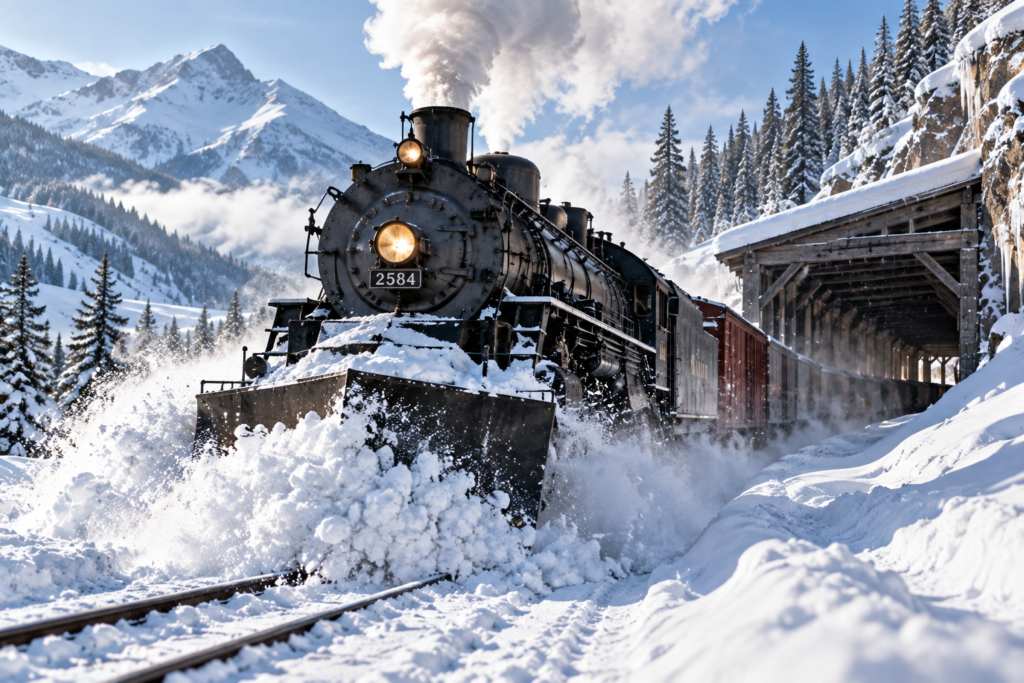
A train could be perfectly capable of crossing Montana in July.
Then winter arrived.
Snow drifted across the track. Switches froze. Visibility disappeared. Mountain passes became difficult to keep open, and crews could clear one section only to watch wind cover it again.
The locomotive was still powerful.
The rails were still there.
But the railroad had become a battle against weather.
This was one of the defining realities of Montana railroad winter operations.
Montana’s major railroads connected communities, mines, farms, and markets across enormous distances. The Northern Pacific completed its transcontinental route through Montana in 1883, while the Great Northern pushed its northern route across the state and through Marias Pass during the following decade. University of Montana
Building those routes was only the beginning.
The harder question returned every year:
How do you keep a railroad operating when winter begins changing the landscape around it?
A Railroad Could Not Simply Close Until Spring
Before railroads transformed transportation in Montana, winter could make travel extraordinarily difficult.
Railroads changed expectations.
Communities began depending on scheduled transportation.
Businesses depended on freight.
Mines needed supplies and transportation for their output.
Farmers and ranchers needed connections to markets.
Passengers expected trains to continue moving.
The railroad therefore had a problem very different from that faced by an occasional traveler.
Waiting several months for better weather was not a realistic operating plan.
The line had to remain usable.
Montana Created Several Different Winter Problems
There was no single version of winter across the state.
Eastern and central Montana could experience wind-driven snow across open country.
Mountain routes faced heavy accumulation, steep terrain, and avalanche exposure.
Cuts through the landscape could collect drifting snow.
Stations and yards had switches and other infrastructure that needed to remain functional.
A solution that worked on an open prairie section might accomplish very little on a mountain pass.
Railroads therefore had to understand the local behavior of snow.
Winter maintenance became part engineering, part observation, and part experience accumulated over many seasons.
Marias Pass Became a Major Test
The Great Northern’s route through Marias Pass provided an important crossing of the Continental Divide.
But completing the railroad did not mean the environmental challenge was solved.
Only months after regular operation began, contemporary reporting described crews struggling to clear snow from the mountain division. Winter conditions quickly demonstrated that keeping the route open would require continuous work rather than a one-time engineering achievement. Railway Age
That distinction matters.
Railroad history is often told through construction dates.
A line reaches a town.
A final spike is driven.
A new route opens.
But operational history begins after the celebration.
The railroad then has to function every day.
Snow on the Track Was Not Always the Same Problem
A few inches of fresh snow and a deep wind-packed drift could require very different responses.
Loose snow could sometimes be pushed aside relatively easily.
Deep drifts could resist ordinary equipment.
Wet snow behaved differently from dry powder.
Repeated storms could build accumulation faster than crews could remove it.
Wind could move snow back onto recently cleared track.
Mountain terrain introduced additional hazards.
This is why the phrase “clear the snow” hides a complicated operating problem.
Railroad workers needed equipment and strategies suited to the conditions in front of them.
Wind Could Undo Hours of Work
Imagine crews clearing a section of track.
The rails are visible again.
The route is ready.
Then the wind continues blowing across an open landscape.
Snow moves with it.
A cut or depression beside the track acts almost like a collection point.
The same location fills again.
Now the railroad has to clear it twice.
This repeated work made snow drifting particularly frustrating.
Railroads therefore had reason to think beyond removing snow after it arrived.
They also looked for ways to control where drifting snow accumulated.
Snow Fences Could Manipulate the Drift
A snow fence does not work by physically sealing snow away from the railroad.
Instead, it changes airflow.
As wind passes the barrier, snow carried by that wind is encouraged to accumulate in a more desirable location rather than directly on the track.
Placement matters.
A poorly positioned barrier may not produce the intended drift.
Local wind direction matters.
Terrain matters.
Distance from the track matters.
Over time, railroads could identify recurring trouble spots and install protective infrastructure accordingly.
It was preventive maintenance at landscape scale.
Snow Sheds Solved a Different Problem
In mountainous territory, railroads sometimes needed more substantial protection.
A snow shed is essentially a protective structure built over a section of track.
Rather than trying to stop all snow movement, the structure allows snow or avalanche material to pass over or around the railroad while protecting the track beneath.
Historical Great Northern engineering records document snow-shed construction in Montana, including plans from Midvale in 1894 and later work around Walton. PNR Archive
These structures were not decorative pieces of railroad architecture.
They existed because geography demanded them.
Snow Sheds Became Part of the Mountain Railroad Landscape
A train entering a snow shed temporarily disappeared beneath a structure built into the mountainside.
To passengers, it may have seemed like another unusual feature of mountain railroading.
To engineers, it represented a response to a specific hazard.
The shed needed to withstand environmental forces while allowing trains to pass reliably underneath.
Designs evolved.
Materials could include timber and concrete.
A surviving archival specification for Snow Shed No. 12 at Walton from 1928 describes a double-track combined timber-and-concrete structure. PNR Archive
That document captures an important reality of railroad history:
winter infrastructure was continuously maintained and modified.
Building the Railroad Did Not End the Engineering
Tracks required constant attention.
So did bridges.
Drainage.
Cuts.
Tunnels.
Snow-control structures.
A railroad might discover after several winters that a particular location needed additional protection.
Infrastructure could be extended.
Rebuilt.
Strengthened.
Repositioned.
Railroad engineering was therefore an ongoing relationship with the landscape.
The original builders made assumptions.
Operations tested those assumptions.
Weather exposed weaknesses.
Maintenance departments responded.
Plows Turned Locomotive Power Against the Snow
Where snow physically blocked the track, railroads needed ways to move it.
The simplest idea is intuitive:
put a plow at the front and push.
Different forms of railroad snowplows developed for different conditions.
Some were integrated with locomotives or mounted on equipment pushed by locomotives.
Others were specialized machines designed specifically for heavy snow removal.
The important point is that clearing track became an operational specialty.
A railroad in snow country needed more than locomotives and freight cars.
It needed winter equipment.
The Wedge Plow Had a Straightforward Mission
A wedge plow uses its shape to force snow away from the track as the equipment moves forward.
For many conditions, this basic approach can be highly effective.
But snow depth, density, terrain, and drifting patterns all influence performance.
A massive drift may require repeated work.
Snow packed against structures can create additional complications.
And simply pushing snow sideways is not always enough when there is nowhere useful for it to go.
That limitation helped make more specialized snow-removal machinery valuable.
Rotary Snowplows Attacked the Deepest Accumulation Differently
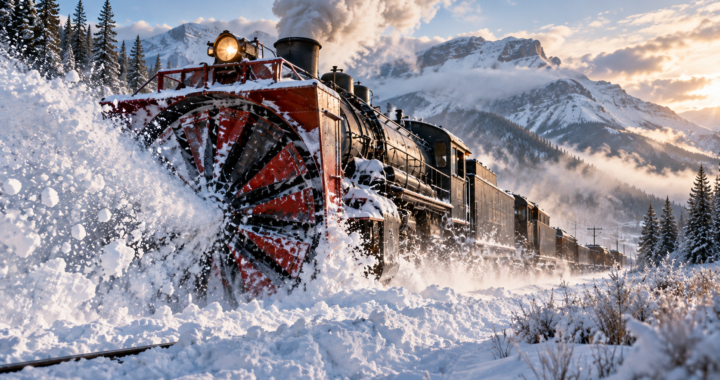
The rotary snowplow became one of the most visually dramatic pieces of railroad winter equipment.
Instead of merely pushing snow aside with a wedge, a large rotating wheel at the front could cut into snow and throw it away from the track.
For deep accumulation, that offered an important advantage.
The machine still required substantial railroad support.
A rotary was not simply a magical snow-eating locomotive traveling independently through every storm.
Operations could involve locomotives, crews, communication, and careful coordination.
Winter snow fighting was a railroad operation, not a single machine.
Snow Removal Could Become a Train of Its Own
Think about everything needed when conditions became severe.
A plow might be at the front.
Locomotives provided power.
Crews monitored conditions.
Additional equipment could follow.
The railroad still had to coordinate these movements with normal traffic.
Snow removal therefore competed for track time while simultaneously making ordinary train movements possible.
This creates an interesting operational paradox.
The railroad sometimes had to reduce regular movement temporarily so maintenance equipment could restore reliable movement.
The First Train Through Was Not Always the End of the Job
A plow passes.
The track is open.
Problem solved?
Not necessarily.
Wind continues.
Snow continues.
Temperatures change.
Another drift forms.
A switch freezes.
Conditions deteriorate somewhere else.
Winter maintenance could become repetitive.
Crews were not always defeating one storm.
They were managing a moving system.
This is one reason Montana railroad winter operations depended so heavily on readiness.
Equipment had to be positioned before it was urgently needed.
Switches Were Small Components With Large Consequences
A main line consists of more than two uninterrupted rails.
Railroad yards, sidings, junctions, and stations rely on switches that allow trains to move between tracks.
Snow and ice could interfere with their operation.
A frozen or obstructed switch might prevent a train from taking a siding or entering a yard correctly.
That could create problems much larger than the physical size of the switch itself.
Keeping routes open therefore required attention not only to miles of track but also to individual mechanical points throughout the system.
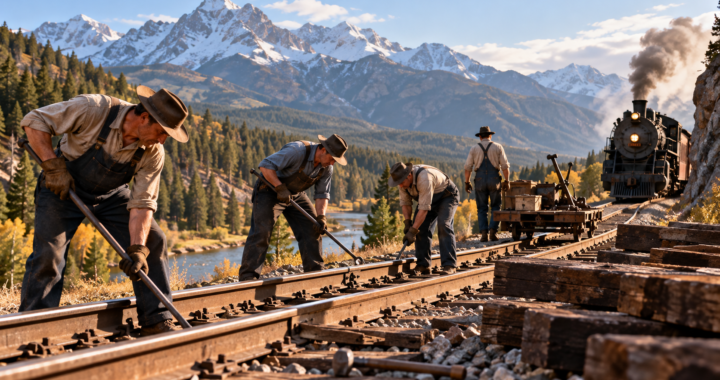
Workers Had to Fight Winter at Ground Level
The dramatic photograph is the locomotive crashing through snow.
But much winter work was less spectacular.
Workers cleared switches.
Inspected track.
Removed ice.
Checked structures.
Maintained equipment.
Responded to weather damage.
Patrolled vulnerable areas.
The railroad’s ability to operate depended on countless local tasks that passengers might never notice.
This connects directly to the role of railroad section crews.
The infrastructure only appeared permanent because workers continually maintained it.
Cold Affected Machinery Too
Snow was not the only enemy.
Low temperatures affected equipment.
Lubricants behaved differently.
Water systems required attention.
Metal components experienced harsh conditions.
Steam-era railroading had particular cold-weather challenges because locomotives depended on water and complex mechanical systems operating outdoors.
Workers needed procedures for keeping locomotives serviceable in freezing temperatures.
A train could have perfectly clear track and still face winter problems if its machinery was not ready for the cold.
Steam Locomotives Needed Water Even in Freezing Weather
Steam locomotives consumed large quantities of water.
That requirement did not disappear when temperatures fell below freezing.
Water tanks and associated infrastructure therefore remained essential.
Railroads had to maintain a reliable supply along the route.
This is an easy detail to overlook when looking at historical photographs.
A steam locomotive seems self-contained.
It was not.
Its movement depended on a network of servicing infrastructure distributed along the railroad.
Winter complicated that network.
Coal and Fuel Supplies Had to Keep Moving
Locomotives needed fuel.
Stations needed supplies.
Communities depended on freight.
Winter disruption could therefore create cascading problems.
A delayed train was not merely a timetable inconvenience.
It could delay the movement of necessities.
That gave railroads powerful economic reasons to restore service quickly.
The importance of Montana’s railroads extended well beyond transportation itself; their arrival fundamentally changed settlement and economic connections across the state. University of Montana
Reliability became part of that transformation.
Crews Needed Information Before Modern Forecasting
Today, railroad operators have sophisticated weather forecasting and communication systems.
Historical crews worked with far more limited information.
They relied on reports from stations, telegraph communication, observations from crews, and accumulated local knowledge.
A station farther west might report worsening snow.
A train crew could describe a growing drift.
Maintenance workers knew which cuts repeatedly caused problems.
This human information network helped railroads decide where equipment and labor were needed.
Experience with a specific stretch of track could be enormously valuable.
Telegraphy Made Winter Coordination Faster
Railroads and telegraph systems developed closely together.
Stations along the route could communicate train movements and operating conditions.
During severe weather, this communication became particularly important.
A dispatcher needed to know whether a section was blocked.
Crews needed to know whether a train was approaching.
Plow operations had to fit into broader traffic management.
Without communication, snow fighting would have been far more dangerous and inefficient.
The railroad was a transportation network and an information network at the same time.
Mountain Passes Could Become Strategic Choke Points
A transcontinental railroad might stretch for thousands of miles.
Yet one blocked mountain section could interrupt movement across a much larger network.
This made passes strategically important.
Marias Pass, for example, became part of the Great Northern’s route across the Continental Divide and remains an important railroad corridor.
Its early winters quickly demonstrated how much effort mountain railroading could demand. Railway Age
The railroad could not treat the pass as just another mile of track.
Its geography gave it disproportionate operational importance.
Avalanches Changed the Scale of the Hazard
Ordinary snowfall accumulates.
An avalanche moves enormous quantities of snow rapidly.
In mountain terrain, that difference matters.
Avalanches can cover track, damage infrastructure, and create serious danger for workers and trains.
Snow sheds represented one historical engineering response in vulnerable areas.
Railroads also learned to monitor avalanche conditions and manage operations around the hazard.
The problem continues into modern railroading; contemporary BNSF operations on Marias Pass still include snow-clearing equipment and avalanche-management work. Railway Age
The technology changed.
The mountain did not.
Winter Could Reshape the Timetable
A published schedule creates an impression of precision.
Train arrives at a certain time.
Train departs at another.
But severe winter weather challenged that precision.
A delayed passenger train could affect connections.
A freight train held for snow-clearing operations could disrupt other movements.
Equipment and crews might end up in the wrong location.
Railroads therefore had to recover not just the physical track but the operating plan.
Opening the line was one problem.
Restoring the network’s rhythm was another.
One Delayed Train Could Affect Many Others
Railroads operate as interconnected systems.
Especially on single-track territory, trains depend on sidings and carefully coordinated meets.
If one train is several hours late, the original sequence changes.
Another train may wait.
A crew may reach working-time limits.
Locomotives and cars may not arrive where they are expected.
Winter disruption could propagate across the railroad.
This is why maintenance and operations could not function independently.
Clearing the track was part of managing the entire transportation network.
Passenger Comfort Was Another Winter Challenge
Even if the train moved, passengers still had to endure the journey.
Railroads needed to heat passenger cars.
Stations provided shelter while travelers waited.
Food-service operations had to function.
Long delays could turn an ordinary trip into an exhausting experience.
Passenger railroading therefore faced two winter objectives:
keep the train moving,
and keep the people aboard reasonably safe and comfortable.
The second challenge became especially difficult when the first one failed.
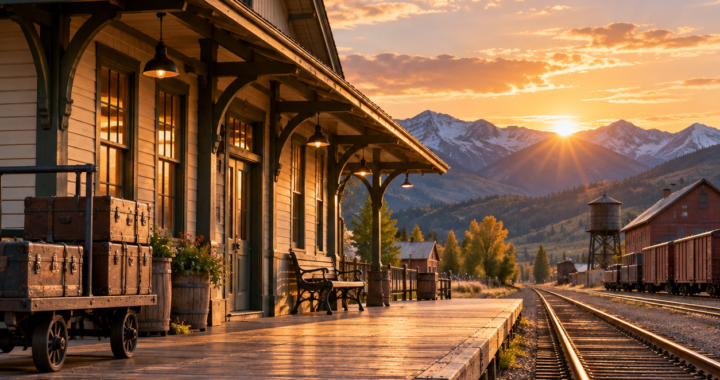
Stations Became Important Winter Refuge Points
A depot was more than a place to buy a ticket.
In many communities it served as a heated point of connection between local life and the railroad.
During bad weather, that mattered.
Passengers could wait indoors.
Railroad employees could exchange information.
Freight and baggage could be handled.
Operational communication flowed through the station.
The depot was both public architecture and working infrastructure.
Its importance became especially visible when weather made movement uncertain.
Winter Work Was Dangerous
Snow-clearing photographs can look dramatic and heroic.
The reality involved substantial risk.
Workers operated around moving trains and heavy machinery.
Visibility could be poor.
Temperatures could be extreme.
Mountain terrain added avalanche danger.
Ice increased the chance of slips and falls.
Crews might work long hours during major storms.
Understanding railroad history requires remembering that keeping the line open depended on people physically entering these conditions.
Infrastructure did not clear itself.
Experience Became a Form of Technology
Modern readers tend to think of technology as machinery.
Locomotives.
Plows.
Signals.
Telegraphs.
But accumulated human knowledge was equally important.
Workers learned where snow drifted first.
Which wind direction created trouble.
Which slopes deserved attention.
How a particular locomotive behaved in extreme cold.
Where water systems froze.
Which section needed a plow before the next storm intensified.
That local knowledge was not written into the steel rail.
It lived with the people who worked the line.
Railroads Learned From Every Winter
A difficult season could reveal weaknesses.
Maybe a snow fence needed extension.
Perhaps a shed required rebuilding.
A particular cut might need more frequent patrol.
Equipment could be repositioned before the following winter.
Procedures changed.
Infrastructure evolved.
Archival records showing snow-shed work across different decades demonstrate that winter protection was not simply installed once and forgotten. PNR Archive
Railroads adapted continuously.
Winter Infrastructure Could Become Part of Permanent Engineering
A storm lasts days.
The infrastructure built because of it can last decades.
Snow fences, sheds, drainage improvements, retaining structures, and altered operating practices became permanent features of railroad landscapes.
In this sense, weather helped design the railroad.
Engineers could draw a route on a map.
But repeated exposure to real Montana winters determined how that route ultimately had to function.
The environment became an unofficial engineering partner.
Snow Was Sometimes Moved Before the Storm Ended
Waiting for snowfall to stop can allow accumulation to become much harder to remove.
Railroads therefore sometimes needed to work continuously during storms.
Plows could make repeated passes.
Crews kept critical areas functional.
The objective was to prevent conditions from reaching the point where reopening became dramatically harder.
This is similar to modern road snow removal.
Maintenance during the storm can be as important as cleanup afterward.
Keeping the Main Line Open Was Only Part of the Problem
Railroads had yards.
Branch lines.
Industry tracks.
Sidings.
Station tracks.
A main line might be cleared while freight cars remained trapped behind snow elsewhere.
Priorities mattered.
Critical routes often received attention first.
Then crews worked outward.
This created difficult decisions about where limited equipment and labor should be deployed during widespread storms.
Winter operations were partly an exercise in resource allocation.
Branch Lines Could Be More Vulnerable
A heavily traveled main line justified significant investment and frequent snow-clearing operations.
A lightly used branch line might not receive the same resources.
This could produce longer disruptions.
The economics of the railroad influenced winter resilience.
Infrastructure investment follows traffic.
A route carrying major transcontinental traffic had a different strategic value from a lightly used spur.
The weather could be identical while the railroad’s response differed because the routes served different purposes.
The Milwaukee Road Faced Its Own Montana Winters
The Milwaukee Road entered Montana as part of its Pacific extension in the early twentieth century and built through central and western portions of the state. Montana Historical Society educational material notes that its route through central Montana and along the Clark Fork toward Seattle was completed in 1909. mhs.mt.gov
That made it another major railroad forced to adapt to Montana geography and weather.
Its famous electrification later changed locomotive operations across portions of the western system.
But electrification did not remove snow from the track.
Winter maintenance remained necessary regardless of locomotive technology.
Electrification Solved Some Problems, Not Winter Itself
Electric locomotives offered important operating characteristics on mountainous routes.
They did not make the mountains disappear.
Track still needed to remain clear.
Switches still needed to function.
Structures still needed maintenance.
Avalanches and drifts still existed.
This distinction is useful whenever discussing railroad technological progress.
A new technology usually solves specific problems.
It rarely eliminates every problem surrounding the system.
Montana winter remained an environmental challenge independent of how locomotives received their power.
Dieselization Changed Equipment but Not the Need for Snow Fighting
Steam eventually gave way to diesel locomotives across American railroads.
That removed many steam-specific servicing requirements.
But the railroad still crossed the same terrain.
Snow still accumulated.
Wind still created drifts.
Mountain passes still experienced avalanches.
Switches still needed to remain usable.
The transition to diesel therefore changed winter operations without making winter maintenance obsolete.
Snowplows and specialized maintenance equipment remained important.
Modern Railroads Still Fight the Same Geography
Today’s railroad looks very different from one operating in 1900.
Locomotives are more powerful.
Weather information is vastly better.
Communication is instantaneous compared with telegraph-era operations.
Maintenance equipment has improved.
Yet Marias Pass can still receive major snowfall and face avalanche hazards.
Modern BNSF maintains snow-removal equipment in the area and uses an avalanche program to protect the route. Railway Age
More than a century of technological progress did not eliminate the fundamental relationship between railroad and landscape.
It improved the railroad’s ability to manage it.
Old Snow Sheds Tell a Larger Story
A historical snow shed may look like an obscure engineering artifact.
But it tells us several things at once.
It identifies where snow created recurring danger.
It reveals how much money and labor railroads were willing to invest to keep a route open.
Its design reflects the engineering knowledge of its era.
Later modifications show how operating experience changed that design.
A single structure can therefore reveal much more than its construction materials.
It is physical evidence of the railroad learning how to survive a specific landscape.
Historical Blueprints Preserve Problems as Well as Solutions
Engineering drawings are particularly valuable historical sources because they record what railroads considered worth building or changing.
A plan for a snow shed tells us that snow was not merely an occasional inconvenience.
It had become a problem significant enough to justify formal engineering work.
Great Northern archival material includes Montana snow-shed plans from the 1890s through the 1920s. PNR Archive
Those documents turn weather history into infrastructure history.
They show where climate, geography, engineering, and railroad economics met.
The Most Important Winter Equipment Was Sometimes a Shovel
Railroad history naturally celebrates large machinery.
Rotary plows are spectacular.
Locomotives are photogenic.
Snow sheds are impressive.
But countless winter problems were solved with ordinary tools.
A worker clearing packed snow from a switch did not look as dramatic as a rotary cutting through a drift.
Yet both tasks could be necessary for the same train to complete its journey.
Railroad systems depend on large technology and small maintenance at the same time.
Ignoring either produces an incomplete history.
Winter Revealed How Interdependent the Railroad Really Was
A locomotive alone cannot create reliable transportation.
It needs:
usable track,
working switches,
communications,
maintenance crews,
fuel or power,
service facilities,
dispatching,
and functioning infrastructure along the route.
Winter could expose weakness in any of these areas.
That is why Montana railroad winter history is really systems history.
Snow provides the visible challenge.
But the story is about how an entire organization responded.
The Railroad Changed Montana—and Montana Changed the Railroad
Railroads helped reshape settlement, trade, travel, and economic development across Montana. The arrival of the transcontinental systems in the late nineteenth century connected places that had previously been extraordinarily difficult to reach, particularly during winter. University of Montana
But influence worked in both directions.
Montana’s geography forced railroads to adapt.
Mountains determined grades and routes.
Rivers influenced bridge locations.
Winter shaped maintenance practices.
Snow created specialized infrastructure.
The railroad changed the state.
The state changed how the railroad had to be built and operated.
Conclusion
Montana railroad winter operations were never simply a matter of attaching a plow to a locomotive and pushing through the snow.
Keeping trains moving required an entire system.
Crews cleared track and switches. Snow fences helped control drifting. Snow sheds protected vulnerable mountain sections. Specialized plows attacked deeper accumulation. Telegraph communication helped coordinate operations, while maintenance workers monitored the places where experience showed that trouble would return.
Routes such as the Great Northern across Marias Pass demonstrated the challenge almost immediately after they opened. Historical engineering records from Montana show that snow-control structures continued to be built, modified, and maintained over subsequent decades. Railway Age
The most important lesson is that a railroad was never finished simply because the final spike had been driven.
Every winter tested it again.
Tracks had to remain accessible.
Machinery had to function.
Crews had to respond.
Infrastructure had to evolve.
That continuing struggle is what makes Montana railroad winter history so revealing. It shows that the great achievement was not merely building railroads across a difficult landscape.
It was finding ways to keep them running after the snow began to fall.