The Northern Pacific’s rails entered Montana Territory from the east and advanced up the Yellowstone Valley, turning a difficult continental crossing into a chain of railroad towns, bridges, and mountain grades. Northern Pacific Railway Montana history tells how steel rails reorganized travel and commerce across southern Montana—and how that corridor still carries freight through the Rockies.
Congress chartered the Northern Pacific Railroad on July 2, 1864, to connect the Great Lakes region with Puget Sound. Construction began in 1870, but financial collapse, harsh geography, and enormous costs repeatedly threatened the project.
When the route was joined near Gold Creek in 1883, Montana became the central stage for completing the first northern transcontinental railroad.
Northern Pacific Railway Montana History: The Original Vision
The federal charter offered a vast land grant along the proposed route. Sales could finance construction and encourage settlement, but the grant tied the railroad to expansion across Indigenous homelands. Its engineering triumph cannot be separated from protected survey parties, contested land, disrupted lifeways, and an accelerating settler economy.
Financier Jay Cooke became the railroad’s chief promoter. By 1873, construction from the east had reached the Missouri River at Bismarck. Then Cooke’s banking house failed in September, helping trigger the Panic of 1873. Work slowed dramatically, and the railroad entered bankruptcy in 1875.
Reorganization under Frederick Billings restored momentum. Billings would lend his name to the city railroad interests established on the Yellowstone River in 1882. In 1881, financier and former journalist Henry Villard gained control and pushed construction toward a rapid finish.
For readers tracing the wider history of Montana railroads, this leadership change marks the moment the Northern Pacific shifted from a struggling vision to an advancing transportation system.
Building the First Transcontinental Railroad Across Montana
The eastward and westward forces followed river valleys, crossed established travel corridors, and built beside existing settlements while also creating new ones.
Glendive took shape as a division point in 1881. The tracks followed the Yellowstone River west through Miles City and Forsyth. The first train reached Forsyth on May 8, 1882, and Billings emerged that year as a planned railroad hub.
By January 15, 1883, a Northern Pacific train had reached Livingston at the eastern approach to Bozeman Pass. Livingston became a vital shop town, while a branch toward Yellowstone National Park strengthened the railroad’s tourism business.
The line’s advance created a recognizable pattern:
- Glendive served as an eastern gateway and division headquarters.
- Miles City connected livestock country with distant markets.
- Forsyth developed around Yellowstone Valley railroad operations.
- Billings became a planned commercial and transportation center.
- Livingston supported locomotive work and Yellowstone traffic.
- Bozeman gained an outlet for agricultural and commercial freight.
- Helena became an important point west of the Gallatin Valley.
- Missoula grew into a major western Montana rail center.
These historic Montana train routes shortened journeys that had demanded days or weeks by wagon or stage. They also redirected trade toward depots, warehouses, stockyards, and company-selected townsites.
Northern Pacific Montana Map: Glendive to Idaho
A Northern Pacific Montana map is easiest to read as an east-to-west journey across the state’s southern corridor. The historic main line broadly anticipates modern Interstate 90, although the tracks curve with river valleys and mountain terrain.
From the Dakota border, the railroad entered near Glendive and followed the Yellowstone through Miles City, Forsyth, Billings, and Livingston. It climbed Bozeman Pass, descended toward Bozeman, and continued through the Gallatin Valley to Logan.
From Logan, the original main line turned north toward Helena. West of the capital, it attacked the Continental Divide at Mullan Pass before descending toward Garrison and the Clark Fork drainage. The rails passed the Gold Creek completion site, continued through Drummond and Missoula, and followed the Clark Fork west through Paradise and Thompson Falls before entering Idaho.
This Northern Pacific Montana route map reveals the company’s logic. River valleys offered water and gentler grades; mountain barriers dictated where tunnels, trestles, cuts, and helper operations were required.
Branches later reached mining districts, farms, and Yellowstone traffic. The Butte route offered another path across western Montana, while the Helena–Mullan Pass line remained a demanding freight artery.
Bozeman Pass and the First Great Mountain Crossing
Bozeman Pass separates the Yellowstone drainage near Livingston from the Gallatin Valley near Bozeman. Indigenous peoples used this corridor long before the railroad arrived; it later became associated with the Bozeman Trail.
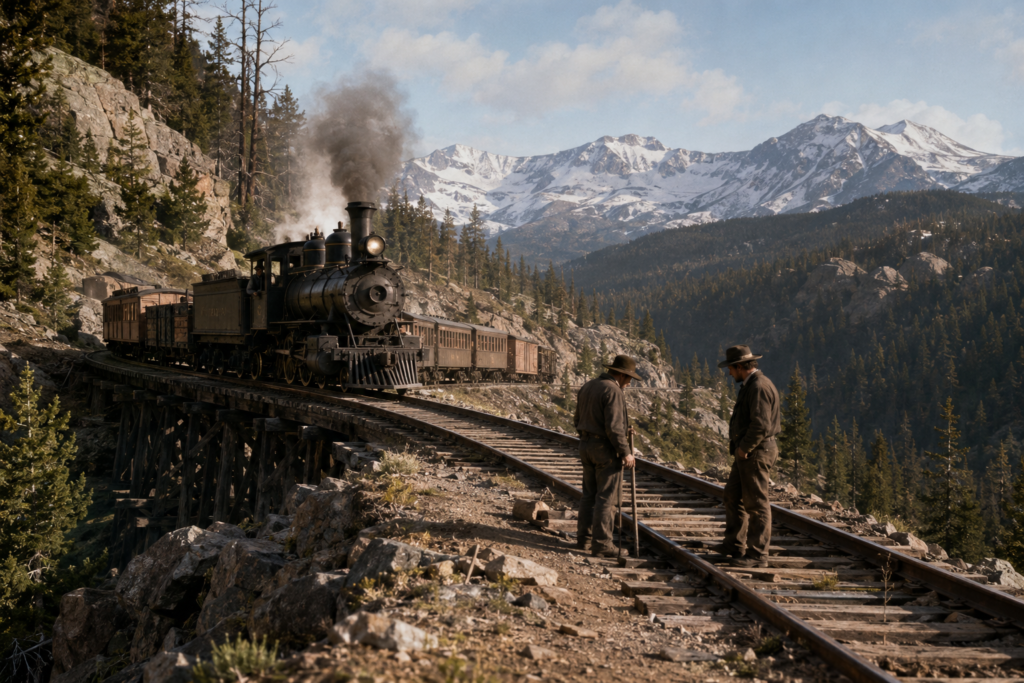
The pass presented the first major Rocky Mountain barrier on the east-to-west route. Trains initially used a temporary summit alignment while crews finished the original tunnel. The roughly 3,600-foot bore opened in January 1884, reducing elevation and improving the operating profile.
Steam locomotives faced steep grades, winter weather, tunnel smoke, and the need for extra power. A newer tunnel opened in 1945 for larger equipment and heavier trains.
The Bozeman Pass railroad corridor remains one of the clearest places to see how geography shaped Northern Pacific operations.
Mullan Pass Rail History and Engineering
West of Helena, the Northern Pacific confronted the Continental Divide again. Mullan Pass required an intricate mountain railroad of sharp curves, heavy grades, high trestles, and a tunnel beneath the summit.
Named for John Mullan, whose military road crossed the northern Rockies, the pass gained its rail crossing and original tunnel in 1883. On the eastern slope, trains climbed grades approaching 2.2 percent—a serious challenge for heavy freight.
Several features made the district famous among railroaders and railfans:
- Mullan Tunnel carried the line beneath the Continental Divide.
- Horseshoe curves stretched the route to control elevation gain.
- Skyline and other trestles crossed steep mountain drainages.
- Helena became a base for helper locomotives assisting heavy trains.
- Snow, smoke, heat, and tight tunnel clearances complicated operations.
Timber structures gave way to steel, track and signaling improved, and the tunnel was enlarged in 2009 for modern freight clearances. Yet the struggle described in Mullan Pass rail history remains visible whenever additional locomotives push a long train toward the summit.
Gold Creek and the Last Spike of 1883
Crews advancing from opposite directions joined the tracks near Independence Creek, close to Gold Creek, on August 22, 1883. The railroad was connected, but Villard planned a grand public ceremony for September 8.
Special trains brought roughly 300 guests, including former President Ulysses S. Grant and visitors from the United States and Europe. Completed track was removed and relaid so the final act could be staged before them.
The event is often called a golden-spike ceremony, but the last spike was not gold. It was an iron spike used in 1870 to mark the start of construction near Carlton, Minnesota. Villard, Grant, and others helped drive it, turning modest iron into a national symbol.
The Gold Creek last spike site marked a through route from the Great Lakes region to the Pacific Northwest. The direct line across Washington’s Cascades would improve later, but Montana’s connection was the defining achievement celebrated in 1883.
How the Railway Reshaped Montana
The Northern Pacific marketed land, promoted immigration, carried livestock and minerals, and linked producers with national markets. Depot towns attracted hotels, elevators, warehouses, newspapers, and banks.
Billings is the clearest example. Planned by railroad interests in 1882 and named for Frederick Billings, it grew into a commercial center. Livingston developed around shops and operations, while Missoula’s facilities shaped its street pattern and industrial geography.
The company also promoted itself as a gateway to Yellowstone, carrying visitors through Livingston and turning western scenery into a national destination.
The benefits were unevenly distributed. Development encouraged settlement and investment while accelerating resource extraction, land transfer, and cultural disruption. Northern Pacific Railway Montana history must hold those consequences beside its celebrated locomotives, depots, and engineering works.
From Northern Pacific to Burlington Northern and BNSF
After another financial crisis, the company was reorganized as the Northern Pacific Railway in 1896. It later became famous for the North Coast Limited and Mainstreeter, while freight remained the Montana route’s economic foundation.
On March 2, 1970, Northern Pacific joined Great Northern, Chicago, Burlington and Quincy, and Spokane, Portland and Seattle to form Burlington Northern. In 1987, Montana Rail Link began operating much of the former Northern Pacific main line under lease.
That arrangement lasted more than three decades. On January 1, 2024, BNSF Railway resumed direct operation. Modern locomotives, unit trains, advanced signaling, and rebuilt infrastructure now occupy a route defined by nineteenth-century surveyors, graders, bridge crews, and steam locomotives.
Northern Pacific Railway Montana history is therefore not a closed chapter. From the Yellowstone Valley to Bozeman Pass, Helena, Mullan Pass, Gold Creek, and Missoula, the old alignment continues to organize movement across the state. Every BNSF freight climbing those grades carries the living legacy of the railroad that joined its rails in Montana in 1883.


