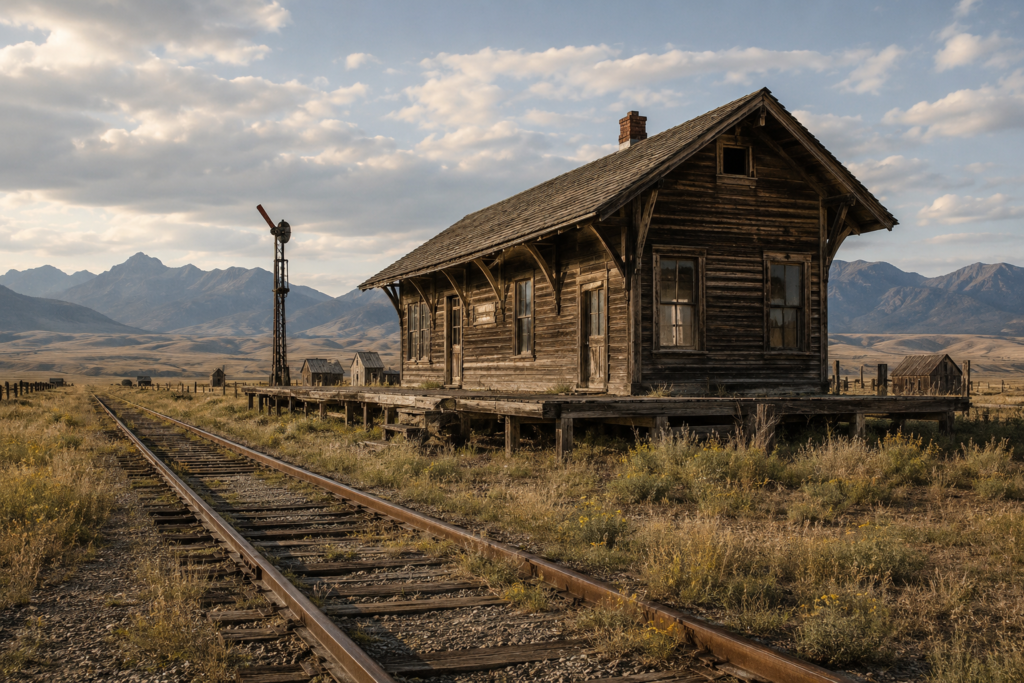
Across Montana’s wide valleys, windswept prairies, and rugged mountain corridors, abandoned train depots stand as quiet witnesses to an era when the railroad determined whether a community would prosper, struggle, or disappear. Some remain recognizable through their weathered platforms and faded wooden walls. Others survive only as foundations beside tracks that no longer carry regular trains.
These buildings were once among the busiest places in their communities. Passengers waited beneath deep roof overhangs, station agents handled telegrams, and freight crews unloaded everything from farm machinery to household supplies. Exploring them today offers a powerful journey into the ambitions, hardships, and everyday lives that shaped Montana.
When the Railroad Depot Was the Heart of Town
During the late nineteenth and early twentieth centuries, a train depot was far more than a passenger shelter. It was a community’s connection to distant markets, government offices, newspapers, relatives, and opportunities.
The station agent often held several responsibilities. He sold tickets, managed freight records, handled mail, received telegraph messages, and communicated with dispatchers. In smaller settlements, the depot might also serve as an informal meeting place where residents gathered to hear news or welcome visitors.
For many towns, the arrival of a railroad represented the beginning of permanent growth. Hotels, grain elevators, warehouses, livestock pens, and stores appeared near the tracks. Streets were sometimes planned around the station rather than around a courthouse or church.
This close relationship between community development and Montana railroad history explains why an abandoned depot can reveal so much about the town surrounding it. Its location, architecture, and remaining features all reflect the economic purpose the railroad once served.
Why So Many Montana Depots Were Abandoned
Montana’s railroad network was built during a period of intense competition. Major companies raced across the state to reach mining districts, agricultural regions, timber country, and Pacific Coast markets.
New routes created towns almost overnight. Yet the same forces that encouraged rapid construction eventually caused many stations to close.
Passenger traffic began declining as automobiles became more affordable and highways improved. Trucks gradually captured freight that had once moved through local depots. Railroad companies consolidated operations, eliminated lightly used branches, and replaced station agents with centralized communication systems.
Some communities lost their depots even though trains continued passing through. Other towns lost the railroad entirely when branch lines were abandoned and the rails removed.
The scattered remains of abandoned train depots in Montana therefore represent more than obsolete transportation infrastructure. They mark major changes in mobility, commerce, technology, and rural population patterns.
The Lonely Stations of Montana’s Open Prairie
Eastern and central Montana contain some of the most evocative depot landscapes in the American West. Long stretches of prairie once supported small stations positioned at regular intervals along transcontinental and regional routes.
A traveler approaching one of these sites may first notice a line of mature cottonwood trees, a raised strip of earth, or pieces of coal-darkened foundation stone. These subtle features can reveal where a station once stood.
Grain, Livestock, and Seasonal Crowds
Prairie depots served farming and ranching communities whose business followed the seasons. Harvest periods brought grain shipments, while livestock movements filled nearby pens with cattle or sheep awaiting transport.
The depot platform became crowded when families traveled to larger towns for supplies, medical care, or social events. New settlers arrived carrying trunks, tools, and expectations of building a life on the northern plains.
When local passenger service ended, the silence arrived gradually. Fewer people waited for trains. Freight business moved elsewhere. Eventually, doors were locked, windows boarded, and the station became a landmark rather than a workplace.
These isolated structures are among Montana’s most emotionally compelling historic railway sites because the open landscape makes their abandonment feel especially visible. A depot that once connected hundreds of residents to the wider nation may now stand miles from the nearest active business.
Ringling and the Memory of a Railroad Town
Ringling offers a striking example of how transportation decisions could shape the destiny of a Montana community. Located in the Smith River Valley, the settlement became associated with the Milwaukee Road and with ranching interests connected to circus entrepreneur John Ringling.
Rail service brought movement and commercial promise to the valley. The station handled passengers, supplies, agricultural goods, and mail. Buildings clustered around the transportation corridor, creating the appearance of a town with a stable future.
But rail-dependent communities were vulnerable. When service declined and the route lost importance, Ringling’s commercial life weakened. Empty buildings and railway remnants began to carry more historical weight than economic purpose.
Today, the area evokes the fragile nature of railroad-created settlement. Its remaining structures illustrate how quickly a once-promising transportation center could become a near ghost town.
Studying places such as Ringling helps visitors understand Montana’s abandoned railway heritage as a human story. The disappearance of regular train service affected families, businesses, postal connections, and the identity of the entire valley.
Maudlow and the Silence of Sixteen Mile Canyon
Few Montana railroad locations feel as remote and dramatic as Maudlow. The former community developed along the Milwaukee Road in Sixteen Mile Canyon, where rails followed a demanding route through steep terrain.
The station supported railroad operations while also serving local residents and nearby agricultural activity. Trains brought supplies into a landscape where overland travel could be slow, difficult, and dangerous during severe weather.
A Corridor Shaped by Engineering
Building through the canyon required careful grading, bridges, cuts, and constant maintenance. Railway workers had to contend with rockfall, flooding, snow, and the limitations imposed by the narrow landscape.
Maudlow’s decline followed the wider retreat of the Milwaukee Road from Montana. Once the trains disappeared, the community lost its principal reason for existing. Nature began reclaiming the route, while abandoned buildings and structural remains became increasingly vulnerable to weather and neglect.
The atmosphere around Maudlow captures the melancholy often associated with forgotten Montana railroad towns. The canyon still carries the physical outline of transportation history, but the sounds of locomotives, telegraph equipment, and platform activity have vanished.
Harlowton and the Legacy of the Milwaukee Road
Harlowton was far larger and more operationally important than many rural station points. It became a major Milwaukee Road center and played a significant role in the railroad’s electrified mountain operations.
The town included yards, maintenance facilities, employee housing, and a substantial depot environment. Railroad employment supported local businesses and shaped daily life for generations.
Harlowton’s significance was closely connected to the Milwaukee Road’s pioneering electrification system. Electric locomotives operated across demanding sections of Montana, offering advantages in mountain territory and giving the route a distinctive technological identity.
When the railroad’s western operations ended, Harlowton suffered a profound economic and cultural loss. Although parts of its railway heritage have received preservation attention, abandoned and altered features throughout the area still communicate the scale of what disappeared.
For preservationists, the community represents an essential chapter in Montana railway preservation. Saving one station building is valuable, but interpreting the surrounding yards, electrical infrastructure, worker neighborhoods, and commercial district creates a much fuller historical picture.
Small Depots Along Forgotten Branch Lines
Not every abandoned depot belonged to a famous transcontinental route. Many served branch lines built to reach mines, timber operations, farms, and isolated communities.
These stations were often modest wooden buildings constructed from standardized railroad plans. A typical depot might contain a waiting room, ticket office, freight room, and living quarters for the station agent’s family.
Their simple appearance can be misleading. A small depot might have coordinated the movement of thousands of animals, handled essential machinery, delivered medicine, and transmitted urgent messages during fires, storms, or accidents.
When a mine closed or agricultural traffic declined, the branch line could quickly become unprofitable. Service was reduced, maintenance was deferred, and abandonment followed. Rails might be lifted and sold, leaving the depot beside an empty grade.
These surviving old Montana train stations show how railroads extended their influence far beyond the state’s major cities. They also demonstrate why seemingly ordinary buildings deserve serious preservation attention.
Reading the Physical Clues at an Abandoned Depot
An abandoned station rarely tells its story through the building alone. The surrounding landscape contains evidence that can help visitors reconstruct how the site functioned.
A long raised area beside the former track may indicate a passenger or freight platform. Concrete blocks can mark the location of water tanks, signal equipment, or loading structures. Dark soil may reveal years of coal handling or locomotive activity.
Nearby foundations might have supported section houses where maintenance workers lived. Depressions in the ground can indicate livestock pens, while parallel grades may show where sidings once allowed trains to pass or freight cars to be stored.
Architectural Details Worth Noticing
Deep eaves protected passengers and freight from snow and rain. Bay windows allowed station agents to observe trains approaching from either direction. Wide freight doors made it possible to move crates, barrels, and machinery between the building and the platform.
Paint layers may reveal a depot’s changing corporate identity. Interior walls can retain traces of ticket windows, telegraph counters, benches, stoves, and segregated workspaces.
Even after decades of abandonment, these details help transform a deteriorating structure into a readable historical document.
The Human Stories Behind Empty Platforms
The most important history of any depot belongs to the people who used it. Station buildings witnessed arrivals, departures, celebrations, separations, and emergencies.
Immigrants stepped onto Montana platforms to begin unfamiliar lives. Soldiers departed for distant wars. Children traveled to school, patients boarded trains for medical treatment, and families waited for relatives they had not seen in years.
Railroad employees worked through bitter winters and long night shifts. Telegraph operators listened for messages that could prevent collisions. Baggage handlers moved heavy trunks, while section crews maintained tracks under physically demanding and sometimes dangerous conditions.
Abandoned depots can appear romantic from a distance, but preservation should not erase the hardship behind them. Railway expansion involved hazardous labor, unequal treatment, corporate conflict, displacement, and environmental change.
Recognizing these experiences gives Montana transportation history greater honesty and depth. The depot becomes not merely a picturesque ruin, but a place where national expansion affected individual lives.
Threats Facing Montana’s Remaining Depot Buildings
Time is not the only danger facing abandoned railroad structures. Roof failure allows moisture to destroy walls and floors. Vandals remove signs, fixtures, hardware, and other features that provide historical context.
Fire is an especially severe threat because many rural depots were built almost entirely from wood. Once a neglected roof collapses or a fire damages the frame, restoration can become prohibitively expensive.
Development creates another challenge. Depot sites often occupy level land near roads and utilities, making them attractive for new construction. Without documentation, historically important foundations and archaeological evidence can disappear during grading.
Relocation may save a building, but it also separates the structure from its original tracks, platform, landscape, and community setting. Preservationists must balance physical survival with the importance of historical location.
How Responsible Visitors Can Protect These Places
Many abandoned depots stand on private property or beside active railroad lines. Visitors should never assume that an unused building is open to the public.
Permission from the property owner is essential. Active tracks must be treated as dangerous transportation corridors, even when trains appear infrequent. Walking on bridges, entering tunnels, or climbing railway equipment can result in serious injury.
Responsible exploration means observing without removing artifacts. A ticket stub, telegraph insulator, nail, sign fragment, or piece of hardware may seem insignificant, but its location can help historians interpret the site.
Photography, written notes, measured observations, and respectful communication with local historical organizations are far more valuable than collecting souvenirs. Sharing accurate information can also encourage preservation before a threatened structure is lost.
Preserving More Than an Empty Building
A successful depot preservation project begins with research and documentation. Historical photographs, railroad maps, employee timetables, property records, and oral histories can reveal how a station changed over time.
Emergency stabilization is often the next priority. Repairing a roof, securing windows, improving drainage, and supporting weakened walls can prevent further deterioration while a long-term plan is developed.
Not every depot must become a formal museum. Some can serve as community centers, visitor facilities, small businesses, trail shelters, or educational spaces. Adaptive reuse gives a building a practical purpose while maintaining its historical character.
Interpretive signs can also preserve stories when complete restoration is impossible. A marked depot foundation, accompanied by photographs and a concise history, can help visitors imagine the movement and energy that once defined the location.
A Journey Through Montana’s Railroad Past
Exploring Montana’s abandoned depots is ultimately an exercise in listening to quiet places. The whistle is gone, the station clock has stopped, and weeds may cover the platform, yet the landscape still holds the pattern of an earlier world.
Each depot tells a different story. Prairie stations recall agricultural settlement and seasonal shipping. Mountain depots reveal the challenges of engineering through difficult terrain. Mining and timber branches preserve memories of industries that rose rapidly and declined just as quickly.
Together, these places form an irreplaceable record of how the railroad transformed Montana. Protecting them allows future generations to understand not only where trains traveled, but how transportation shaped communities, livelihoods, and personal destinies.
An abandoned depot may look empty, but it is never truly without a story. In its worn floors, broken windows, and fading platform edges, Montana’s past is still waiting to be discovered.


