
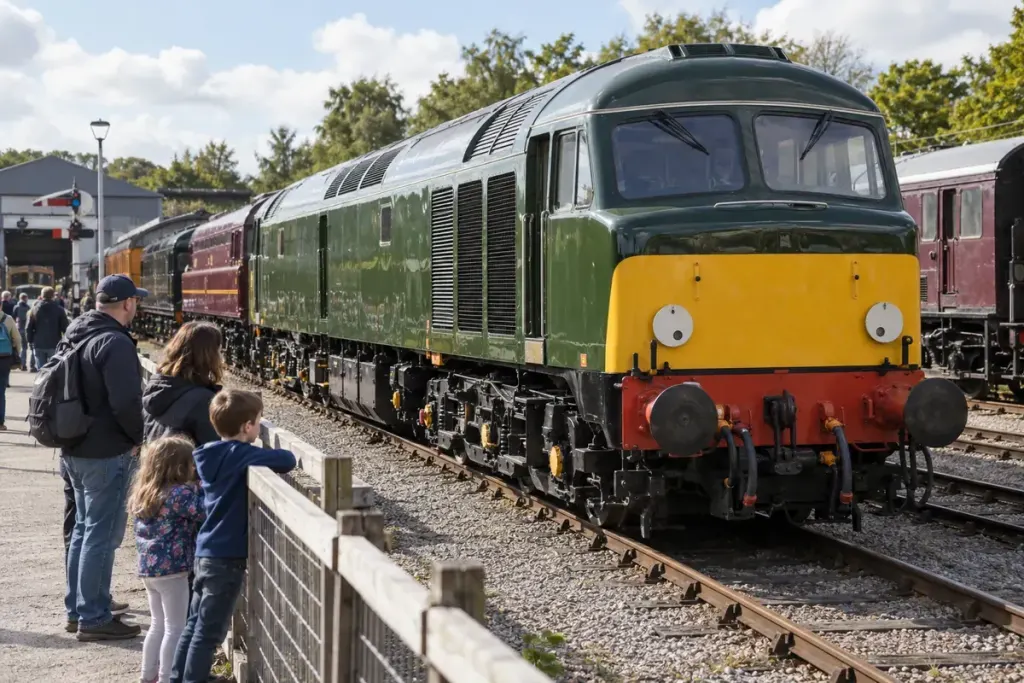
A large diesel engine does not necessarily mean a locomotive has a mechanical transmission resembling a truck’s. In a diesel-electric locomotive, the engine supplies an electrical system that powers traction motors. Following that energy path makes a museum exhibit much easier to understand.
The Swedish Railway Museum’s account of locomotive T41 204 describes the engine driving a generator, with electric motors providing the drive. That is a useful example of the principle, rather than a specification for every diesel locomotive.
Trace the jobs, not just the largest component
Start with the diesel engine: it converts energy from fuel into mechanical rotation. A generator or alternator then converts mechanical energy into electricity. Traction motors convert electrical energy back into mechanical motion at the running gear. Equipment between these stages controls how power reaches the motors.
A display label may name the engine model, electrical equipment and wheel arrangement separately. Read those descriptions as different parts of a system. The most prominent horsepower figure does not, by itself, describe the locomotive’s adhesion, gearing or suitability for a particular train.
Three questions for an exhibit visit
- Which component produces the electricity, and where is it located?
- Which axles are powered on this particular locomotive?
- Does the interpretation describe the locomotive as built, or after a later rebuild?
Draw a simple arrow diagram while reading the exhibit, leaving unknown details blank. This is more useful than filling gaps with features remembered from a newer locomotive. An older museum example and a modern freight engine can share the broad energy path while using different electrical equipment.
When comparing Montana railway photographs, look for an identified class and date before assigning technical details. A locomotive’s paint scheme tells a historical story, but it cannot reveal the entire drive system under its hood.