
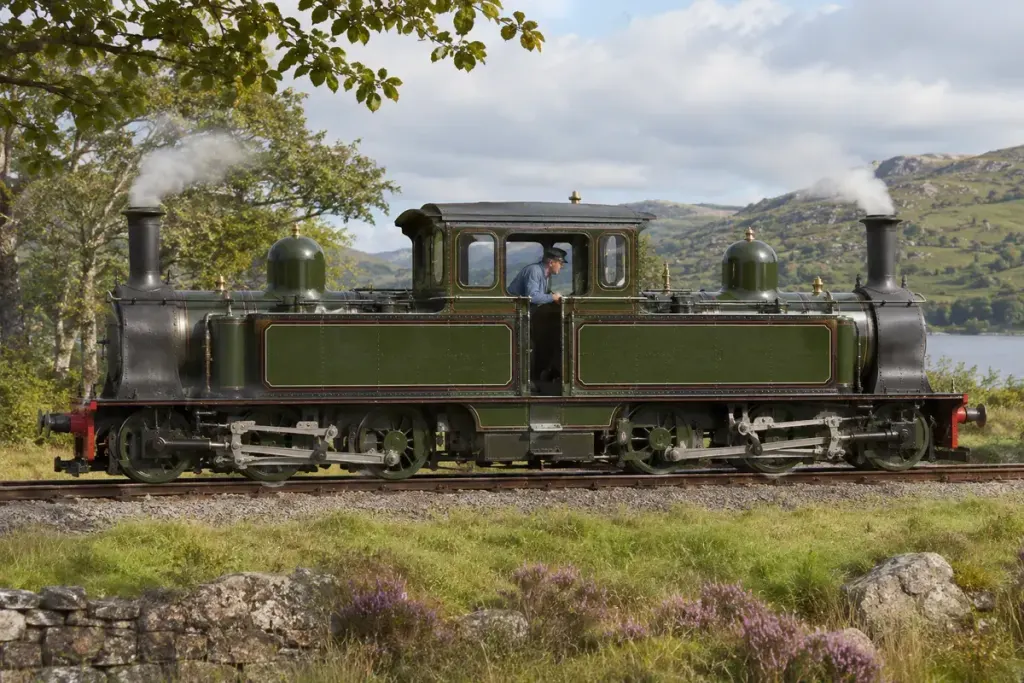
From the side, a double Fairlie can look as though two steam locomotives have been joined back to back. The central cab and a chimney towards each end make it a memorable design, but the arrangement beneath the boiler is just as important.
The Ffestiniog Railway’s own history describes the 1870 demonstration of Little Wonder, which helped establish the Fairlie design on its narrow-gauge line. Its locomotive collection notes identify later examples, including Merddin Emrys, built at Boston Lodge in 1879.
Look for the parts that can turn
The double-ended boiler arrangement sits above two powered bogies. Articulation allows the wheel units to follow curves while supporting the larger locomotive structure. The two-ended appearance is part of an engineering response to the work and track, rather than a decorative symmetry.
Distinguish a double Fairlie from other articulated designs. A Garratt has a different arrangement of boiler and engine units, and a single Fairlie is not simply another name for the double-ended version.
Read a photograph in stages
First locate the cab, chimneys and wheel groups. Then inspect the tanks, outline and nameplate. Finally, compare those details with the railway’s records. A familiar silhouette can identify a design family without identifying the particular locomotive or the date of the photograph.
Rebuilding complicates the story further. A preserved engine may retain a historic name while incorporating later components or alterations. Record what the source actually says about construction and subsequent work instead of treating one date as the age of every visible part.
For a museum notebook, a rough side-view sketch can be more useful than a close photograph of the nameplate alone. Mark the central cab and the two wheel units. That diagram helps preserve the design’s distinguishing feature when several types of steam engine begin to look alike.