The collision of Montana’s mining booms with railroad expansion transformed isolated mountain camps into one of America’s most productive industrial regions. Gold may have drawn the first prospectors, but steel rails made it possible to move machinery, workers, timber, coal, and enormous quantities of ore through a landscape defined by steep grades and punishing winters.
The story of Montana mining railroads history is therefore larger than the familiar image of a steam locomotive pulling wooden ore cars. Railroads determined which mining districts could grow, which smelters received their ore, and which settlements disappeared when mineral production declined.
From the gold diggings of Virginia City and Helena to the copper empire surrounding Butte and Anaconda, trains became the circulatory system of Montana’s mining economy.
Montana’s Gold Rush Began Before the Railroads
Montana’s first major gold discoveries came before railroads reached the territory. Prospectors found gold at Grasshopper Creek near Bannack in 1862, followed by the spectacular Alder Gulch discovery in 1863 and Last Chance Gulch in 1864.
These strikes created Bannack, Virginia City, and Helena almost overnight. Supplies initially arrived by wagon over long, dangerous trails. Heavy equipment moved slowly, freight rates were high, and a broken axle or snowbound mountain pass could interrupt an entire mining operation.
Early placer miners needed relatively simple equipment, including pans, sluice boxes, and shovels. As shallow deposits were exhausted, however, companies began pursuing underground veins and processing lower-grade material.
That change demanded:
- Steam engines and pumps for deep shafts
- Stamp mills and ore-crushing machinery
- Timber for mine supports
- Coal and coke for industrial furnaces
- Reliable transportation to distant smelters
- Affordable shipment of concentrated ore
The original rush had created Montana’s mining settlements, but railroads allowed mining to continue on a much larger and more capital-intensive scale.
For readers exploring the broader history of Montana’s railroads, mining explains why so many lines were pushed toward valleys that otherwise appeared remote and sparsely populated.
Early Montana Gold Rush Train Routes
Railroad construction reached Montana as mining districts were transitioning from frontier camps into permanent commercial centers. The narrow-gauge Utah & Northern Railway entered Montana from the south and reached Butte in December 1881.
Its arrival was a turning point. Butte could now obtain machinery, building materials, fuel, and consumer goods at lower cost. Ore and processed minerals could move outward more efficiently than they had by wagon.
The Northern Pacific completed its main line across southern Montana in 1883. Connections and branch lines gradually tied mining communities to regional markets, while the Montana Central Railway linked Great Falls, Helena, and Butte during the late 1880s.
These were not “gold rush trains” in the cinematic sense of carrying prospectors directly to every dig site. Many famous gold camps had already passed their earliest boom years. Instead, the railroads supported the industrial phase that followed the rush.
They enabled mining companies to work deeper deposits, consolidate smaller claims, and send ore to increasingly specialized reduction works. The development of historic Montana train routes turned mineral wealth that was trapped underground into a commodity that could reach national and international markets.
Helena: From Last Chance Gulch to Railroad Hub
Helena began with the 1864 discovery at Last Chance Gulch. Within a few years, the rough camp had become one of the richest communities in the territory.
Yet Helena’s long-term importance came from more than placer gold. It developed into a banking, supply, and administrative center serving mining districts across west-central Montana.
Rail connections reinforced that role. The Northern Pacific reached Helena by branch, and the Montana Central later created a strategically valuable route connecting the city with Great Falls and Butte.
Trains brought coal, lumber, machinery, food, and manufactured goods into Helena. Outbound freight included ore, concentrates, livestock, and agricultural products from the surrounding region.
Railroad access also encouraged the construction of mills and smelters near dependable transportation. Ore from scattered mountain districts could be collected and processed at larger facilities instead of being treated near every individual mine.
The Helena railroad heritage visible today is inseparable from the capital city’s former role as a financial gateway between mines, reduction works, and national transportation networks.
Virginia City and the Limits of Railroad Expansion
Virginia City presents a different story. Alder Gulch produced one of the greatest gold strikes in the Rocky Mountain West, but geography complicated transportation.
The settlement sat away from Montana’s principal mainline corridors. Roads connected the district to railheads, yet no major common-carrier railroad penetrated Virginia City during its original mining boom.
This absence mattered. Rich placer deposits could initially justify expensive wagon transportation, but lower-grade ore required cheaper movement. Mining districts without direct rail access faced higher costs for fuel, machinery, and shipment.
Virginia City survived as a government and commercial center for a time, but it never developed into a rail-served industrial giant comparable to Butte.
Its experience demonstrates an important truth: railroads did not simply follow successful mines. They also helped determine which districts could remain competitive after the easiest mineral deposits were gone.
Today, Virginia City’s preserved streets reveal the pre-rail phase of Montana’s mining frontier, while nearby transportation corridors show how later development shifted toward communities with better access to national rail systems.
Butte’s Transformation From Gold Camp to Copper Capital
Butte began as a gold and silver district, but copper ultimately defined its identity. By the late nineteenth century, expanding electrical networks across the United States created tremendous demand for conductive copper wire.
The mines beneath Butte contained rich copper deposits, but extracting the metal required an industrial system of extraordinary scale. Shafts descended deeper, pumps removed groundwater, hoists lifted ore, and timber reinforced underground workings.
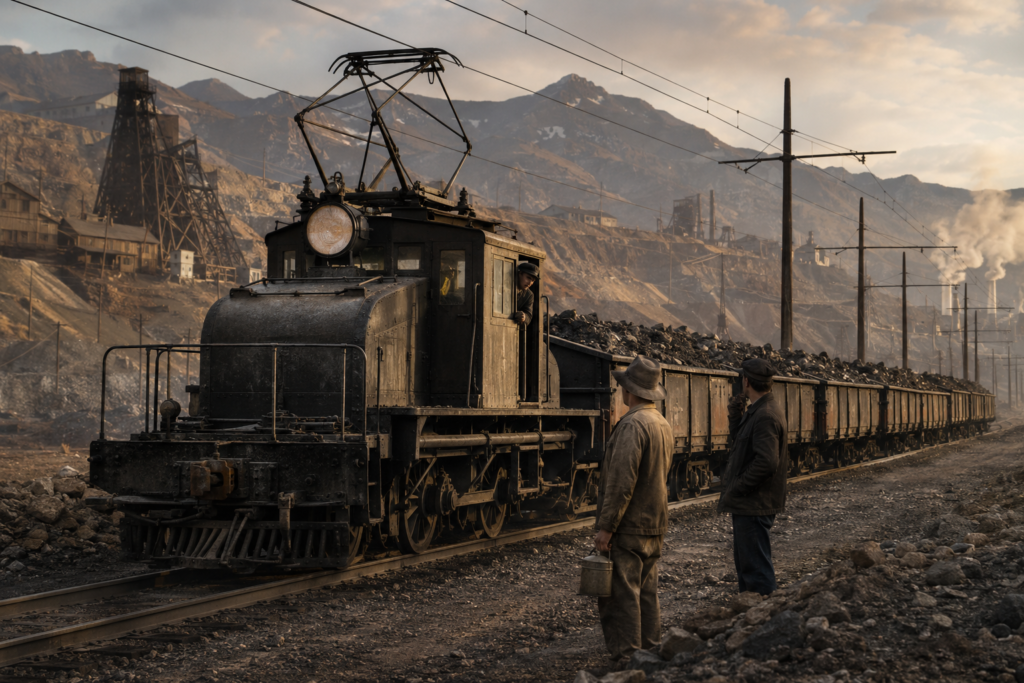
Above ground, locomotives moved ore between mines, concentrators, smelters, warehouses, and interchange yards. Railcars also delivered coal, lumber, explosives, steel, and replacement machinery.
Major national railroads competed for Butte’s freight. The Utah & Northern, Northern Pacific, Montana Central, and later Milwaukee Road all recognized the value of serving the district.
The Butte railroad network became a dense industrial landscape where mainline trains shared the city with mine spurs, switching tracks, ore yards, and company-owned locomotives.
Smoke, steam, metallic dust, and the constant pounding of machinery filled the air. In Butte, the railroad was not merely transportation operating beside the mining industry. It was part of the mine itself.
The Butte, Anaconda & Pacific Railway
The Butte, Anaconda & Pacific Railway was incorporated in 1892 and began operating the following year. Its central purpose was direct and highly profitable: carry copper ore from the Butte mines to the reduction and smelting works at Anaconda.
The railway also transported passengers and general freight, but ore movement remained its defining business. Heavy trains crossed the roughly 26-mile corridor between the mining hill and the smelter complex, with branches and industrial tracks reaching individual facilities.
This vertical integration gave the copper companies greater control over transportation. Instead of relying entirely on outside carriers, they could manage the flow of ore between extraction and processing.
The BA&P handled more than loaded ore cars. Empty cars had to be returned, supplies moved toward the mines, and processed copper traveled outward for connection with larger railroad systems.
Few copper mining rail lines illustrate the relationship between mine, railroad, and smelter as clearly as the BA&P. Its tracks physically joined two communities whose identities were shaped by different stages of the same industrial process.
Early Electrification in the Copper Corridor
In 1913, the Butte, Anaconda & Pacific electrified much of its main operation using a 2,400-volt direct-current system. This made the railway an important early example of heavy-duty railroad electrification in the United States.
Electric locomotives were well suited to the route’s demanding freight service. They provided strong pulling power, rapid acceleration, and efficient operation over repeated runs between mines and smelters.
Electrification offered several practical advantages:
- Electric motors delivered high torque for heavy ore trains
- Regenerative braking could return energy to the electrical system
- Locomotives produced no smoke from onboard combustion
- Faster acceleration improved frequent industrial movements
- Reduced dependence on steam simplified some servicing requirements
- Consistent performance supported tightly scheduled ore transfers
The BA&P’s wires and electric locomotives made Montana’s copper industry look strikingly modern. They also foreshadowed the larger electrification projects later associated with the Milwaukee Road across the northern Rockies.
Anaconda: Where Railcars Fed the Smelters
Anaconda existed because Butte’s ore needed to be processed. Marcus Daly selected the site for a large smelting operation during the 1880s, taking advantage of water, nearby timber, and sufficient space for an expanding industrial complex.
The city became the destination for an almost continuous stream of ore trains. Loaded cars arrived from Butte, while processed copper and industrial byproducts moved outward.
Rail transportation allowed the smelter to operate on a scale impossible with wagon haulage. A disruption on the line could affect production at both ends: mines needed empty cars, and furnaces needed a steady supply of ore.
Anaconda’s industrial landscape included yards, sidings, loading facilities, repair areas, and tracks serving different parts of the reduction works. The railroad coordinated this complicated movement while handling steep grades and immense tonnage.
The enduring remains of the smelting complex and the Anaconda railway corridor show how transportation infrastructure could create an entire city around the processing of minerals extracted somewhere else.
Historic Narrow-Gauge Railroads in Montana
Narrow-gauge construction offered important advantages during the early development of the Mountain West. Tracks with rails closer together could follow sharper curves and sometimes required less extensive grading than standard-gauge lines.
In mountainous mining country, those advantages were attractive:
- Lower initial construction costs
- Tighter curves through confined terrain
- Lighter bridges and smaller earthworks
- Easier penetration of undeveloped districts
- Equipment suited to modest early traffic volumes
The Utah & Northern entered Montana as a three-foot narrow-gauge railway. Its smaller equipment helped push rail service into the territory, but narrow gauge also created problems when freight had to transfer to standard-gauge cars.
As traffic increased, interchange efficiency became more important. The Utah & Northern route was converted to standard gauge in the late 1880s, reflecting a broader movement toward a unified national railroad system.
Short industrial tramways and mine tracks continued to use specialized gauges where convenient. Underground rail systems carried ore cars from working areas to shafts, while surface trackage connected dumps, mills, and loading points.
These small systems rarely possessed the public visibility of a mainline railroad, but they were essential components of Montana’s mineral economy.
How Railroads Changed Mining Communities
The arrival of a railroad often divided mining settlements into winners and losers. A town with a depot, freight yard, or smelter connection attracted businesses and workers. A bypassed camp could lose population even when mineral deposits remained nearby.
Railroads changed daily life by delivering mail, fresh food, manufactured goods, newspapers, and passengers. They also accelerated environmental change.
Locomotives and smelters consumed resources, while industrial tracks expanded across valleys and hillsides. Waste rock, slag, smoke, and contaminated runoff became part of the landscape.
Employment was dangerous. Miners faced cave-ins, blasting accidents, toxic dust, and underground fires. Railroad workers confronted heavy equipment, unstable loads, severe weather, and crowded industrial yards.
The wealth produced by the mines stood beside harsh working conditions and violent labor conflict. Montana’s railways carried copper that helped electrify the nation, but the system depended on workers performing difficult jobs in unforgiving environments.
From Ore Trains to Industrial Heritage
The decline of individual mines, technological change, corporate consolidation, and competition from trucks gradually reduced many traditional mining-railroad operations. Spurs were abandoned, tracks removed, and once-busy loading facilities fell silent.
Some corridors remained active under new ownership or with different traffic, while others became trails, access roads, or overgrown grades. Bridge abutments, catenary foundations, cuts, embankments, and abandoned industrial buildings still reveal where the trains ran.
These remains should be explored responsibly. Much of the property surrounding old mines and rail corridors is private, unstable, contaminated, or still used by active industry.
Preserved equipment, museums, historic districts, and publicly accessible trails offer safer ways to study Montana’s industrial railroad legacy without entering dangerous structures or trespassing.
Montana’s mining railroads did not launch the first gold rushes, but they converted short-lived frontier excitement into a durable industrial system. They carried supplies into isolated districts, moved ore from Butte to Anaconda, linked Helena with regional markets, and demonstrated why geography could limit places such as Virginia City.
The lasting importance of Montana mining railroads history lies in this transformation. Rails turned mineral discoveries into cities, copper veins into national infrastructure, and remote mountain valleys into vital parts of the American industrial economy.


