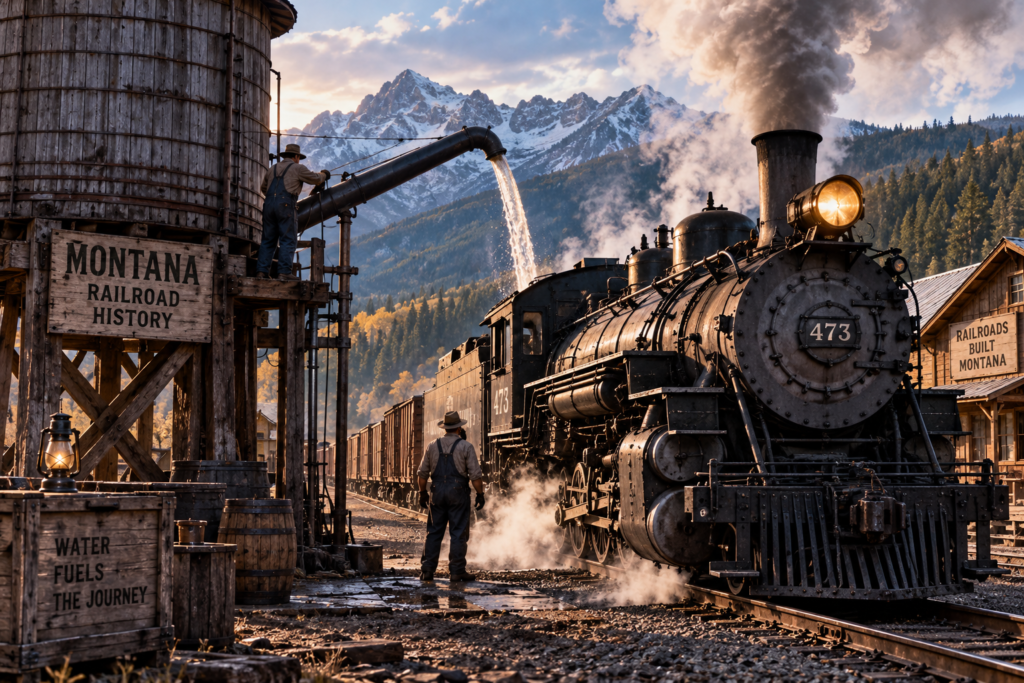
Picture a steam locomotive crossing Montana.
Heavy freight behind it.
Smoke stretching across the sky.
Steel wheels turning steadily over the rails.
From the outside, the machine looks almost unstoppable.
It can pull enormous loads across long distances.
Climb grades.
Cross valleys.
Operate through landscapes where roads were once limited or nonexistent.
And yet there was one surprisingly ordinary thing capable of stopping the entire journey:
water.
A steam locomotive could carry coal or other fuel aboard its tender, but it also needed a substantial supply of water to keep producing steam.
Use enough of that water?
The train had to stop.
That simple requirement influenced railroad infrastructure across the American West, including Montana.
Understanding steam locomotives in Montana therefore isn’t only about famous engines and dramatic photographs. It also means understanding the network of water tanks, pumping systems, wells, reservoirs, pipes, maintenance crews, and stopping points that allowed those locomotives to keep moving.
A Steam Locomotive Was Basically Carrying Its Own Power Plant
Steam locomotives can look mechanically complicated.
And they were.
But the basic principle is surprisingly understandable.
Water enters a boiler.
Fuel creates heat.
The water becomes steam.
Steam pressure helps move pistons.
The pistons transfer motion through rods to the driving wheels.
Train moves.
Simple explanation.
Extremely complicated machine.
Water Wasn’t Just Something Stored for Emergencies
It was continuously used during operation.
The locomotive didn’t fill its boiler once at the beginning of the trip and then carry the same water indefinitely.
Steam production consumed the supply.
As the locomotive worked harder, demand could increase.
Heavy Trains Required Serious Work
Imagine pulling:
freight cars,
passenger cars,
mail,
agricultural products,
timber,
mining materials,
or other heavy loads.
Now add:
grades,
wind,
cold,
and long distances.
The locomotive needed energy to overcome all of that.
Montana Was Not a Flat Railroad Playground
Railroads crossing Montana encountered a wide variety of terrain.
Some stretches were comparatively forgiving.
Others involved:
river valleys,
mountain approaches,
passes,
and significant elevation changes.
A locomotive working hard against a grade could consume resources differently from one rolling across easier terrain.
This Made Infrastructure Planning Important
Railroad companies couldn’t simply say:
“We’ll find water somewhere.”
Routes needed reliable support.
Water availability became an operational concern.
The Tender Carried the Locomotive’s Supplies
Look behind many classic steam locomotives and you’ll see the tender.
This vehicle typically carried essential supplies such as:
fuel
and
water.
Its capacity influenced how far the locomotive could operate before replenishment became necessary.
Bigger Tender, Longer Range?
Generally, carrying more supplies could extend operating range.
But there were practical limits.
Water is heavy.
Fuel is heavy.
Everything added weight.
Railroads therefore had to balance capacity against operating requirements.
Water Is Surprisingly Heavy
A large volume of water represents substantial mass.
So increasing water capacity wasn’t free.
The locomotive had to haul that additional weight everywhere it traveled.
Railroads Solved the Problem With Infrastructure
Instead of trying to carry unlimited water, companies created places where locomotives could refill.
This is where the classic railroad water tank enters the story.
Water Tanks Became Familiar Railroad Landmarks
Historic photographs of railroad settlements often include a tall cylindrical structure beside the tracks.
Sometimes wood.
Sometimes steel.
Often elevated.
That’s not decorative architecture.
It served an essential operational purpose.
Elevation Helped Deliver Water
A raised tank could use gravity to move water quickly into a locomotive tender.
Speed mattered.
Railroads didn’t want trains sitting unnecessarily long while supplies were replenished.
The Spout Was Positioned Beside the Track
A locomotive or tender stopped in the correct location.
The water spout was moved into position.
Water flowed into the tender.
Once filled sufficiently?
The train could continue.
Sounds Easy
Until you ask:
Where did the tank get its water?
Now the story becomes more interesting.
The Tank Needed Its Own Supply
Depending on location and local conditions, railroad water infrastructure might rely on sources such as:
wells,
streams,
springs,
rivers,
reservoirs,
or municipal systems.
Getting water into the tank could require pumping equipment and additional infrastructure.
A Water Tank Was Part of a System
What looks like one simple structure in an old photograph might actually represent:
a water source,
pump,
pipeline,
storage tank,
delivery mechanism,
and maintenance responsibility.
Remove one component?
The locomotive still can’t refill.
Reliability Was Critical
Imagine a freight train arriving with a low water supply.
Tank empty.
Pump broken.
Pipe frozen.
Now what?
Railroad operations depended on these facilities working when needed.
Montana Winters Made Everything More Complicated
Water has one particularly inconvenient property.
It freezes.
And Montana is not exactly famous for tropical winters.
Cold Weather Could Threaten Water Systems
Pipes.
Pumps.
Tanks.
Valves.
Spouts.
All had to function despite harsh conditions.
Railroad infrastructure had to account for seasonal weather.
Steam Locomotives Themselves Faced Winter Challenges
Cold affected more than water stations.
Railroads also dealt with:
snow,
ice,
frozen equipment,
reduced visibility,
and difficult track conditions.
Keeping trains moving required constant preparation.
Water Stops Were Only One Piece of a Larger Support Network
Steam railroads required much more infrastructure than:
rails
and
stations.
They needed facilities supporting locomotives themselves.
Think About What a Steam Locomotive Required
Fuel.
Water.
Lubrication.
Inspection.
Repairs.
Cleaning.
Crew attention.
Mechanical servicing.
A railroad route was therefore supported by strategically placed facilities.
Some Locations Became Important Because Trains Needed Service
Not every railroad stopping point existed because large numbers of passengers lived there.
Some places mattered because the railroad needed:
water,
fuel,
crew changes,
maintenance,
or operational control.
That’s an Important Way to Read Railroad History
See a small settlement beside an old rail line?
Don’t immediately ask:
“Why would the railroad stop here?”
Instead ask:
“What did the railroad need here?”
The answer may explain the location.
Water Could Influence Stop Spacing
A steam locomotive could only travel so far before needing more water.
Exact range varied with many factors.
Locomotive design.
Tender capacity.
Train weight.
Terrain.
Speed.
Weather.
Operating practices.
Because of those variables, water facilities had to be placed where they were operationally useful.
A Mountain Grade Could Change the Equation
Imagine two stretches of railroad with equal distance.
Route A:
mostly gentle terrain.
Route B:
long climb.
Same distance doesn’t necessarily mean identical resource use.
A locomotive working hard may consume steam—and therefore water—more aggressively.
This Made Geography Part of Mechanical Planning
Railroad engineering wasn’t only about finding a route where tracks could physically fit.
Companies had to think about how locomotives would actually operate over that route.
Could they climb?
Could they be supplied?
Could they be serviced?
Rivers Were Valuable Transportation Corridors
Railroads often followed river valleys for practical geographic reasons.
Valleys could provide more manageable grades than forcing routes directly across difficult terrain.
Water access could also be useful, though obtaining suitable locomotive water still required planning and infrastructure.
Not All Water Was Equally Friendly to Boilers
Here’s where the story gets less obvious.
A locomotive didn’t simply need:
wet water.
Water chemistry mattered.
Minerals Could Create Problems
Water containing dissolved minerals could contribute to scale inside boilers.
Scale is not something you want accumulating inside equipment responsible for producing high-pressure steam.
Scale Reduced Efficiency
Mineral deposits could interfere with heat transfer.
That meant more fuel might be required to achieve the same result.
Over time, deposits could also contribute to maintenance problems.
Water Treatment Became Important
Railroads therefore paid attention not only to:
how much water was available,
but also:
what kind of water it was.
Treatment methods could help reduce undesirable effects.
Boiler Maintenance Was Serious Business
Steam locomotives operated under high pressure.
Boiler condition was a major safety and performance concern.
Inspection and maintenance weren’t optional details.
Poor Water Could Increase Maintenance Demands
Imagine repeatedly sending mineral-rich water through a boiler.
Day after day.
Trip after trip.
Deposits accumulate.
Cleaning and treatment become part of operating economics.
Water Quality Could Vary by Location
A railroad crossing a large state could encounter very different local water conditions.
That meant operating practices sometimes needed to reflect geography.
This Is a Hidden Part of Railroad Engineering
When people admire historic railroads, they naturally focus on visible achievements:
bridges,
tunnels,
locomotives,
depots.
But operational success often depended on less glamorous questions.
Where do we get water?
Is it usable?
Can we pump enough?
Will the system work in January?
Railroad History Is Full of Problems Like This
Transportation systems succeed because thousands of ordinary problems are solved repeatedly.
The spectacular locomotive gets photographed.
The person maintaining the pump?
Less famous.
Still essential.
Water Stations Needed People
Infrastructure doesn’t maintain itself.
Workers might need to:
inspect equipment,
repair leaks,
maintain pumps,
keep tanks functional,
and respond to weather-related problems.
Small Railroad Jobs Supported Big Movements
A train carrying enormous economic value could depend on a worker maintaining one piece of infrastructure in a remote location.
That’s an interesting contrast.
Massive system.
Tiny point of failure.
Railroads Were Networks of Dependency
Track problem?
Train stops.
Signal problem?
Operations affected.
Water problem during the steam era?
Locomotive affected.
Transportation networks work because many components function together.
Water Towers Became Symbols Almost Accidentally
Today, old railroad water tanks can feel nostalgic.
They look unmistakably historic.
But originally?
They were practical industrial equipment.
Nobody built them primarily because they looked good in black-and-white photographs.
Function Created the Architecture
Large storage capacity.
Height for gravity.
Access beside the track.
Weather resistance.
Maintenance access.
Form followed operational need.
Wood Was Common in Early Railroad Structures
Historic water tanks were often constructed with wood.
Wood was available and could be assembled into large storage structures.
But maintaining a large wooden tank presented obvious challenges.
Water Finds Weaknesses
Tiny gap?
Leak.
Aging material?
Leak.
Freeze damage?
Potential problem.
Keeping water contained requires constant attention.
Steel Tanks Became Another Familiar Form
As railroad infrastructure evolved, steel water tanks became increasingly visible in many places.
Different railroads and eras used different designs.
The infrastructure changed alongside technology.
Some Tanks Served More Than Locomotives
Railroad water systems could sometimes support surrounding railroad facilities or settlements depending on local circumstances.
Infrastructure built for transportation could influence life beyond the tracks.
Railroads Sometimes Created Their Own Utility Systems
Remote railroad locations couldn’t always depend on established municipal infrastructure.
Companies might need their own:
water,
communications,
housing,
maintenance facilities,
and power-related systems.
A railroad could function almost like a narrow industrial settlement stretched hundreds of miles along the tracks.
That’s Why Old Railroad Sites Can Contain More Than Rails
Explore historic maps or photographs and you may encounter labels for:
water tanks,
section houses,
depots,
roundhouses,
coal facilities,
stockyards,
sidings,
and other structures.
Each tells you something about how the railroad operated.
The Track Was Only the Skeleton
The supporting facilities made the system usable.
A line of steel rails alone couldn’t maintain regular steam-era transportation.
Fuel Stops Were Another Major Requirement
Water wasn’t the only consumable.
Steam locomotives also needed fuel.
Depending on railroad, location, and era, coal was especially important in many operations.
Montana Had Strong Connections to Coal
Railroad development and extractive industries often intersected.
Coal could be both:
something railroads consumed
and
something railroads transported.
That created an interesting economic relationship.
Trains Hauled the Resource That Helped Power Trains
Coal moved by rail.
Railroads burned coal.
Rail networks helped mining industries reach broader markets.
Transportation and resource development reinforced one another.
Fuel and Water Facilities Could Make Certain Locations Operationally Important
A place where locomotives could:
refuel,
take water,
be inspected,
or receive repairs
could become an important railroad point even without a huge civilian population.
Some Railroad Towns Grew Around Operational Necessity
Workers needed somewhere to live.
Families arrived.
Businesses appeared.
Services developed.
What began as railroad infrastructure could contribute to settlement growth.
But Not Every Water Stop Became a Town
Important distinction.
Some facilities remained relatively isolated.
A train needed the water.
That didn’t necessarily mean hundreds of people needed to live there.
Technology Determines Geography More Than We Notice
Today, a modern vehicle can travel long distances between fuel stops.
Electric transportation creates another geography around charging.
Steam railroads created their own geography around:
water
and
fuel.
Every Transportation Technology Has Its Infrastructure Map
Horse travel:
water and rest.
Steam railroad:
water and fuel.
Automobile:
gas stations and roads.
Commercial aviation:
airports and fuel infrastructure.
Electric vehicles:
charging networks.
Technology changes.
Infrastructure follows.
Then Infrastructure Changes Human Movement
Once those networks exist, people organize travel around them.
Transportation infrastructure doesn’t merely serve geography.
Eventually, it helps shape geography.
Steam-Era Railroad Maps Can Be Read Differently With This in Mind
Instead of seeing only:
Point A
and
Point B,
look at what exists between them.
Why siding here?
Why railroad structure there?
Why small settlement at this location?
Operational needs may provide clues.
Grades Are Especially Worth Examining
Railroad grades reveal how much work locomotives faced.
A steep section could influence:
train length,
locomotive assignment,
helper operations,
speed,
and resource consumption.
Helper Locomotives Added Another Layer
On difficult grades, additional locomotives could assist heavy trains.
More locomotives?
More machines consuming:
fuel
and
water.
Mountain railroading increased logistical complexity.
Imagine Coordinating a Heavy Freight Movement
Main locomotive.
Possibly helper power.
Crew.
Water.
Fuel.
Track availability.
Weather.
Mechanical condition.
Schedule.
What looks like:
“train goes uphill”
is actually an operational system.
Water Consumption Was Visible in the Landscape
A steam locomotive working hard could produce dramatic clouds of exhaust and steam.
The visual spectacle was connected to continuous energy conversion happening inside the machine.
Smoke and Steam Aren’t the Same Thing
Historic locomotive images often show dramatic plumes.
Part of what viewers see may come from combustion exhaust, while steam can also be visible in various operating circumstances.
The locomotive’s appearance reflects multiple processes occurring at once.
The Boiler Was Constantly Managing Water and Steam
Crew members had to pay close attention to locomotive conditions.
Water level inside the boiler was especially important.
Running Low Was Not Simply an Inconvenience
A steam locomotive boiler depended on maintaining appropriate water levels.
Operating a boiler improperly could create serious hazards.
This is one reason locomotive crews required substantial knowledge and experience.
The Engineer Wasn’t Driving a Giant Car
Steam locomotive operation involved understanding:
steam pressure,
throttle use,
braking,
grade,
speed,
train handling,
and mechanical behavior.
The Fireman Had Critical Responsibilities Too
On coal-fired locomotives, maintaining an effective fire was demanding work.
Fuel had to support the steam production required by the locomotive.
Steam Production Was a Balancing Act
Too little steam?
Not enough power.
Operating inefficiently?
Waste fuel and water.
Crew skill affected performance.
Experienced Crews Learned Their Routes
They knew:
grades,
curves,
stations,
water points,
signals,
and operational challenges.
A route wasn’t simply coordinates on a map.
It was learned physically through repeated operation.
Crews Knew Where Resources Were Available
Imagine driving across Montana without a fuel gauge and simply hoping a gas station appears.
Not ideal.
Railroad crews and dispatching systems operated with knowledge of the facilities along the route.
Scheduling Could Reflect Service Needs
A locomotive might need more than passenger boarding time at certain stops.
Operational activities could occur simultaneously:
water,
fuel,
inspection,
crew-related work.
Passenger Experience Hid Much of This Work
Passenger sits inside.
Reads newspaper.
Looks through window.
Meanwhile railroad employees are maintaining the machine and infrastructure making the trip possible.
The Best Infrastructure Often Becomes Invisible
When it works?
Nobody notices.
Water available.
Train serviced.
Journey continues.
When it fails?
Suddenly everyone notices.
That’s true of infrastructure today too.
Steam Locomotives Created Frequent Interaction With the Landscape
Modern diesel locomotives generally operate with very different servicing requirements from steam engines.
Steam locomotives needed more frequent attention.
This made support facilities especially prominent.
Dieselization Changed the Railroad Landscape
When railroads transitioned away from steam power, many steam-specific facilities became unnecessary.
Water tanks.
Coaling structures.
Some servicing facilities.
Their operational purpose disappeared.
Infrastructure Can Become Obsolete Very Quickly
Imagine a structure essential for decades.
Then locomotive technology changes.
Suddenly?
Nobody needs it.
This is one reason many steam-era structures vanished.
Some Were Demolished
No longer useful.
Maintenance costs money.
Land can serve another purpose.
Structure disappears.
Others Were Simply Abandoned
Time takes over.
Wood deteriorates.
Metal rusts.
Vegetation grows.
Eventually only fragments remain.
A Few Survived
Preservation efforts, museums, historical organizations, private owners, or simple luck allowed some steam-era structures to remain.
These survivors are valuable because they show the physical scale of railroad operations.
An Old Water Tank Tells a Bigger Story Than It Seems
At first glance:
big container.
Look deeper:
locomotive technology,
railroad logistics,
local water supply,
maintenance work,
weather,
settlement patterns,
and technological change.
One structure can connect many parts of history.
Historic Photographs Become More Interesting Once You Know What to Look For
Next time you see a steam-era railroad photograph, don’t look only at the locomotive.
Scan the background.
Look for the Water Tank
Tall structure beside track.
Possibly with visible spout.
Where is it positioned?
How close to station?
Look for Fuel Facilities
Coal towers.
Fuel storage.
Other servicing equipment.
These indicate how locomotives were supported.
Look for Multiple Tracks
Main line.
Sidings.
Yards.
Service tracks.
Track arrangement can suggest what happened at the location.
Look for Maintenance Buildings
Roundhouses and engine houses can indicate significant locomotive servicing activity.
A small depot tells one story.
A large engine facility tells another.
Look at the Terrain
Mountain nearby?
River?
Valley?
Open plains?
Geography helps explain why railroad infrastructure was located where it was.
Compare Old Maps With Modern Maps
A modern road may hide the logic of the old railroad.
Historic maps can reveal:
sidings,
abandoned routes,
water facilities,
and settlements that no longer exist.
Place Names Can Preserve Railroad History
Sometimes a location remains on maps long after the original reason for its importance disappeared.
Researching why a place exists can lead directly into transportation history.
Abandoned Grades Can Still Reveal Routes
Even when tracks are gone, the landscape may preserve:
cuts,
embankments,
bridge approaches,
and other traces.
But remember:
historic railroad property can cross private land.
Respect Property and Safety
Don’t assume abandoned railroad infrastructure is public.
Old structures can also be unstable.
Observe from legal, safe locations and follow local access rules.
History isn’t worth trespassing or getting injured.
Museums Can Help Decode Railroad Equipment
A preserved water tank means more when you understand how it functioned.
Museums and historical displays can provide context for:
locomotives,
tools,
railroad structures,
and crew work.
Ask Operational Questions
When studying an old railroad site, ask:
Where did locomotives get water?
Where did they get fuel?
Where were they repaired?
Where did crews work?
Where did trains pass each other?
These questions reveal the railroad as a system.
Don’t Study Only the Famous Locomotives
Railroad history naturally celebrates iconic engines.
Understandably.
They’re impressive.
But the locomotive was one component.
Study the Ordinary Equipment Too
Water tank.
Signal.
Switch.
Tool shed.
Section house.
Pump.
These objects explain how the railroad functioned every day.
Ordinary Infrastructure Often Tells Better Daily-Life Stories
A famous locomotive might appear once.
A water tank served train after train.
Day after day.
Year after year.
Its history is repetitive.
That’s exactly why it matters.
Think About the Worker Behind Every Structure
Someone inspected it.
Someone repaired it.
Someone operated it.
Someone noticed when it wasn’t working correctly.
Infrastructure history is also labor history.
Railroad Labor Extended Far Beyond Train Crews
Engineers and conductors are visible.
But railroads also depended on:
maintenance workers,
shop employees,
track crews,
station staff,
signal workers,
and many other roles.
The railroad was an enormous coordinated workforce.
Remote Infrastructure Increased the Challenge
Montana’s distances could place facilities far from major population centers.
Maintaining equipment across a large territory required organization.
Supplies Had to Reach the Facilities Too
A water station needed:
parts,
tools,
maintenance materials.
Workers needed support.
Infrastructure created its own logistical needs.
The Railroad Supplied the Railroad
That’s one of the fascinating things about rail networks.
Trains could transport:
fuel,
replacement materials,
equipment,
and workers
needed to keep the railway operating.
The network supported itself.
Water Was Also Connected to Fire Risk
Steam locomotives burning fuel produced sparks and hot material.
In dry environments, railroad operations could present fire concerns.
Railroads had to manage another relationship with the landscape:
fire.
Montana’s Seasons Changed Operating Conditions
Winter brought one set of problems.
Dry periods could bring another.
Railroad operations had to adapt continuously to environmental conditions.
This Is Why Transportation History Is Environmental History Too
Railroads didn’t operate outside nature.
They crossed:
rivers,
forests,
grasslands,
mountains,
snow,
heat,
and water systems.
Engineering was partly the process of negotiating with those conditions.
Water Was Both Resource and Obstacle
Railroads needed water for steam locomotives.
But rivers also created engineering challenges.
Need to cross?
Build bridge.
River floods?
Potential damage.
The same landscape feature could help and complicate operations.
Mountain Snow Was Similar
Water in frozen form.
Beautiful in photographs.
Operationally?
Potentially serious.
Snow removal became another major part of railroad work in certain areas.
The Romantic Image Hides the Maintenance
Steam locomotive crossing snowy Montana landscape.
Beautiful.
What the photograph doesn’t show:
workers keeping the line open.
That’s often the difference between railroad nostalgia and railroad history.
Nostalgia Focuses on the Journey
History asks:
How was the journey made possible?
Water tanks are part of that answer.
The Steam Era Required Constant Servicing
Modern observers sometimes imagine locomotives simply running continuously.
In reality, steam power demanded considerable attention.
Fuel.
Water.
Lubrication.
Ash removal.
Inspection.
Repairs.
Ash Had to Go Somewhere
Burn fuel.
Material remains.
Railroad facilities had to manage combustion waste as well.
Again:
another piece of infrastructure.
Engine Terminals Could Be Busy Industrial Environments
Locomotives arriving.
Crews working.
Fuel being loaded.
Water supplied.
Repairs performed.
Engines turned or reassigned.
The romantic steam locomotive existed within an industrial workplace.
Roundhouses Supported Locomotive Maintenance
At important terminals, roundhouses allowed locomotives to be inspected and serviced.
Turntables could position locomotives onto different tracks.
These facilities represented substantial railroad investment.
Compare That With a Simple Water Stop
One location:
major shop complex.
Another:
tank beside the main line.
Different infrastructure reflected different operational roles.
Not Every Stop Was Equal
Passenger station.
Freight station.
Junction.
Water stop.
Division point.
Maintenance location.
Railroad geography had its own hierarchy.
Understanding Function Makes Maps More Meaningful
Without context, a dot is a dot.
With operational history, you can ask:
Why did trains stop here?
Why was this place important?
Why did it decline?
Technology Can Explain Decline
Suppose a settlement depended heavily on steam locomotive servicing.
Then diesel locomotives arrive.
They don’t need the same infrastructure.
Traffic patterns change.
Jobs change.
The local economy can change too.
Dieselization Was More Than an Engine Swap
It affected:
maintenance,
labor,
facilities,
operating practices,
and railroad landscapes.
The disappearance of water tanks is one visible symbol of a much larger transformation.
Diesel Locomotives Could Operate Differently
They did not require the same frequent boiler-water replenishment as steam locomotives.
That allowed railroads to rethink servicing infrastructure.
Old Water Stops Lost Their Purpose
Tank no longer needed.
Pump no longer needed.
Employees may no longer be needed there.
A once-essential point could become operationally insignificant.
Railroad Maps Simplified in New Ways
Infrastructure built around steam-era limitations could be reduced, relocated, or abandoned.
Technological change reshaped the network.
That’s Why Preserved Steam Infrastructure Matters
A surviving water tank isn’t just:
“old railroad stuff.”
It’s physical evidence of how transportation technology once organized movement across enormous distances.
Imagine the Route Without It
Locomotive approaches.
Tender low.
No water facility.
Train cannot simply continue indefinitely.
Suddenly the importance becomes obvious.
Infrastructure Is Most Visible When You Remove It Mentally
Road without fuel stations.
Airport without fuel.
City without electricity.
Steam railroad without water.
The network stops working.
A Water Tank Could Determine Whether a Train Continued
That’s an enormous responsibility for something that looks so ordinary.
The Railroad Was Only as Strong as Its Support System
Powerful locomotive?
Excellent.
But power without:
fuel,
water,
track,
maintenance,
and trained crews
doesn’t move freight.
This Changes How We Think About “Power”
The locomotive looks powerful because it is.
But its strength depended on a network.
The same is true of most industrial technology.
Big Machines Depend on Small Systems
Valve.
Pump.
Pipe.
Tank.
Track switch.
Signal.
One small failure can affect something enormous.
That’s engineering reality.
Railroad History Rewards Looking Beyond the Main Subject
See locomotive?
Look behind it.
See station?
Look beside it.
See town?
Look at why it’s there.
See abandoned structure?
Ask what problem it once solved.
That’s how ordinary objects become historical evidence.
FAQ
Why did steam locomotives need so much water?
Steam locomotives heated water in a boiler to produce the steam used to generate mechanical power. Because water was continuously consumed during operation, locomotives needed regular replenishment.
Where did steam locomotives get water in Montana?
Railroads built water facilities along their routes. Depending on the location, these systems could draw from wells, rivers, streams, springs, reservoirs, or other available water supplies.
Why were railroad water tanks elevated?
Elevating the tank allowed gravity to help deliver water quickly through a spout into the locomotive tender.
Did terrain affect how often steam locomotives needed water?
Yes. Water consumption could vary according to locomotive design, train weight, operating conditions, grades, speed, weather, and other factors. Hard-working locomotives could consume resources more rapidly.
Why was water quality important to steam railroads?
Minerals and other characteristics of local water could contribute to scale and other boiler-related issues. Railroads therefore had reasons to monitor and, where necessary, treat locomotive water.
What happened to railroad water towers after steam locomotives disappeared?
Many lost their original purpose during dieselization. Some were demolished or abandoned, while others survived through preservation, reuse, or historical conservation.
Why are old railroad water tanks historically important?
They provide physical evidence of how steam-era railroads operated. They can reveal information about locomotive servicing, route logistics, local water resources, railroad labor, and technological change.
Conclusion
A steam locomotive rolls across Montana.
Massive.
Loud.
Powerful enough to pull thousands of tons.
It looks like the dominant force in the landscape.
Then it stops beside a wooden tank.
Why?
Water.
That’s what makes railroad history interesting.
The largest machines often depended on the simplest things.
A pump had to work.
A tank had to hold water.
A pipe couldn’t freeze.
Someone had to inspect the equipment.
Someone had to maintain it.
And the facility had to be positioned where locomotives could reach it before their supply became a problem.
Without those systems, the dramatic locomotive photographs we remember wouldn’t represent a functioning railroad.
They’d represent machines that couldn’t travel very far.
So when you look at an old Montana railroad photograph, don’t focus only on the locomotive.
Look behind it.
Find the tank.
The service track.
The pump house.
The workers.
The pieces nobody thought were glamorous enough to become famous.
Because those ordinary pieces tell us something essential about the steam era:
the locomotive may have pulled the train, but an entire hidden infrastructure kept the locomotive alive.
