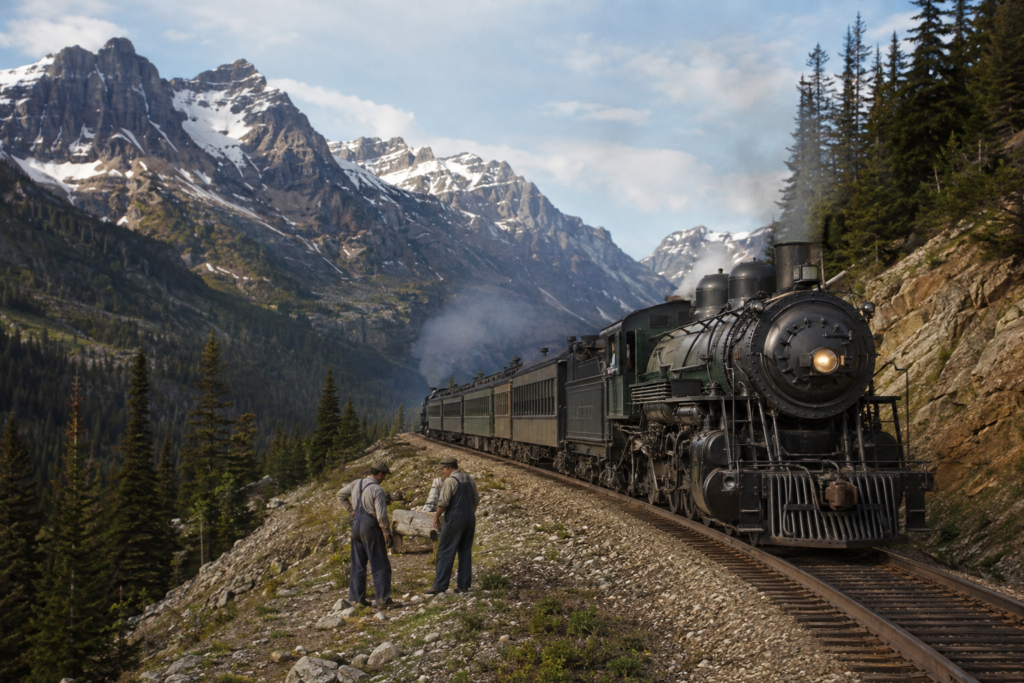
The Great Northern Railway pushed across northern Montana in the early 1890s, laying steel through open prairie, river valleys, and the formidable Rocky Mountain Front. Its arrival transformed scattered settlements into rail towns, opened distant markets to farmers and merchants, and created a transportation corridor that still carries trains across the state today.
At the center of the story was James J. Hill, the hard-driving Canadian American executive known as “The Empire Builder.” Unlike many railroad promoters of his generation, Hill constructed his transcontinental system without accepting federal land grants. He relied instead on private capital, careful route planning, and the conviction that a railroad could prosper only if the territory around it prospered as well.
The result was a distinctive chapter in Great Northern Railway Montana history—one shaped by commercial ambition, mountain engineering, settlement campaigns, and the deliberate creation of Glacier National Park as a major railway tourism destination.
James J. Hill and the Railroad Built Without Federal Land Grants
James Jerome Hill did not begin with a transcontinental empire. During the 1870s, he worked in transportation and trade around St. Paul, Minnesota, learning how freight moved between farms, rivers, warehouses, and rail terminals.
Hill and his partners eventually gained control of the financially troubled St. Paul and Pacific Railroad. They rebuilt its operations and expanded westward, forming the network that became the Great Northern Railway in 1890.
His strategy differed from the speculative methods associated with several earlier transcontinental projects. Hill refused federal land grants, which meant the Great Northern could not simply depend on selling government-provided acreage to finance construction. Its routes had to be chosen with operating efficiency and future traffic in mind.
This financial independence became central to Hill’s public reputation. It also encouraged an intense focus on grades, curves, locomotive efficiency, and regional development. For readers exploring the broader history of Montana railroads, the Great Northern stands out as both a transportation system and a privately financed settlement enterprise.
Hill understood that empty territory produced little freight. His agents promoted northern Montana to farmers, ranchers, merchants, and immigrants. The railway distributed information about soil, climate, crops, and available communities, hoping every new homestead would generate shipments in both directions.
Building the Great Northern Across Montana
The Great Northern entered Montana from the east and followed a path across the state’s northern tier. Construction crews worked through a landscape that appeared open and level from a distance but presented serious logistical difficulties.
Supplies had to be delivered across sparsely settled country. Water was not always available where steam locomotives needed it. Severe winter temperatures damaged equipment and slowed construction, while spring mud could make wagon roads nearly impassable.
The railway followed the Milk River across much of eastern and north-central Montana. This alignment offered relatively manageable grades while connecting emerging communities near the Canadian border.
Track reached key points with remarkable speed. Towns appeared beside sidings, water tanks, depots, and division facilities. Some settlements already existed, but the railroad reorganized their economic lives around train schedules and freight movement.
The expanding line formed the backbone of what would become the northern Montana railway corridor. Grain, livestock, timber, mail, manufactured products, and passengers all moved through communities that were suddenly tied to regional and national markets.
Key Milestones in Great Northern Railway Montana History
Several decisive events turned Hill’s northern route from an ambitious construction project into a durable transcontinental system.
In 1887, the railway interests controlled by Hill reached Great Falls. The city’s location near the falls of the Missouri River offered industrial potential and access to central Montana commerce.
By 1890, the Great Northern Railway name had been adopted. Construction continued westward across the plains while engineers searched for the most practical passage through the Rocky Mountains.
In December 1891, John F. Stevens located the long-sought crossing at Marias Pass. Rails passed through the route the following year, allowing the main line to continue toward the Flathead Valley and the Pacific Northwest.
In January 1893, the transcontinental line was completed near Scenic, Washington. The Great Northern now connected the Great Lakes region with Puget Sound through a continuous route controlled by Hill’s company.
Passenger operations later received a powerful identity with the introduction of the Oriental Limited in 1905 and the Empire Builder in 1929. Meanwhile, the railway’s tourism campaigns helped make Glacier National Park internationally recognizable.
John F. Stevens and the Marias Pass Rail Route
The Rocky Mountain crossing presented the greatest engineering question on the Montana main line. The railway needed a route low enough to reduce operating costs but direct enough to keep construction and travel distances under control.
John Frank Stevens, an engineer who later became prominent for his work on the Panama Canal and other major projects, was assigned to locate the passage. Working with limited maps and difficult winter conditions, he explored the Rocky Mountain Front in 1891.
Stevens confirmed that Marias Pass offered the practical crossing Hill needed. At approximately 5,200 feet above sea level, it was substantially lower than many alternative passages through the northern Rockies.
The discovery was crucial. A lower crossing reduced the severity of grades, although the route still required heavy locomotives, snow-fighting equipment, and constant maintenance. The Marias Pass rail route became one of the most strategically important mountain segments in American railroading.
Its key advantages included:
- A comparatively low elevation through the Continental Divide
- A direct connection between the plains and the Flathead Valley
- More economical freight movement than steeper alternatives
- Access to the southern boundary of present-day Glacier National Park
- Long-term value as a passenger and transcontinental freight corridor
The pass was never an easy environment. Deep snow, avalanches, high winds, rockfalls, and extreme cold demanded vigilance. Snow sheds, rotary plows, maintenance crews, and operating rules all became part of daily life along the mountain line.
Havre, Whitefish, and the Railway Town Network
Great Northern operations depended on carefully positioned division points where locomotives could be serviced, crews changed, trains assembled, and freight transferred.
Havre became one of the most important railway centers in northern Montana. Its roundhouse, yards, repair facilities, and workforce tied the town’s fortunes closely to the railroad. From Havre, routes extended west toward the Rockies and south toward Great Falls and Butte.
Whitefish emerged as another major operating center west of the Continental Divide. The railway’s presence attracted workers and businesses, helping turn the community into a significant Flathead Valley transportation hub.
Other stations ranged from substantial towns to isolated trackside facilities. Their roles changed as steam engines gave way to diesels and centralized operations reduced the need for frequent servicing stops.
Important Great Northern locations included:
- Havre: A major division point, yard, crew base, and locomotive-servicing center
- Shelby: A strategic junction with connections into north-central Montana
- Great Falls: An industrial center served by important Great Northern branches
- Browning: A gateway community on the eastern approach to Glacier country
- Whitefish: A western Montana division point and gateway to the Flathead Valley
- Essex: A mountain operations location near the steepest part of the pass
- Kalispell: A commercial center initially served by the original main-line alignment
These communities reveal how the James J. Hill Montana railroad influenced urban geography. Rail yards, depots, warehouses, hotels, and worker neighborhoods became organizing features of local life.
Glacier National Park Train History and Railway Tourism
The creation of Glacier National Park in 1910 gave the Great Northern an extraordinary opportunity. Hill’s railway already ran along the park’s southern edge, placing spectacular mountain scenery within reach of passengers from the Midwest and East.
The company marketed Glacier as an American alternative to the Swiss Alps. Advertising presented a landscape of glaciers, alpine lakes, forests, wildlife, and rugged peaks—all accessible by train.
This campaign was more than promotional language. The railway and its associated companies developed lodging, transportation services, and visitor facilities designed to turn remote scenery into a coordinated travel experience.
Notable destinations and facilities included:
- Glacier Park Lodge: Built near the eastern gateway at East Glacier Park
- Many Glacier Hotel: Positioned beside Swiftcurrent Lake in the park’s northeastern interior
- Belton Chalet: Located near the western entrance to Glacier
- Sperry Chalet: A backcountry destination reached by trail
- Granite Park Chalet: A high-country lodge serving adventurous visitors
The buildings used immense timbers, stonework, broad verandas, and dramatic interiors to create a rustic architectural identity. Although presented as part of a supposedly untouched wilderness, the visitor experience depended on extensive railway planning and labor.
The Great Northern also promoted automobile tours, horseback journeys, hiking, and connections between its lodges. Its publicity helped shape how generations of travelers imagined the northern Rockies.
The Glacier National Park train history is therefore inseparable from the park’s early development. The railroad did not create the mountains, but it created a powerful system for reaching, interpreting, and marketing them.
The Empire Builder Route History
The Empire Builder entered service in 1929 as the Great Northern’s premier passenger train. Its name honored James J. Hill, who had died in 1916 after becoming one of the most influential railroad executives in North American history.
The train connected Chicago and the Pacific Northwest, crossing Montana through Havre, Shelby, Glacier Park, Whitefish, and other communities. It offered a polished passenger experience along a route originally built for practical freight economics.
Over time, the train received upgraded locomotives, streamlined equipment, sleeping cars, dining service, observation spaces, and scenic dome cars. The mountains of western Montana became one of its defining attractions.
Passengers could watch the landscape change from broad prairie to the Rocky Mountain Front, then pass through Glacier country before descending into the forested Flathead Valley. The scenery transformed a long-distance journey into a moving panorama of the American West.
The Empire Builder route history also reflects changing American transportation habits. Passenger traffic declined as automobiles and commercial aviation expanded, but the service outlived many competing trains.
After Amtrak assumed most intercity passenger operations in 1971, the Empire Builder name survived. It continues to connect Montana communities with the Pacific Northwest, the Upper Midwest, and Chicago.
Freight, Farming, and Montana’s Northern Economy
Passenger trains created glamour, but freight supplied the Great Northern’s economic foundation. The railway carried agricultural products from Montana farms and delivered machinery, lumber, fuel, household goods, and building materials to developing communities.
Hill encouraged agricultural settlement because productive farms generated recurring traffic. Grain elevators rose near tracks throughout the northern plains, giving the railway some of its most recognizable rural landmarks.
Cattle and sheep also moved by rail, while western Montana contributed forest products and other natural resources. Branch lines linked the transcontinental main line with additional commercial districts.
The railroad’s impact was not uniformly beneficial. Its arrival accelerated settlement on lands already inhabited and used by Indigenous nations. Railway development, federal policy, tourism promotion, and resource extraction all altered Native communities and landscapes.
A complete account of Montana transportation history must therefore recognize both the economic connections created by the tracks and the unequal consequences of expansion.
From the Great Northern to BNSF’s Northern Transcon
The Great Northern remained independent until 1970, when it merged with the Northern Pacific Railway, Chicago, Burlington and Quincy Railroad, and Spokane, Portland and Seattle Railway to form Burlington Northern.
That consolidation ended the Great Northern as a separate corporate system, but its Montana main line remained indispensable. Burlington Northern later merged with the Atchison, Topeka and Santa Fe Railway in 1995, creating BNSF Railway.
Today, much of Hill’s route across northern Montana forms part of BNSF’s Northern Transcon. Modern freight trains carry containers, agricultural products, automobiles, energy commodities, and other cargo across the same broad corridor selected by nineteenth-century surveyors.
Locomotives and operating technology have changed, yet the logic of the route remains recognizable. Havre is still a major railroad location. Whitefish continues to serve railway operations and passengers. Marias Pass remains a working mountain crossing rather than a relic.
Historic depots, hotels, track alignments, town plans, and cultural landscapes preserve additional traces of the Great Northern legacy in Montana.
James J. Hill’s empire was built through relentless expansion, disciplined route selection, community promotion, and faith in long-distance commerce. It also imposed lasting changes on Indigenous lands and on the environmental and social geography of northern Montana.
The strongest measure of Great Northern Railway Montana history is that the line never became merely historical. More than a century after trains first crossed Marias Pass, Hill’s corridor remains a vital part of BNSF’s Northern Transcon, while the Empire Builder continues to carry passengers past Glacier National Park. The names on the locomotives have changed, but the steel pathway across Montana still follows the vision—and the enduring consequences—of the Empire Builder.


