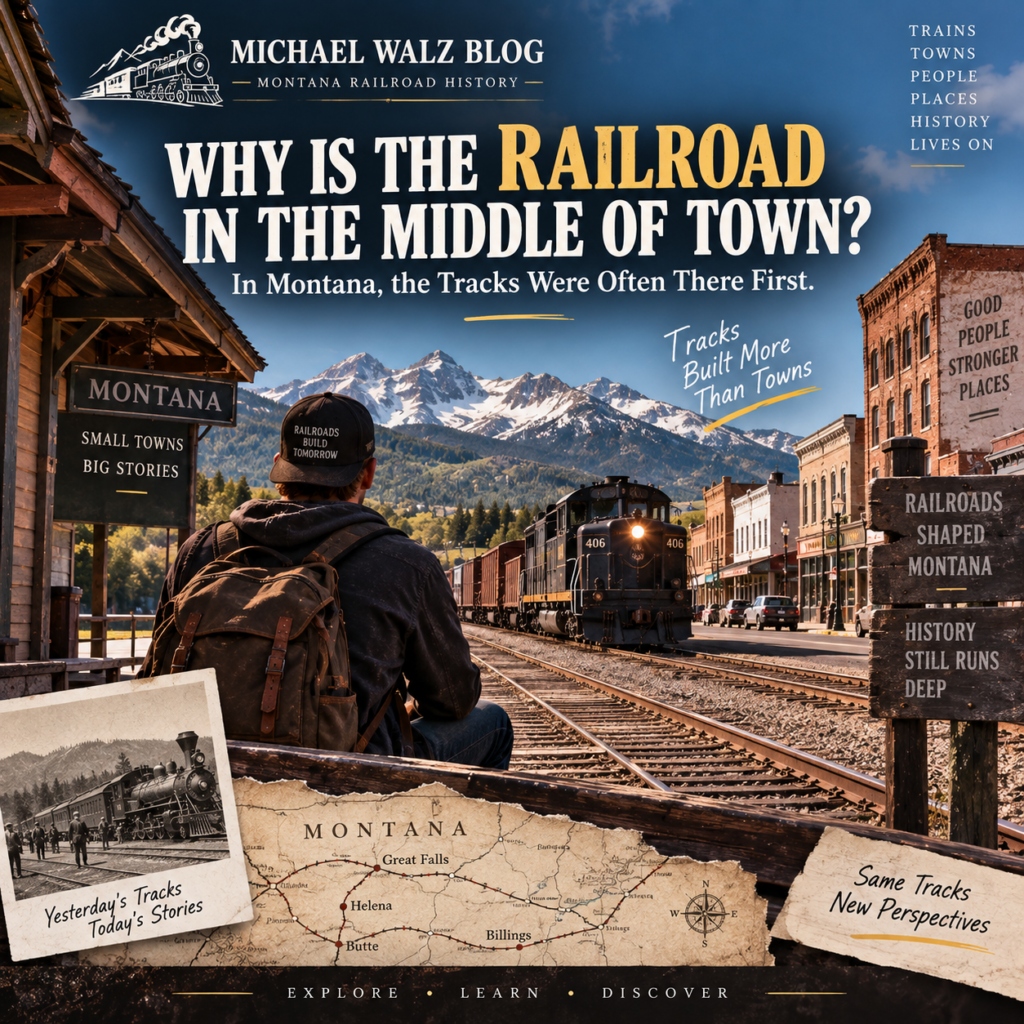
You arrive in a small Montana town.
There is Main Street.
A few blocks of businesses.
Older brick buildings.
Maybe an old grain elevator in the distance.
And then, cutting straight through everything:
railroad tracks.
At first, the layout can seem inconvenient.
Why would anyone put tracks so close to the center of town?
Why are some of the oldest buildings facing the railroad instead of the highway?
Why does one side of town feel older than the other?
And why are there enormous industrial structures sitting beside tracks that barely seem busy today?
The answer is often surprisingly simple.
The railroad was not built through the town.
In many cases, the town developed around the railroad.
Understanding Montana railroad history therefore means looking beyond locomotives and famous rail companies.
Railroads helped determine where people settled, where businesses opened, how agricultural products reached markets, and why some communities grew while others remained small.
To understand the map of Montana today, sometimes you have to look for the tracks underneath it.
Before the Railroad, Distance Was a Much Bigger Problem
Modern maps can make Montana look deceptively manageable.
A highway connects one town to another.
Drive for an hour.
Arrive.
But transportation was a completely different challenge during the nineteenth century.
Moving:
people,
mail,
equipment,
food,
timber,
livestock,
and minerals
over long distances required enormous time and effort.
Montana’s geography made the problem even harder.
Mountain ranges, rivers, valleys, plains, and severe winter weather could turn relatively short distances into difficult journeys.
Railroads changed the equation.
A Railroad Was More Than Transportation
Today, we often think about transportation as something that serves an existing community.
A city exists.
Then transportation infrastructure helps people move around it.
During railroad expansion, the relationship could work differently.
A rail line could create an economic reason for a settlement to exist.
Once tracks reached an area, suddenly there might be demand for:
a station,
freight facilities,
housing,
hotels,
restaurants,
warehouses,
stores,
and other services.
People followed opportunity.
Businesses followed people.
And a town could begin forming around the transportation network.
The Station Could Become the Center of Activity
Imagine arriving in a Montana community more than a century ago.
The railway station might be one of the busiest places in town.
Passengers arrived.
Mail arrived.
Goods arrived.
Visitors departed.
Farm products left.
News traveled.
Business happened.
Naturally, businesses wanted to be nearby.
Hotels benefited from passengers.
Restaurants needed travelers.
Warehouses needed access to freight.
Merchants needed goods.
This helps explain why old commercial districts in railroad towns often developed close to the tracks.
Main Street Was Not Always the Most Important Street
Today we naturally look for:
Main Street,
downtown,
or the highway
to understand a town.
Historically, the most economically valuable direction may have been:
toward the depot.
Buildings were positioned according to how people and goods actually moved.
That movement often centered on the railroad.
So if an old town layout seems unusual by modern standards, it may make perfect sense when viewed from the platform of a long-gone station.
Railroads Needed Towns Too
The relationship worked both ways.
Communities needed railroads.
But railroads also needed infrastructure.
Steam locomotives required regular support.
Railroad operations could require:
water,
fuel,
maintenance,
crew changes,
repair facilities,
sidings,
switching yards,
and administrative services.
Certain locations became natural operational points.
Those operations created jobs.
Jobs attracted workers.
Workers needed homes and businesses.
A railroad facility could therefore become the economic anchor of a community.
Water Could Influence Where Trains Stopped
Steam locomotives consumed significant amounts of water.
That made water supply an important consideration along early railroad routes.
Stations and support facilities were not positioned randomly.
Railroad companies had to think practically about what their locomotives needed to keep moving.
A location that made sense operationally could eventually become important economically as well.
Railroads Connected Montana Agriculture to Distant Markets
Imagine producing grain or livestock in an era before modern trucking.
Growing something is only half the problem.
You still need to sell it.
And that means moving it.
Railroads dramatically expanded the distance agricultural products could travel efficiently.
Farm communities near rail connections gained access to broader markets.
This is why grain elevators became such familiar structures beside railroad tracks across the northern plains.
Why Are Grain Elevators Right Beside the Tracks?
Because that was the point.
Farmers brought grain to the elevator.
The grain could then be stored and loaded into railcars.
Rail transportation carried it onward.
The entire structure was designed around the movement of agricultural commodities.
Even when an old elevator is no longer operating, its location can reveal the transportation system that once supported the local economy.
Mining and Railroads Became Closely Connected
Montana’s mining history also created enormous transportation needs.
Mining operations required equipment and supplies.
Extracted materials needed transportation.
Growing mining communities needed food, construction materials, and workers.
Railroads provided a way to move heavy freight at scales that earlier transportation methods struggled to match.
That made railroad development an important part of the broader industrial history of Montana.
But Mountains Made Railroad Construction Difficult
A locomotive cannot simply climb wherever engineers want it to.
Railroads work best with manageable grades and curves.
Montana did not offer engineers an empty flat surface.
Routes had to deal with:
mountain passes,
river valleys,
rock formations,
elevation changes,
and winter conditions.
Sometimes the route that looks indirect on a modern map was the practical route available to railroad engineers.
Rivers Often Helped Shape Rail Corridors
River valleys provided natural pathways through difficult terrain.
Instead of forcing a railroad directly across every obstacle, engineers could follow geographic corridors where grades were more manageable.
This is one reason railroads, rivers, highways, and towns can sometimes appear closely connected on maps.
They are all responding, in different ways, to the same geography.
The Railroad Could Decide Which Town Grew
Now imagine two nearby settlements.
One gets a railroad connection.
The other does not.
The first town suddenly has easier access to:
passengers,
freight,
mail,
supplies,
and outside markets.
Businesses have a reason to locate there.
Travelers have a reason to stop.
The economic balance between the two communities can change quickly.
Transportation access has always influenced development.
Railroads simply made that influence extremely visible.
Some Communities Actively Wanted the Railroad
A rail connection could represent economic opportunity.
Communities and landowners understood that.
The arrival of a railroad might increase:
trade,
population,
land values,
business activity,
and access to distant markets.
Getting the tracks close to town could therefore become an important local issue.
Because being bypassed could have serious consequences.
Sometimes the Railroad Created an Entirely New Town
Railroad companies did not always adapt themselves to existing settlements.
Sometimes development followed the chosen route instead.
A new station could become the center of a new community.
Businesses appeared.
Homes followed.
Streets were laid out.
What looks today like an ordinary Montana town might originally have existed because a railroad needed a particular location along its route.
Why Do Some Montana Towns Have Such Straight Streets?
Many railroad-era communities were planned quickly and practically.
A grid made land easier to:
survey,
divide,
sell,
and develop.
The tracks might form one organizing line.
Streets and lots developed around them.
That produces a pattern still visible today even when the railroad’s economic importance has declined.
The Railroad Divided Towns Physically
Railroads connected communities to the wider world.
But inside towns, tracks could also create a physical division.
One side of the tracks might develop differently from the other.
Industrial activity could cluster near freight facilities.
Residential neighborhoods might grow farther away.
Road crossings influenced movement.
Over decades, these physical patterns could become social and economic patterns too.
That is one reason the phrase “the other side of the tracks” became so culturally recognizable.
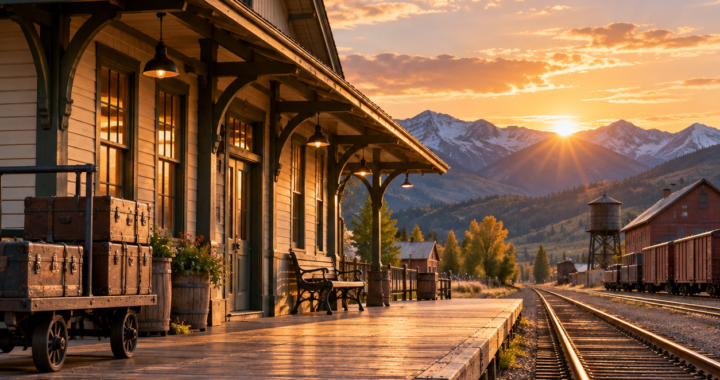
Depots Were Gateways to the Outside World
Before airports and interstate highways, railroad stations connected communities with distant places.
Imagine the activity around a depot when a passenger train arrived.
Families waiting.
Travelers carrying luggage.
Mail being transferred.
Hotel representatives.
Workers.
Freight.
For smaller communities, the arrival of a train could be a major event in the rhythm of the day.
Hotels Often Appeared Near Stations for an Obvious Reason
A traveler stepping off a train needed somewhere to stay.
So where would you build a hotel?
Probably not several miles away.
Businesses that depended on travelers naturally clustered around stations.
This can help explain the location of historic hotels and commercial buildings in older railroad communities.
Restaurants Followed Travelers Too
The same logic applied to food.
Passengers waiting between connections or staying overnight needed meals.
Railroad workers needed food.
Visitors needed services.
Transportation hubs generate customers.
That principle has not disappeared.
We see it today around:
airports,
highway exits,
and major transit stations.
The technology changed.
The business logic did not.
The Railroad Changed How People Experienced Distance
Before reliable rail travel, distant communities could feel extremely remote.
Railroads compressed that distance.
Trips that previously required difficult overland travel became more predictable.
People could travel farther.
Mail could move faster.
Goods could reach markets more efficiently.
Communities became connected to larger economic networks.
Montana did not become geographically smaller.
But in practical terms, the distance between places changed dramatically.
Time Itself Became More Important
Railroads run on schedules.
Schedules require agreement about time.
That sounds obvious now.
But imagine coordinating trains when communities use different local interpretations of noon.
Railroad operations contributed to the broader need for standardized time.
Transportation networks did not just change where people went.
They helped change how people organized daily life.
Railroad Jobs Created Their Own Communities
Railroad operations required many kinds of workers.
Depending on location and period, that could include:
engine crews,
station staff,
maintenance workers,
track crews,
yard workers,
mechanics,
clerks,
and other employees.
These workers had families.
Families needed:
housing,
schools,
stores,
and community institutions.
Railroad employment could therefore shape the social character of a town for generations.
A Town Could Hear the Railroad All Day
Imagine living beside an active railroad in the steam era.
The railroad was not an abstract piece of infrastructure.
You could:
hear locomotives,
smell smoke,
see workers,
watch freight move,
and hear whistles announcing arrivals.
The railroad was physically present in everyday life.
For many communities, it was part of the town’s identity.
Then Transportation Changed Again
Railroads did not remain the only dominant transportation system.
Automobiles became widespread.
Road networks improved.
Trucking expanded.
Air travel developed.
Passenger transportation patterns changed.
Businesses increasingly oriented themselves toward highways instead of depots.
And many communities began reorganizing around a different transportation network.
The Center of Gravity Could Move Away From the Tracks
Imagine an older downtown beside the railroad.
Then a highway develops outside the historic center.
New businesses begin appearing near:
intersections,
parking lots,
gas stations,
and highway exits.
Over decades, commercial activity can shift.
The old railroad district remains.
But it is no longer automatically the busiest part of town.
This helps explain why some historic downtowns feel separated from newer commercial areas.
Some Rail Lines Disappeared
Railroad networks change.
Routes can be:
abandoned,
consolidated,
rerouted,
or converted to other uses.
Tracks may disappear entirely.
But removing rails does not remove the history that formed around them.
Look closely and you may still find evidence.
An Old Rail Corridor Can Hide in Plain Sight
Former railroad routes may survive as:
trails,
unusually straight property lines,
empty strips of land,
old bridges,
cuts through hills,
embankments,
or roads following former rights-of-way.
Once you learn what to look for, abandoned rail infrastructure becomes easier to recognize.
Old Depots Sometimes Find New Lives
A station may no longer serve passenger trains.
But the building can survive as:
a museum,
community center,
restaurant,
office,
visitor center,
or historic site.
That preservation matters because depots can tell the story of how a community once connected with the rest of the region.
Look for Buildings Facing “The Wrong Way”
Here is a fun historical clue.
You find an old commercial building.
Its orientation seems strange.
The modern road is behind it.
Why would anyone design it like that?
Maybe because when it was built, the important traffic was somewhere else.
Possibly the railroad.
Buildings remember old transportation patterns even after people forget them.
Street Names Can Preserve Railroad History
Names such as:
Railroad Avenue,
Depot Street,
Station Road,
or names connected to historic rail companies
can survive long after the original infrastructure changes.
Street names are tiny historical records.
We drive past them without thinking about why they exist.
Old Maps Can Completely Change How You See a Town
Compare a historic map with a modern one.
Suddenly things make sense.
That empty strip of land?
Former railroad.
That strange curve?
Old industrial connection.
That isolated building?
Once beside the depot.
Historic maps can reveal an earlier logic hidden underneath today’s streets.
Follow the Tracks When Exploring Railroad History
If you visit a Montana community with railroad roots, start near the tracks.
Then look outward.
Where is the historic commercial district?
Where are the warehouses?
Are there old grain elevators?
Where was the depot?
Which buildings appear oldest?
How does the street grid relate to the rail corridor?
You can often begin reconstructing the town’s development just by observing these relationships.
Do Not Assume Quiet Tracks Were Always Quiet
A rail line that sees limited activity today may once have been much more important.
The opposite can also happen.
Transportation networks evolve.
Present-day traffic does not automatically tell you how important a corridor was 50, 100, or more years ago.
Historical context matters.
Railroads Are Also Stories About People
It is easy to focus entirely on:
locomotive models,
rail companies,
engineering,
and route maps.
Those are important.
But railroad history is also about ordinary lives.
Someone worked the station.
Someone maintained the track.
Someone ran a hotel near the depot.
Someone shipped grain.
Someone arrived looking for work.
Someone left town on a passenger train and never returned.
Infrastructure becomes history because people built their lives around it.
The Town Is Part of the Railroad Museum
You do not always need a preserved locomotive to see railroad history.
Sometimes the entire town is evidence.
The street layout.
Old warehouses.
Grain elevators.
Bridges.
Neighborhoods.
Industrial areas.
Depot buildings.
Even empty land.
They can all reveal how transportation shaped the community.
Next Time You Cross the Tracks, Look Around
Do not only watch for the train.
Look at what surrounds the crossing.
Ask:
Which buildings are oldest?
What industries are nearby?
Does the downtown follow the tracks?
Is there an abandoned siding?
Where might the depot have been?
Why was the railroad routed here?
Suddenly an ordinary crossing becomes a historical clue.
FAQ
Why were railroads important to the development of Montana towns?
Railroads connected communities with distant markets and made it easier to move passengers, agricultural products, minerals, equipment, mail, and supplies. Stations and railroad facilities could also create jobs and encourage businesses to develop nearby.
Why are railroad tracks often close to historic downtown areas?
In many railroad-era communities, commercial districts developed near stations because passengers, freight, mail, and business activity were concentrated there. The railroad may therefore have influenced where downtown developed.
Why were grain elevators built beside railroad tracks?
Their location allowed agricultural products to be stored and efficiently transferred into railcars for shipment to larger markets.
Did railroads create new towns in Montana?
Railroad development contributed to the creation and growth of numerous communities. Stations, maintenance facilities, freight operations, and other railroad needs could attract workers, businesses, and residents.
Why did some railroad districts decline?
Transportation patterns changed as automobiles, highways, trucking, and aviation became increasingly important. Railroads themselves also consolidated or abandoned some routes and services.
How can I identify old railroad history in a town?
Look for preserved depots, grain elevators, warehouses, old bridges, unusually straight corridors, former rights-of-way, railroad-related street names, historic maps, and buildings oriented toward former rail facilities.
Conclusion
The next time railroad tracks seem strangely close to the center of a Montana town, reverse the question.
Instead of asking:
“Why did they put the railroad here?”
ask:
“What grew here because the railroad was already here?”
Now the map begins to change.
The old hotel makes sense.
The grain elevator makes sense.
The warehouses make sense.
Even the orientation of Main Street may start making sense.
Railroads did more than carry trains through Montana.
They influenced where people lived, where businesses opened, how goods moved, and which communities became connected to larger markets.
The locomotives may have changed.
Some stations have disappeared.
Some tracks are gone completely.
But the railroad is still visible.
You just have to learn how to read the town around it.