
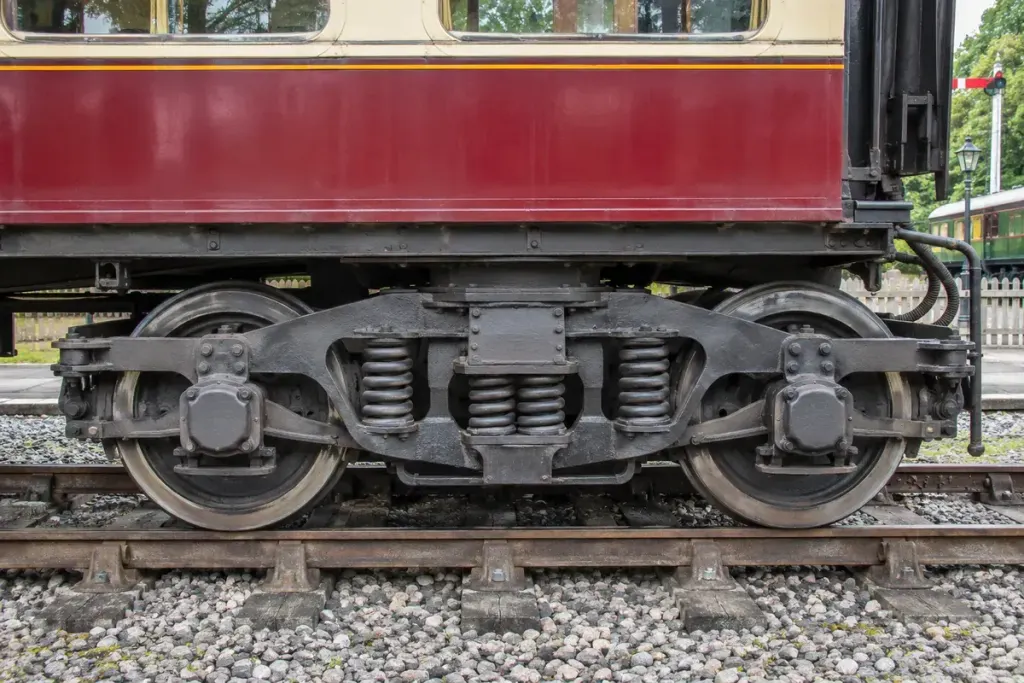
Under a railway carriage, the wheels usually belong to a larger assembly. A bogie—or truck in much North American railway usage—supports the vehicle and helps it follow the track. Looking at that assembly makes a stationary museum exhibit much easier to understand.
The Rail Motor Society’s bogie collection describes bogies as fundamental to supporting and guiding rail vehicles. Its examples also show why “a bogie” is a category rather than one universal arrangement.
Look for relationships, not just wheels
Begin with the wheelsets, then identify the frame around them and the visible suspension elements. Next, look at how the vehicle body is supported above the assembly. If brakes or drive components are visible, notice where they fit rather than assuming every part beneath the carriage serves the same function.
A bogie can move relative to the body, helping a long vehicle negotiate curves. The exact support, guidance and suspension arrangements depend on the design. A passenger coach and a heavy freight vehicle may solve those problems differently.
Use a museum comparison
If two bogies are on display, compare the number of axles, the spacing between them, the frame shape and the visible springs. Read the labels for the vehicle type and service period. Those details offer a more useful comparison than deciding the more complicated-looking one must be newer or better.
For a Montana railway-history notebook, record the builder, vehicle and date only when the exhibit or another reliable record supplies them. An Australian technical example can explain the general idea without proving which equipment a Montana railway used.
A photograph that will still make sense later
Take one overall view and, where permitted, a closer image of a particular feature and its label. Do this from public viewing areas; never go beneath rolling stock or enter railway property to improve the angle.
When reviewing the photographs, try explaining how load travels from the carriage toward the wheels. Any point you cannot identify becomes a focused question for the museum or a technical drawing. That is a productive way to move from admiring a locomotive to understanding the equipment that carries it.