
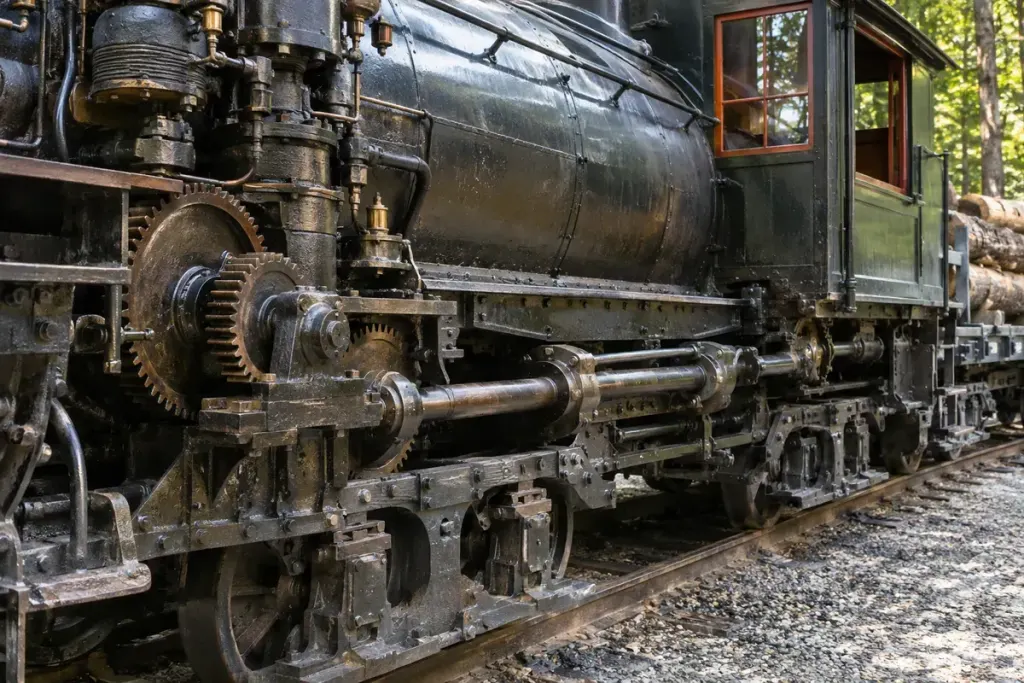
A Shay locomotive can sound busy while moving slowly. Its visible machinery turns rapidly, but gears carry that motion to the wheels at a different speed. Looking along the side reveals why it does not resemble a conventional rod-driven steam locomotive.
A National Park Service historic-registration description of a three-truck Shay traces power from vertical cylinders to a crankshaft, then along a drive shaft and through bevel gears at the axles. The document concerns a particular surviving engine, but it provides a clear view of the principle.
Follow the drive rather than the boiler
Start with the cylinders on the side. Find the shaft beneath them, then follow the connected shaft sections toward the wheel trucks. The gears turn the drive through an angle to reach the axles. The trucks can negotiate the track while the articulated shaft arrangement continues to transmit power.
This makes a useful museum sketch: cylinders, shaft, gears, wheels. It captures the main chain of motion without requiring you to identify every valve or pipe. Check the museum label for the locomotive’s specific truck count and configuration.
The Steamtown collection description identifies Meadow River Lumber Company No. 1 as a two-truck Shay associated with industrial railway work. The difference from a three-truck example is a reminder that “Shay” names a family of locomotives, not one identical machine.
Read the operating landscape with the engine
Gearing and articulated trucks suited work where grades, curves and demanding track mattered more than high main-line speed. When studying a logging railway, place the locomotive beside its route map and traffic history. A compact industrial route asked different questions of an engine than a fast passenger service.
Do not infer a locomotive’s original job solely from where it is displayed today. Record its builder’s number, earlier owners and the dates of any modifications. The visible mechanism explains how the machine worked; the operating records explain why someone chose it and what it actually hauled.