
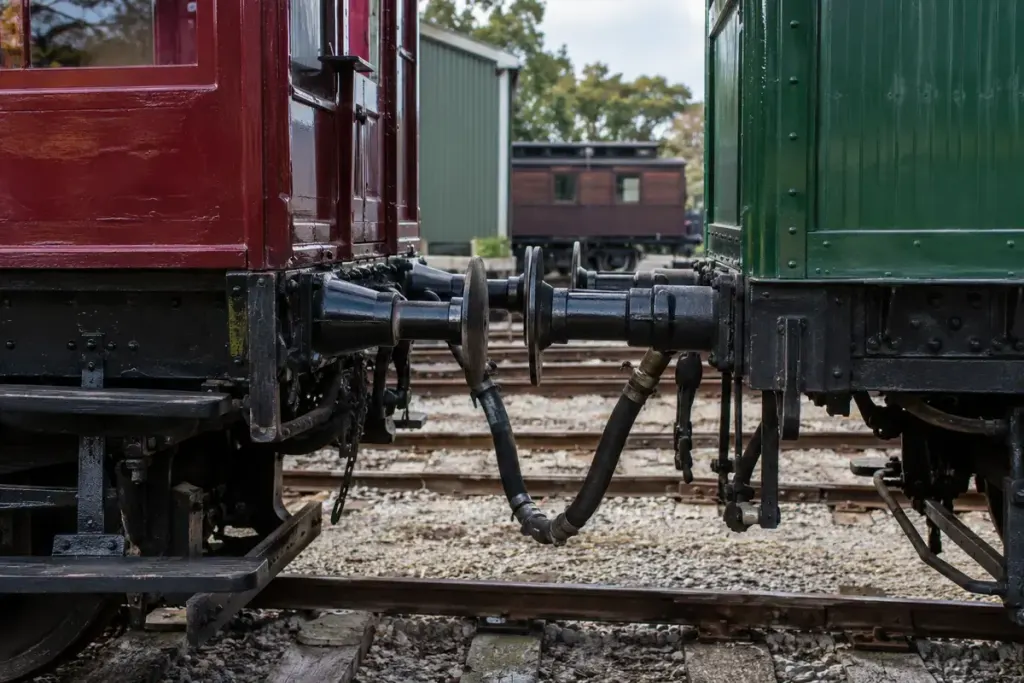
The flexible hose between two railway vehicles looks like a small detail beside their wheels and couplers. Yet in an automatic air-brake system, the connected pipe carries a signal along the train. A reduction in its pressure can cause brakes to apply rather than release.
That can seem backwards if you imagine compressed air simply being pushed from the locomotive into every brake cylinder. The automatic arrangement also uses stored air on the vehicles and valves that respond to changes in the train pipe.
Stored air changes the logic
The American Society of Mechanical Engineers’ account of the Westinghouse automatic brake describes the control-valve system and individual reservoirs. Its historical significance included a safeguard: loss of air pressure, including through a train separation, could initiate braking.
In a simplified explanation, the charged system has air available on each vehicle. A pressure reduction in the brake pipe causes the control equipment to direct stored air into the brake cylinder. This differs from relying only on a continuous supply from the front of the train to produce the braking action.
The real equipment includes more states and operating requirements than that short description. “Automatic” does not mean that every possible failure is harmless or that a stationary train needs no other securing measures.
What to look for in a museum display
A useful display may identify the brake pipe, a reservoir, a control valve and the cylinder linked to the brake rigging. Look for labels explaining how they connect rather than assuming every tank beneath a vehicle has the same purpose.
The Science Museum Group’s catalogued Westinghouse diagram is an example of the explanatory material used to make that system visible. A diagram can show relationships that are difficult to trace beneath a full-sized wagon.
For railway-history reading, this engineering change helps explain why braking arrangements mattered to train operation and the work of railway staff. It is not an instruction for operating or testing railway equipment. At a heritage site, stay in public areas and let authorised staff explain the working machinery.