
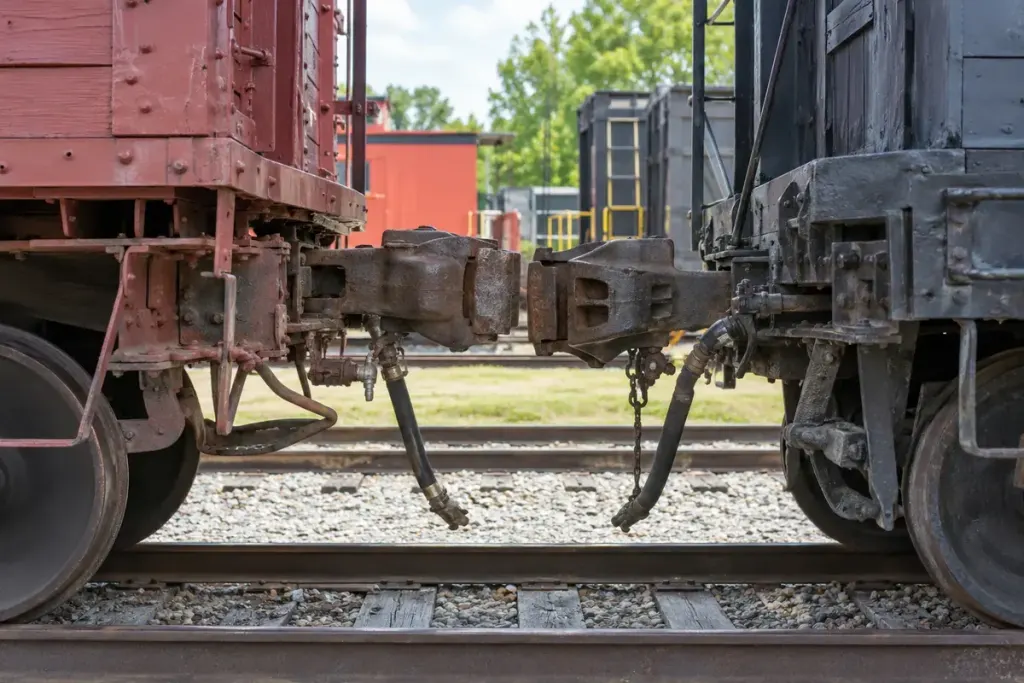
A long freight train can appear to start in a sequence rather than as one rigid object. Connections between vehicles allow movement, and the forces through those connections change as the train accelerates, brakes or travels over changing gradients.
Slack is not simply a visibly loose chain. Coupler arrangements and cushioning components differ between railway systems and vehicle types. A museum label or technical source is needed before applying an explanation from one design to another.
Distinguish movement from separation
Small relative movements can occur while vehicles remain properly connected. As forces change, the connections may move from a compressed condition toward tension, or the reverse. Across many vehicles, these movements can have significant consequences for train handling.
A Transportation Safety Board of Canada investigation discusses slack and longitudinal forces in a particular freight-train context. It illustrates why abrupt changes require professional management; it should not be read as a universal dimension or operating instruction for every coupler.
For a safe learning exercise, compare photographs of preserved coupling arrangements. Identify the connector, any cushioning mechanism and the parts that carry pulling or compressive loads. Leave uncertain details labelled as questions rather than naming every moving part a spring.
Read historical descriptions carefully
An account of loose-coupled wagons belongs to its technology and operating period. Modern passenger sets, freight wagons and permanently coupled units may behave differently. Note the railway, date and equipment before using an old description to explain a contemporary video.
Observe railway equipment only from authorised public areas or supervised museum displays. Never enter tracks or stand between vehicles to inspect a connection.
The useful insight is that a train is a connected mechanical system with movement distributed along its length. A jolt or delayed movement is a clue to investigate in context, not enough evidence to diagnose a fault from a short clip.