
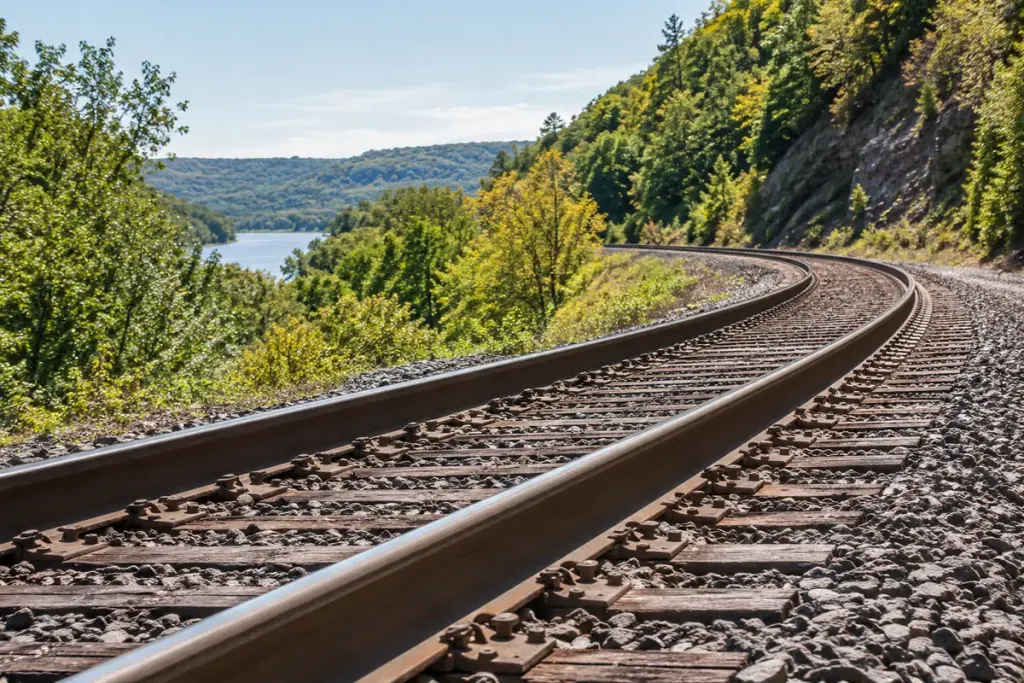
In a photograph of a railway curve, the two rails may not appear level with one another. The outer rail can be raised relative to the inner rail, producing a banked track arrangement known as cant or superelevation.
The UK Office of Rail and Road’s technical discussion of permanent speed restrictions defines track cant as that vertical difference on a curve. The basic geometry is useful when interpreting railway images, even though design standards and operating conditions differ between systems.
Look across the track and along it separately
Cant concerns the relationship between the rails across the track. Gradient concerns the rise or fall along the route. A curve can have cant while also climbing, descending or following a broadly level alignment.
When studying an archival photograph, look for the direction of the curve and the sleeper plane. Then consider whether the camera itself is tilted. A leaning horizon can make a level object appear banked or exaggerate an existing slope.
Keep the photograph’s limits visible
A single oblique image rarely supports a reliable measurement. Perspective, lens effects and the absence of a dependable level reference can all distort the impression. Describe an apparent feature cautiously unless survey data or engineering drawings confirm it.
For a research note, record the image date, location if known, viewing direction and the evidence for identifying the outer rail. If the date is approximate, keep that uncertainty beside the description rather than assigning a precise year.
Do not enter railway property to check a visual hypothesis. Use public archives, museum interpretation and lawful viewing locations. Operational track is not a safe place for an informal geometry exercise.
Once you distinguish cant from gradient and camera tilt, railway photographs become richer sources. The track’s shape can suggest a question about engineering and operation without being forced to prove more than the image actually shows.