
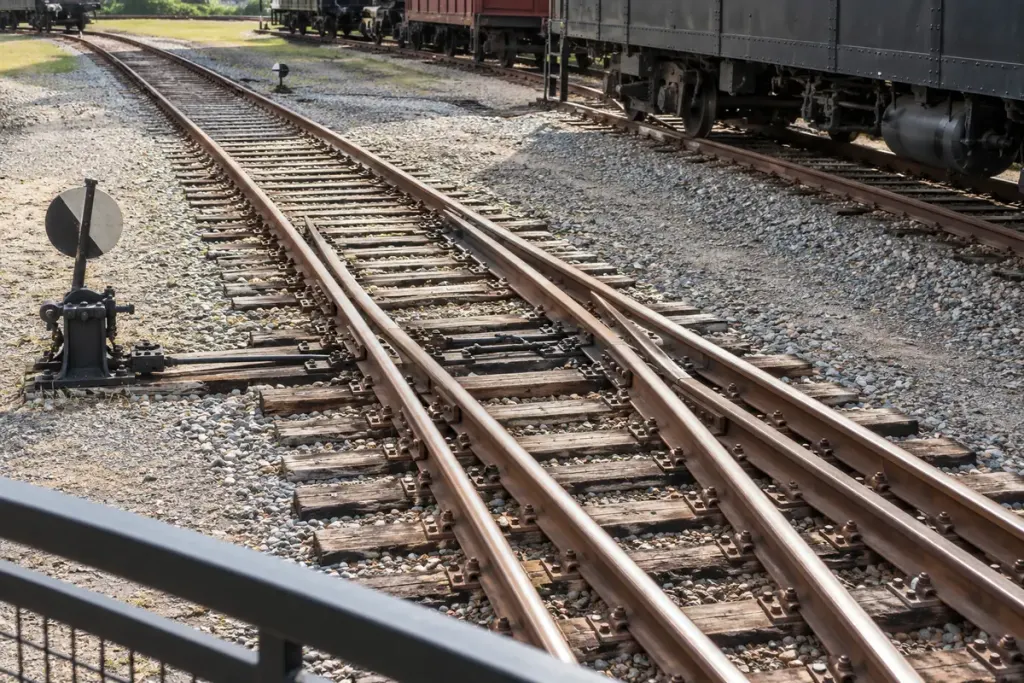
At a junction, the rails seem to split into a complicated bundle. Reading the arrangement in stages makes it easier to understand how a train follows one route while its wheels remain guided through the crossing geometry.
Start where the route is selected
The movable switch rails, often called points, lie beside fixed stock rails. Their position establishes the route into the turnout. Further along, the crossing area allows wheel paths to intersect. In North American terminology, an important part of that crossing is commonly called the frog.
Terminology varies between railway systems. Network Rail’s railway glossary includes points and crossings, switches and crossings, and specialised arrangements such as swing-nose crossings. A term in a British document may not match the wording on a Montana museum label exactly.
Follow one imaginary wheel path
Use a museum diagram or a photograph taken from a permitted public location. Trace one rail from the approach through the junction, then trace its partner. Notice where check rails or other guiding features appear. Do not infer that every turnout uses the same crossing design.
For a historical note, ask how the points were operated: a nearby hand lever, mechanical linkage or powered mechanism. Look for evidence in a dated plan or interpretation panel. The visible mechanism at a preserved site may have been altered after the period represented by a photograph.
Record the site, date and terminology used by the source beside your sketch. If a label is missing, leave the identification provisional rather than applying the nearest name you recognise.
Never enter a track area or operate a lever to improve the view. Even museum railways can have moving vehicles and active machinery. A good observation explains the relationship between parts from an authorised viewpoint; it does not require touching equipment or standing between rails.