
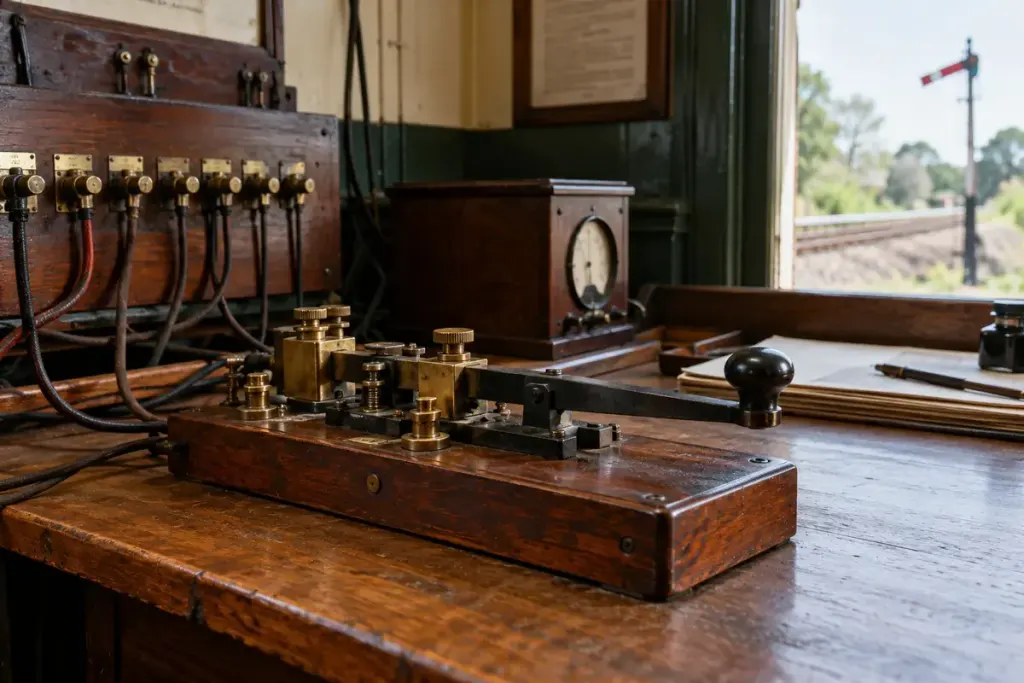
A historic depot photograph often draws the eye to the train outside. The smaller equipment inside the office can explain another essential part of railway operation: how information travelled ahead of the locomotive.
Telegraph communication allowed messages to move between distant points without waiting for a person or train to carry the paper all the way. On a railway, that capability supported the coordination of movements as well as ordinary business communication.
A historical narrative in the National Register documentation for Cut Bank Municipal Airport and Army Air Force Base includes the town’s railway background. It describes a depot telegrapher copying train orders and giving instructions to trains. Although the nominated property is an airport, that passage provides a local example of railway communication work in Montana.
Read the office as a workplace
When examining a depot exhibit, identify the telegraph instrument, writing surface and any displayed message forms. Ask which items are original to the building and which have been assembled to illustrate a period. A convincing display is not automatically an untouched historical room.
Dates matter too. Equipment and operating methods changed. Avoid using one photograph to describe every station across a railway’s entire history. Record the railway, place, approximate date and collection reference before drawing a wider conclusion.
Follow a message rather than just a wire
A useful research question is: who originated the instruction, who received it, and how did the crew obtain it? Look for operating documents or archive descriptions that answer those steps for the specific railway and period.
A surviving form may reveal abbreviations, handwriting and acknowledgement practices, but do not guess the meaning of an unfamiliar code. Compare it with an appropriate contemporary rulebook or ask the holding archive for context.
This approach turns a telegraph key from an attractive antique into evidence of work. The story is not only that electricity carried a signal; people had to interpret, record and act on information within an organised railway system.