
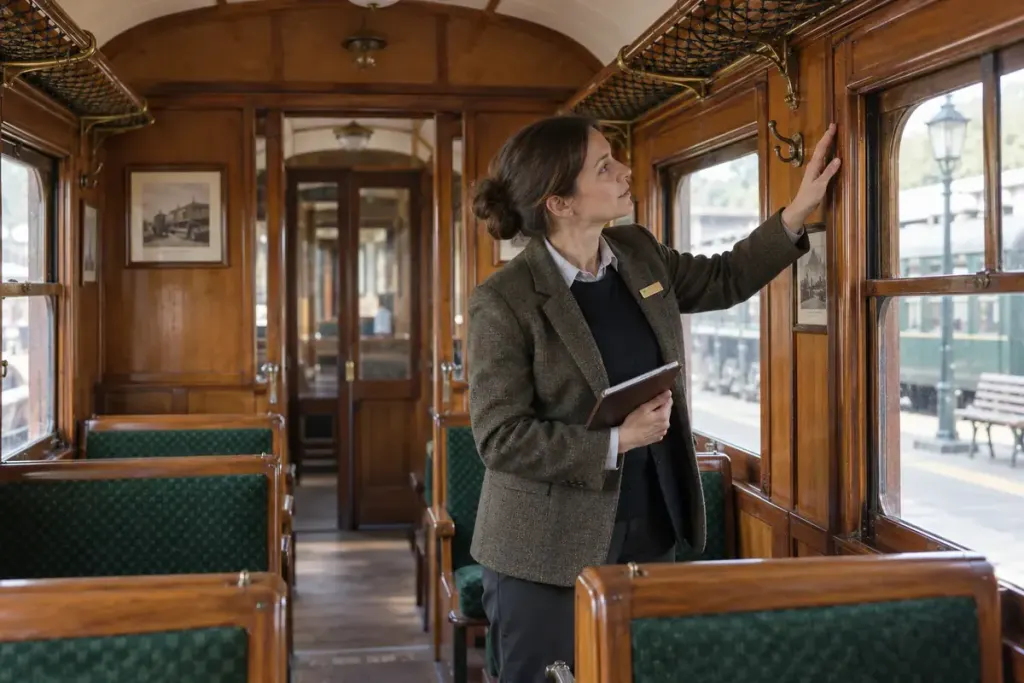
The carriage looks ready for a journey: polished timber, upholstered seats and neatly painted lettering. At a museum, that appearance can help you imagine travel in another period. It does not necessarily mean every component has survived unchanged since the carriage was built.
Restoration, conservation and reconstruction can involve different decisions. Read the museum’s description of the particular object rather than applying one label to every visible repair. A replacement part can be carefully researched without being an original part.
Ask which date the display represents
A carriage may have been altered during its working life. Its final colour scheme could differ from the one it wore when new, and the preserved interior may represent a chosen stage. Look for a display date alongside the construction date.
Useful questions include: which features are original, which were replaced, and what evidence guided the work? Photographs, drawings, surviving paint layers and records can contribute different kinds of information. A guide may be able to explain where the evidence was strong and where a decision remained uncertain.
Record what you observed separately
In your notes, distinguish “the label states” from “I can see”. If a panel looks newer, that is an observation, not proof of when it was fitted. Photograph labels where permitted so the explanation stays with the image of the carriage.
Do not touch fittings or open compartments to test a theory. Fragile surfaces and operational equipment may require protection even when the display looks robust. Ask staff about areas that are not accessible to visitors.
A restoration history adds another layer to a railway visit: how later people chose to preserve and interpret the vehicle. Understanding those choices makes the carriage more interesting, while keeping your account honest about which details come from the original railway era and which belong to its preservation.