
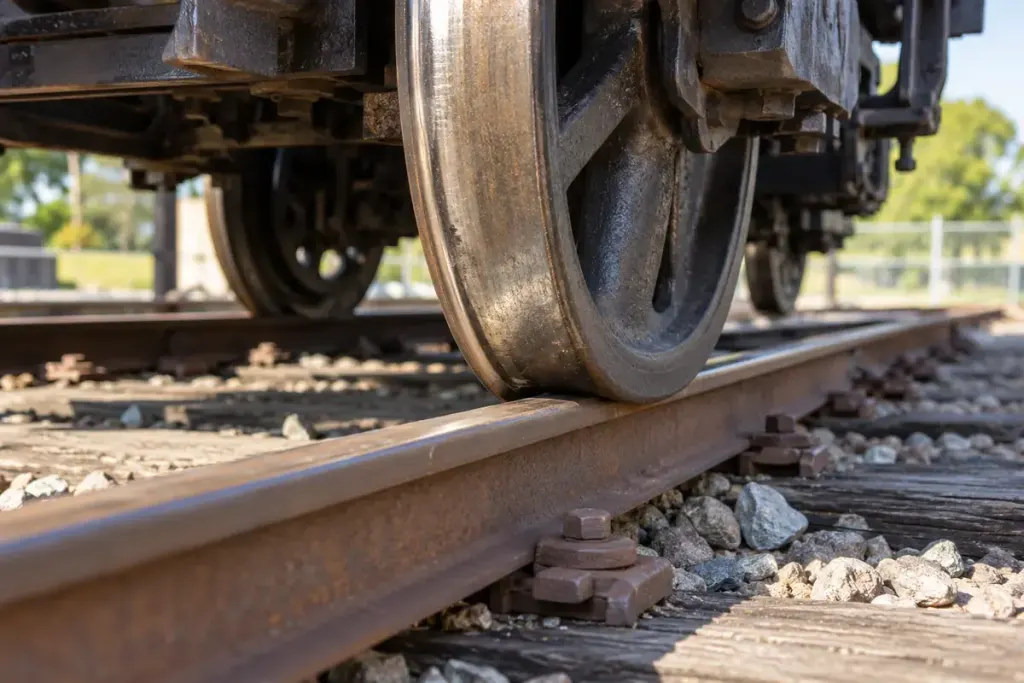
A railway wheel has a raised flange beside the surface that normally carries its load. Seen in a museum, that shape can look like a simple lip preventing the wheel from falling sideways. The relationship between wheel and rail is more interesting than that first impression.
The National Railway Museum’s discussion of self-steering wheelsets describes the role of wheel shape and the flange contact that can occur on curves. A conventional wheelset does not steer like a car whose front wheels turn independently under a steering wheel.
Separate the tread from the flange
The tread is the running surface. On many conventional wheelsets, the two wheels are fixed to an axle and rotate together. Their profiles and lateral movement influence the effective rolling radii at the rail contacts. The flange provides additional guidance when the geometry and forces bring it against the rail.
This does not mean every railway wheel uses one identical profile or that flange contact is absent in normal service. Vehicle design, track curvature and wear all matter.
Make a better museum observation
From the permitted visitor area, look for the transition between tread and flange. Photograph the whole wheelset as well as the close detail so the relationship to the axle remains clear. Include the museum label in a separate image rather than relying on memory for the object’s identity.
A useful note might say: “Flange visible on the inner side; wheelset displayed separately; vehicle type identified on label.” Avoid diagnosing wear or declaring a wheel unsafe from an exhibit photograph. Maintenance decisions require measurements and specifications that a casual view does not provide.
When reading an old railway image, this vocabulary helps you ask better questions about the visible machinery. It also explains why a track curve involves more than pointing the locomotive’s front toward the destination. Always study these details in a museum or authorised setting, never by approaching operational railway equipment.