Montana’s railroads were built through mountain passes, river valleys, and immense stretches of open prairie. Behind this celebrated engineering achievement stood thousands of immigrant laborers whose names rarely appeared in official records.
They cleared forests, moved rock, laid rails, constructed bridges, and entered unstable tunnels with little protection. Their work connected Montana to national markets, but the human cost included injury, exploitation, discrimination, loneliness, and death.
The history of these workers reveals a difficult truth: Montana’s transportation network was not created by wealthy railroad executives alone. It was built by people who often possessed the least power to demand fair treatment.
The Human Cost Behind Montana’s Railroad Expansion
Railroad construction reached Montana during a period when corporations were competing to control transportation across the American West. The Northern Pacific crossed the territory in the early 1880s, while the Great Northern later developed a northern route. The Milwaukee Road added another transcontinental line during the early twentieth century.
These companies required enormous mobile workforces. Local populations could not supply enough labor, so contractors recruited immigrants and migrants from distant regions.
Irish, Chinese, Italian, Scandinavian, Slavic, Japanese, Greek, and other workers became part of the construction camps. Some had recently arrived in the United States. Others had already followed railroad projects across several states.
The surviving story of Montana railroad workers history is therefore inseparable from migration. Workers moved wherever contractors promised employment, carrying tools, clothing, and modest personal possessions from camp to camp.
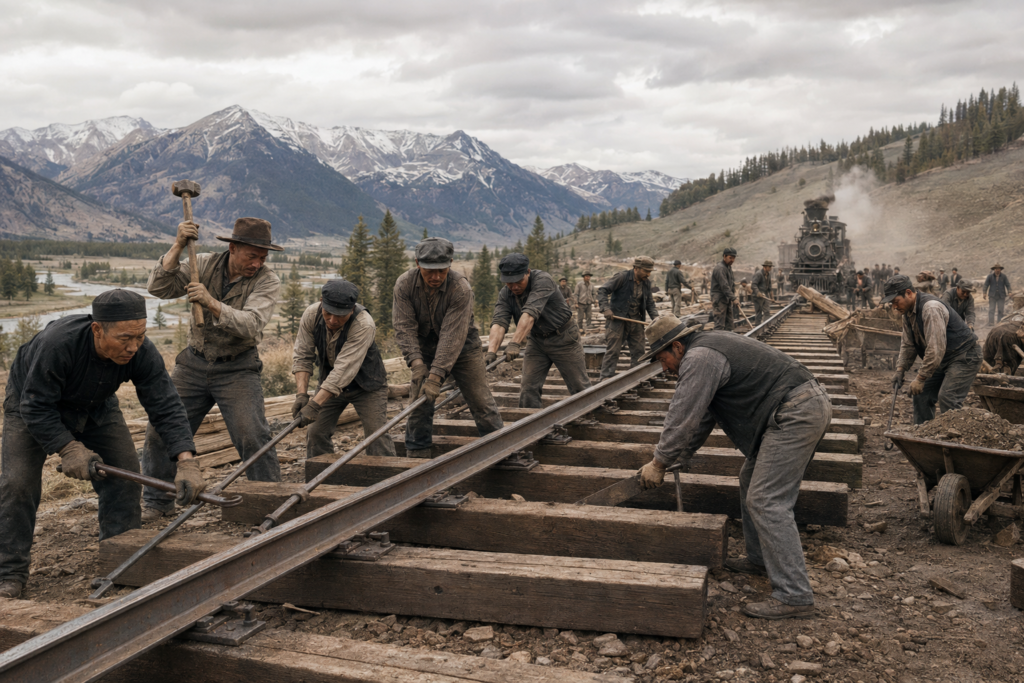
Their labor was physically demanding and frequently dangerous. Crews worked with picks, shovels, wheelbarrows, hand drills, horses, and explosives. A mistake near a rock face or bridge foundation could become fatal within seconds.
Why Immigrants Took the Most Dangerous Jobs
Many immigrant laborers accepted railroad work because other opportunities were closed to them. Language barriers, racial discrimination, limited savings, and hostility toward newcomers restricted their choices.
Railroad contractors understood this vulnerability. They could place immigrant crews in hazardous positions, reduce wages, or dismiss workers who protested. A laborer who lost his job might also lose access to food and shelter because both were often controlled by the contractor.
For newcomers, the railroad still appeared to offer a path toward survival. Regular wages could support relatives, pay debts, or finance a future farm or business. The promise was powerful, even when the reality was harsh.
Laborers often received lower compensation than skilled workers or supervisors. In some cases, deductions were taken for meals, transportation, lodging, tools, or medical care. After these charges, a worker could finish a difficult month with far less money than expected.
This unequal system became one of the defining contradictions of American railroad labor history. Immigrants were essential to expansion, yet their economic insecurity was repeatedly used against them.
Chinese Workers and the Northern Pacific Railway
Chinese laborers played an important role in railroad construction across the American West. Their contributions are commonly associated with the Central Pacific, but Chinese crews also worked on portions of the Northern Pacific’s route into and through Montana.
Railroad contractors valued these workers for their experience with grading, tunneling, blasting, and track construction. Many had already developed specialized knowledge while working on earlier western lines.
Their skill did not protect them from racism. Chinese workers were frequently treated as a separate laboring class. They could receive inferior accommodations, unequal pay, and the most dangerous assignments while facing hostility from white workers and surrounding communities.
Anti-Chinese prejudice was reinforced by political campaigns that portrayed immigrant laborers as a threat. Such arguments ignored the fact that companies deliberately recruited Chinese workers to complete difficult projects quickly and cheaply.
After construction crews moved on, Chinese residents who remained in Montana sometimes opened laundries, restaurants, shops, or small service businesses. Yet discriminatory laws and social exclusion continued to limit their security.
The history of Chinese railroad labor in Montana deserves more than a passing sentence. These workers were active participants in the physical creation of the state’s transportation system, even as society denied them equal recognition.
Life Inside the Temporary Railroad Camps
Construction camps were rough settlements designed for production rather than comfort. They appeared near grading sites, tunnels, bridges, and future rail towns, then disappeared when the work moved forward.
Workers slept in crowded bunkhouses, tents, converted railcars, or hastily constructed shelters. Bedding could be poor, ventilation limited, and sanitation primitive.
Clean water was not always available. Food varied according to the contractor, location, season, and cultural organization of the camp. Some crews employed their own cooks, while others depended on company kitchens that charged workers for basic meals.
Disease spread easily in crowded conditions. Respiratory illness, digestive infections, and untreated wounds could become serious problems, particularly during Montana’s severe winters.
Isolation added another burden. Camps might stand far from established communities, leaving workers dependent on employers for transportation and supplies. Letters from home could arrive slowly, if they arrived at all.
Understanding historic Montana railroad camps means recognizing them as places of endurance. They were temporary communities where workers formed friendships and mutual-support networks while living under exhausting conditions.
Dynamite, Tunnels, and Unrecorded Deaths
Railroad construction in Montana demanded an assault on difficult geography. Crews cut through mountains, filled ravines, crossed rivers, and maintained grades suitable for heavy locomotives.
Tunneling was particularly dangerous. Workers drilled holes into rock, packed them with explosives, lit fuses, and attempted to reach safety before detonation. Premature explosions, unstable stone, and miscommunication could kill entire groups.
Blasting also exposed laborers to dust that damaged their lungs. At the time, occupational health protections were weak or nonexistent. A worker who became ill might simply be replaced.
Bridge construction created different hazards. Men worked above fast water while handling heavy timber, iron components, ropes, and machinery. Falls, structural failures, and shifting materials were constant threats.
Winter intensified almost every risk. Extreme cold caused frostbite, weakened equipment, and made metal tools painful to handle. Snowstorms could isolate camps, while spring thaws produced mud, floods, and unstable embankments.
Many injuries and deaths were recorded only in local notices or company documents. Others were never documented clearly. The incomplete evidence surrounding railroad construction dangers in Montana makes the true human cost difficult to calculate.
Ethnic Divisions Were Used to Control Labor
Railroad contractors often organized crews by language or nationality. This arrangement could make communication easier, but it also allowed employers to maintain divisions between workers.
Different groups sometimes received different wages, food, housing, or assignments. Supervisors could exploit ethnic tension to prevent collective action. If one crew protested, another group might be hired to replace it.
Workers were also affected by stereotypes. Certain nationalities were described as naturally suited to heavy labor, while others were considered more appropriate for skilled positions. These labels had little to do with individual ability and much to do with the racial hierarchy of the period.
Despite these divisions, immigrant communities created forms of solidarity. Workers shared information about contractors, helped injured companions, translated instructions, and pooled money for emergencies.
Labor resistance took many forms. Some crews slowed production, abandoned a camp, demanded overdue wages, or refused especially dangerous work. Organized strikes were difficult because railroad companies could recruit replacement labor and use law enforcement to protect company property.
The struggle for dignity within Montana railroad labor history was therefore not limited to famous strikes. It also existed in smaller acts of cooperation and refusal that rarely entered official histories.
Railroad Wealth and Worker Poverty
The arrival of the railroad transformed Montana’s economy. Mines gained faster access to national markets. Ranchers could ship livestock over long distances. Timber, grain, copper, coal, and manufactured goods moved with greater speed.
Towns located along major lines grew into commercial centers. Land values changed, businesses expanded, and investors gained access to new opportunities.
The workers who created this infrastructure did not share equally in its wealth. Many remained trapped in cycles of temporary employment. When one section was completed, they had to travel to another worksite or search for employment in mines, lumber camps, farms, and factories.
Injured laborers faced an especially uncertain future. Compensation systems were limited, and legal action against a powerful corporation was difficult. A serious accident could destroy a family’s financial stability.
This contrast lies at the heart of Montana transportation history. Railroads generated enormous commercial value, but much of the risk was carried by laborers whose personal security remained fragile.
The Wider Cost of Building Across Montana
Immigrant suffering formed one part of a wider pattern of upheaval. Railroad expansion crossed Indigenous homelands and accelerated settlement, resource extraction, and federal control across the region.
Railroad companies received substantial land grants and promoted western settlement. The land was presented to investors and prospective settlers as an economic opportunity, although Indigenous nations had lived on and traveled through these territories for generations.
Immigrant workers and Indigenous communities occupied different historical positions, and their experiences should not be treated as identical. However, both were affected by a system that placed corporate expansion above human rights and local sovereignty.
The railroad changed relationships between land, labor, and capital. It made long-distance travel and commerce possible on a new scale, but it also strengthened institutions that could remove communities, exploit workers, and reshape environments without meaningful consent.
A responsible interpretation of railroad development must hold these realities together. Technological achievement does not erase dispossession, and economic growth does not cancel the suffering that made it possible.
Women and Families Behind the Labor Force
Railroad history often centers on male construction crews, but women also sustained immigrant communities connected to the tracks.
Some operated boardinghouses, prepared food, washed clothing, raised children, or managed household finances while family members worked long hours. Others ran businesses in growing railroad towns.
Women’s labor was frequently unpaid or poorly documented. Yet a camp, settlement, or railway community could not function without cooking, cleaning, caregiving, and informal medical assistance.
Families also experienced the emotional consequences of railroad employment. Men could be absent for months, moving between isolated projects. Wages might arrive irregularly, and news of an accident could travel slowly.
For immigrant families, cultural traditions offered continuity. Religious gatherings, shared meals, music, mutual-aid societies, and community celebrations helped preserve identity in an unfamiliar environment.
These contributions broaden the story of immigrant railroad communities beyond the track itself. Railroad construction was not simply a workplace experience; it shaped entire households and neighborhoods.
Why So Many Workers Disappeared From the Record
Corporate histories traditionally celebrated executives, engineers, locomotives, and construction milestones. Ordinary laborers appeared mainly as numbers: the size of a crew, the cost of a project, or the number of miles completed.
Names were often misspelled, shortened, or altered by payroll clerks. Workers who moved frequently left few permanent records. Racial prejudice also influenced whose memories were preserved by newspapers, museums, and historical organizations.
Photographs can present another problem. A construction image may show dozens of workers without identifying a single person. The landscape and machinery are described, while the human subjects remain anonymous.
Recovering their experiences requires careful attention to payroll lists, census records, immigration documents, newspapers, cemetery records, family histories, and archaeological evidence from labor camps.
Even then, the record remains incomplete. Historians must avoid inventing details while still acknowledging that silence in an archive does not mean a person’s contribution was insignificant.
Remembering the People Who Built the Tracks
Montana’s historic railroads remain powerful symbols of industrial ambition. Old depots, abandoned grades, tunnels, bridges, and surviving tracks reveal how deeply rail transportation changed the state.
These structures should also be understood as labor monuments. Every cut through stone represents hours of drilling and hauling. Every bridge reflects dangerous work performed above water or unstable ground. Every mile of track carries the imprint of human effort.
Remembering immigrant workers does not require rejecting railroad history. It requires telling that history more honestly.
The workers were not merely anonymous muscle employed by powerful companies. They were migrants, parents, skilled laborers, community builders, and individuals pursuing uncertain futures.
Their struggles expose the darker foundations of western development: racial exclusion, dangerous workplaces, unequal pay, corporate power, and forgotten deaths. Their achievements reveal courage, adaptability, and endurance.
The Montana railroad was more than steel laid across a dramatic landscape. It was a human undertaking built by people whose sacrifices deserve a permanent place in the history of the American West.


