
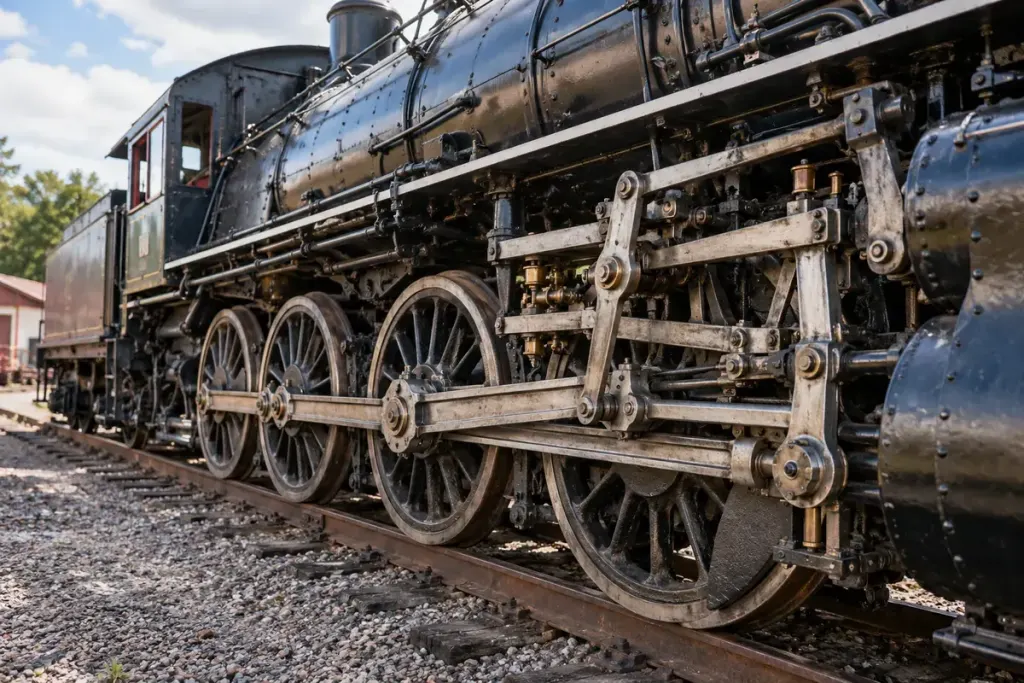
The rods outside a steam locomotive are often the first moving parts a visitor notices. Some transfer power to the wheels; others help coordinate the valves that control steam entering and leaving the cylinders. Seeing that distinction makes the mechanism much easier to read.
The German Museum of Technology’s explanation of steam engines describes how valve control directs steam through the working cycle. A locomotive uses this general principle within a particular arrangement of cylinders, valves and linkages.
Follow the two jobs separately
The piston moves back and forth as steam acts within the cylinder. A connecting rod transfers that motion to a crank on the driving wheel. The valve mechanism has a different task: timing the openings through which steam is admitted and exhausted.
Imagine trying to push a playground swing without considering where it is in its arc. Timing changes what the push achieves. That is only an analogy, not a mechanical model of a cylinder, but it explains why opening a steam passage at an arbitrary moment would not produce the intended cycle.
Use a labelled model before a moving engine
At a museum, start with a diagram that identifies the piston rod, connecting rod and valve rod. Trace one component at a time. A slow demonstration model can be more informative than a full-size locomotive moving quickly past a platform.
Different valve-gear designs arrange their links differently, so do not identify every rod from one photograph of another engine. Read the locomotive’s technical label or ask a knowledgeable guide which arrangement it uses. Some important parts may also be hidden inside frames or casings.
For a historical notebook, draw two paths with different colours: the route by which piston motion reaches a driving wheel, and the route by which the valve receives its motion. Label uncertain parts as uncertain until you can check a suitable drawing.
Stay behind barriers and never reach towards a demonstration mechanism, even when it appears to be stopped. The useful discovery is visual: what looks like a tangle of rods is a set of coordinated jobs. Once the power-transmission path and the valve-timing path are separated, the motion begins to tell a much clearer story.