
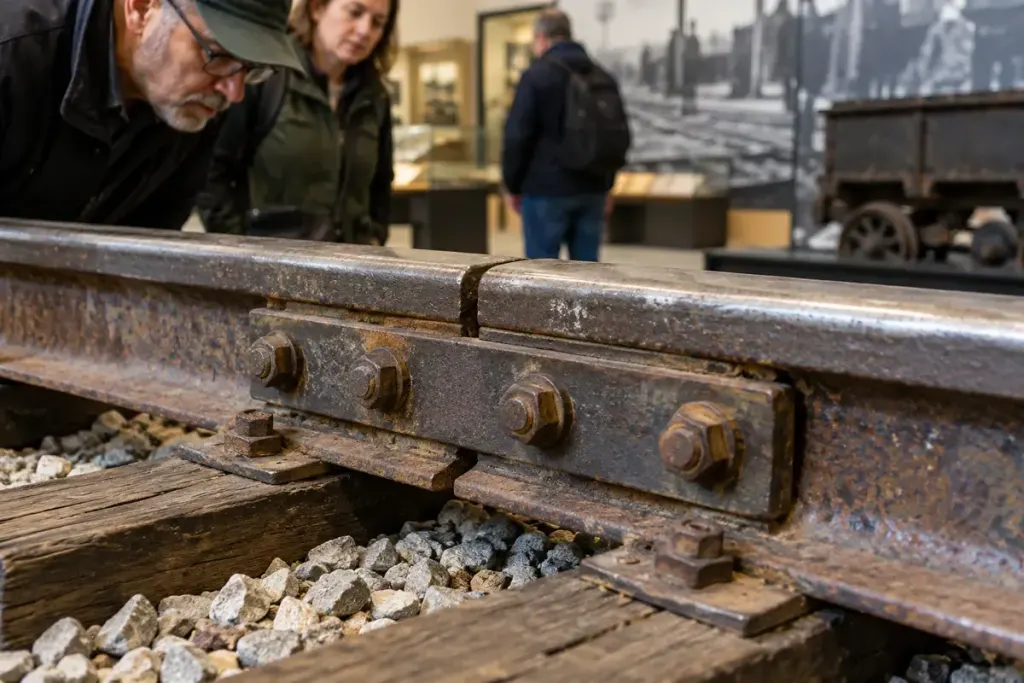
In an old railway photograph, the track can reveal details that the locomotive distracts us from seeing. Look along the rails for repeated connections, plates, and bolts. These may help distinguish jointed construction from longer welded lengths, provided the image is clear enough.
Network Rail’s account of track-renewal work describes both plated joints and fully welded track in modern operations. That is a useful warning against a simple dating shortcut: a visible joint does not automatically mean a photograph is old, and an apparently continuous rail does not date it precisely.
Make observations before assigning a period
Enlarge a good scan rather than guessing from a thumbnail. Record what is actually visible: a plate alongside the rail, a possible bolt pattern, or a repeated break at intervals. Shadows, image damage, and overlapping rails can imitate some of those shapes.
For a Montana railway image, combine the track observation with independent evidence such as a collection caption, photographer’s notes, a dated timetable, or documented work at the location. A rail detail can support an interpretation; it should not carry the entire argument.
Try a two-column research note. In the first column, write “three apparent joints visible on the near rail.” In the second, write “possibly jointed track; original scan needed.” Keeping evidence and interpretation separate makes it easier to revise the conclusion when a better image appears.
Do not infer safe operating condition from a photograph or approach active railway infrastructure to obtain a comparison. Museum displays and authorised public viewpoints offer safer opportunities to learn the visible components. The strongest historical reading comes from several modest clues agreeing, not one small mark being asked to prove a whole date and construction history.