
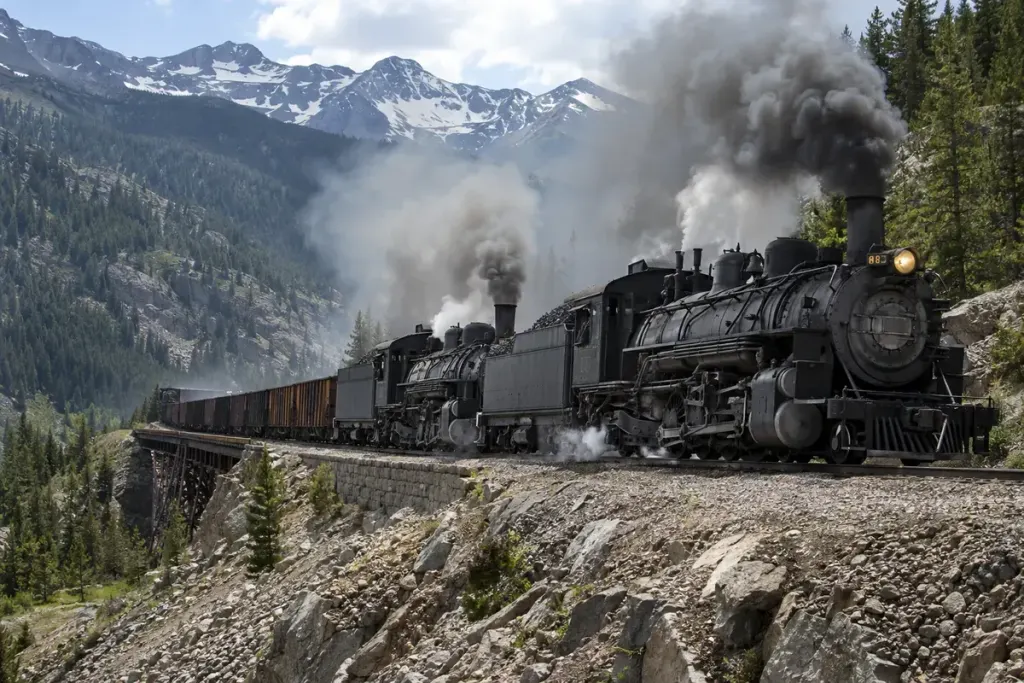
A freight train in an old mountain photograph has an extra locomotive behind it. The second engine may be doing a specific job for a difficult section, rather than accompanying the train for its entire journey.
Helper or banking locomotives supplied additional tractive effort where a train needed assistance, often on a steep grade. An historic landmark nomination preserved by the National Park Service describes pusher engines being added for a mountain grade. The document provides an example of the practice; it does not establish that every railway used the same arrangement.
Read the route around the photograph
Find the location, direction of travel and approximate date. A gradient profile can explain why assistance was needed at that point. A nearby siding, locomotive facility or turning arrangement may then make more sense as part of the operating pattern.
Do not assume that two locomotives always mean a helper operation. They might be working together over a longer route, moving equipment or performing another duty. A caption, timetable instruction or operating record is stronger evidence than engine count alone.
The position of the assisting locomotive also needs context. Railways used different arrangements depending on equipment, route and operating rules. Front, rear and intermediate positions should not be treated as interchangeable practices.
Ask what happened after the climb
Where did the helper detach? How did it return to its base? What facilities supported the crew and locomotive? Those questions shift attention from a dramatic image of power to the daily work behind it.
Keep a research note with three columns: visible in the photograph, stated by the source and still uncertain. For example, “second locomotive at rear” is visible; “assigned helper returning after this summit” requires supporting evidence.
That distinction lets a museum visit or archive search build a reliable account. The extra engine becomes a clue to how the railway organised its work, rather than an invitation to invent a story from smoke and scenery.