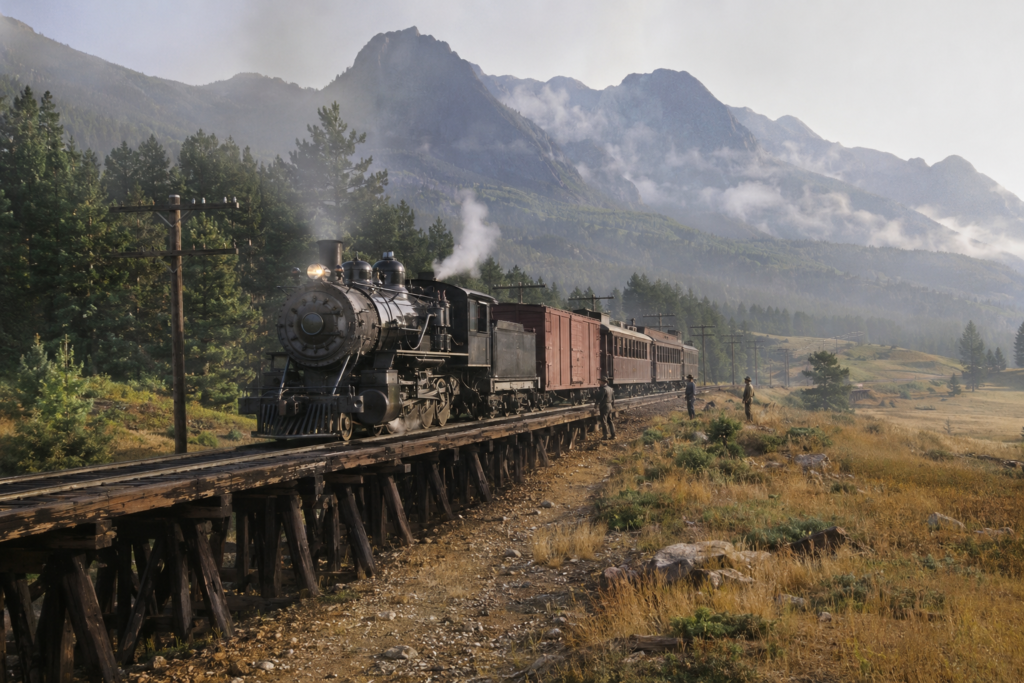
The railroads of the American West were built across a landscape of immense distances, steep mountain passes, powerful rivers, and sparsely populated plains. During the nineteenth century, these iron routes transformed isolated territories into connected economic regions.
Montana experienced this transformation more dramatically than most western territories. Rail construction opened access to mines, ranches, forests, and agricultural land while encouraging the creation of towns along previously remote transportation corridors.
The history of these railways is therefore more than a record of locomotives and tracks. It is a documentary story of engineering ambition, corporate competition, human migration, environmental change, and the rapid development of the American frontier.
Transportation Across the West Before the Railroad
Before railway construction, travel across the American West depended on rivers, military roads, Indigenous trails, wagon routes, and stagecoach lines. These transportation networks followed the natural geography of the region.
Mountain passes provided rare openings through major ranges. River valleys offered relatively gradual routes, while broad plains allowed wagons to travel long distances without encountering steep slopes.
However, these early systems had serious limitations. Heavy snow could close mountain roads for months. Spring floods damaged bridges and river crossings, while mud made many overland routes nearly impassable.
Freight transportation was slow and expensive. Mining machinery, food, building materials, and household goods often traveled hundreds of miles by wagon. The cost of moving supplies could exceed the original value of the products.
For Montana’s early settlements, transportation was one of the greatest obstacles to permanent growth. A railway promised faster travel, lower freight costs, and dependable access to national markets.
The Expansion of Railroads Across the American West
The development of western railroads accelerated after the American Civil War. Federal land grants, private investment, military priorities, and commercial expansion encouraged companies to construct lines across the continent.
The completion of the first transcontinental railroad in 1869 demonstrated that distant western regions could be connected with industrial centers in the East. Although that original route crossed farther south, it established the economic and political model for later northern lines.
Railroad corporations received land and financial support in exchange for building transportation infrastructure through difficult territory. Their routes were not selected purely for engineering convenience. Companies also considered mineral deposits, agricultural potential, timber resources, military installations, and opportunities for settlement.
This broader history of Western American railroads reveals how private corporations became major agents of territorial development. They did not simply enter established communities; in many cases, they determined where future communities would appear.
Surveyors Enter the Northern Rockies
Before tracks could be laid, surveying teams had to identify practical routes through the northern Rocky Mountains. Engineers measured grades, mapped river valleys, studied rock formations, and searched for mountain passes suitable for heavy trains.
Railway grades had to remain as gentle as possible. A route that appeared short on a map could become impractical if it required steep climbs, sharp curves, or expensive tunnels.
Surveyors often followed corridors that Indigenous peoples had used for generations. These established pathways reflected a deep knowledge of regional geography, water access, seasonal conditions, and mountain crossings.
Once a route was selected, construction crews arrived with horses, wagons, explosives, timber, steel rails, and portable camps. Their work turned geographic observations into permanent transportation corridors.
The Northern Pacific Railway Reaches Montana
The Northern Pacific Railway became one of the most influential forces in Montana’s early transportation history. Its planned route was intended to connect the Great Lakes region with the Pacific Northwest through the northern United States.
Construction in Montana advanced during the late 1870s and early 1880s. The line followed the Yellowstone River through the eastern and central parts of the territory before confronting the mountainous landscape farther west.
The arrival of the railway dramatically reduced travel time. Journeys that once required weeks by wagon could eventually be completed in days. Mail, passengers, machinery, livestock, and consumer goods began moving with greater speed and predictability.
The developing Montana railroad network also connected local producers with national markets. Cattle, wool, minerals, lumber, and agricultural products could be shipped beyond the territory in much larger quantities.
Engineering Mullan Pass
One of the Northern Pacific’s greatest engineering challenges was crossing the Continental Divide. Mullan Pass, west of Helena, provided an important route through the mountains, but its gradients still demanded careful construction.
Cuts were carved into hillsides, embankments were built across uneven ground, and bridges carried tracks over streams and ravines. Curves were designed to help trains gain elevation without exceeding the operating limits of steam locomotives.
Even after construction, the pass remained difficult. Heavy freight trains often required additional locomotives to assist them over the summit. Snow, ice, falling rocks, and mechanical strain made the route demanding for railway crews.
Mullan Pass illustrates how historic railroad engineering adapted industrial technology to Montana’s severe terrain. The infrastructure was not static; it was repeatedly strengthened and improved as trains became heavier.
The Great Northern Railway and Montana’s Northern Corridor
The Great Northern Railway created another major transportation corridor across Montana. Developed under the leadership of James J. Hill, the system connected the upper Midwest with the Pacific Coast without relying on the same federal land-grant structure used by several competitors.
Its route crossed northern Montana through towns such as Glasgow, Havre, Shelby, and Kalispell. The railway then approached the Rocky Mountains through the Marias Pass corridor.
This northern line influenced settlement patterns across the plains. Railway companies promoted agricultural opportunities, distributed information to prospective settlers, and helped establish stations at regular intervals.
Many stations grew into service towns. Grain elevators, stockyards, hotels, warehouses, repair facilities, and commercial streets appeared near the tracks.
The legacy of railway expansion across Montana remains visible in the arrangement of these communities. Their streets, industrial districts, and older business centers often still reflect the location of the original depot and rail yard.
Marias Pass and the Continental Divide
Marias Pass offered the Great Northern a comparatively low crossing of the Continental Divide. Even so, building and maintaining a reliable route through the area required substantial labor.
Construction crews faced extreme winters, unstable slopes, remote supply lines, and limited communication. Bridges and track foundations had to withstand snowmelt, temperature changes, and the repeated force of heavy trains.
Snow management became a permanent operational concern. Railway companies constructed snow sheds in vulnerable areas and used specialized plows to clear the tracks.
The line also contributed to the growth of tourism near Glacier National Park. Railway advertising presented Montana’s mountains as a national destination, while hotels and passenger services helped visitors reach landscapes that had previously been difficult to access.
Mining Railroads and Industrial Growth
Mining was one of the strongest economic forces behind railroad development in Montana. Gold discoveries had already attracted migrants, but copper, silver, lead, and coal created even greater demand for industrial transportation.
Butte became a major mining center, while Anaconda developed around large-scale smelting operations. These industries required enormous quantities of machinery, timber, fuel, and labor.
Railways transported ore from mines to processing facilities and carried refined materials toward distant markets. Branch lines connected extraction sites with major trunk routes, creating an industrial web around mining districts.
The relationship between Montana mining and railroads was mutually reinforcing. Mines generated freight revenue for the railways, while rail access made larger and deeper mining operations economically possible.
The Butte, Anaconda and Pacific Railway
The Butte, Anaconda and Pacific Railway was built specifically to serve the industrial corridor between Butte and Anaconda. It carried copper ore, workers, equipment, and processed materials between mines and smelting facilities.
Unlike transcontinental lines, its primary purpose was regional and industrial. Nevertheless, it became an important example of specialized railroad infrastructure.
The railway later adopted electric operation on part of its system. Electric locomotives were well suited to frequent heavy movements and demonstrated how Montana’s industrial railways could become testing grounds for advanced technology.
Towns Created and Reshaped by the Tracks
Railroad construction reorganized Montana’s urban geography. A community located along a major line could attract merchants, hotels, grain buyers, livestock facilities, and government services.
Towns bypassed by the railway often struggled. Some residents moved homes and businesses closer to new depots, while older stagecoach stops declined after losing passenger and freight traffic.
Railway divisions and junctions had especially strong economic influence. These locations required roundhouses, repair shops, water towers, coal facilities, offices, and housing for employees.
Havre, Livingston, and other railway centers grew partly because of their operational importance. Their economies depended not only on passing trains but also on the skilled workforce needed to maintain the system.
The surviving historic railway towns of Montana provide physical evidence of this development. Depot locations, warehouse districts, worker neighborhoods, and trackside commercial buildings continue to reveal how transportation shaped community life.
Social Consequences of Railroad Expansion
The railroads brought workers, settlers, investors, tourists, and entrepreneurs into Montana. Construction camps included immigrants, Civil War veterans, skilled engineers, laborers, and people seeking new economic opportunities.
Railway employment created a distinct working culture. Conductors, engineers, firemen, brakemen, telegraph operators, section crews, machinists, and station agents performed specialized duties within a tightly organized system.
The work could be dangerous. Employees faced derailments, equipment failures, severe weather, long shifts, and the hazards of coupling cars by hand. Labor disputes emerged over pay, safety, scheduling, and working conditions.
Railway expansion also accelerated the displacement of Indigenous communities. Tracks crossed traditional territories, encouraged settlement, and supported military and commercial systems that restricted Native movement and access to resources.
A complete documentary account must therefore recognize both development and disruption. The railway generated economic opportunity, but its benefits and costs were distributed unequally.
Railroads as Ancient Transportation Infrastructure
Although nineteenth-century railways were once symbols of modern technology, their surviving structures are now forms of historic transportation infrastructure. Abandoned grades, stone bridge supports, tunnels, depots, water towers, and telegraph lines preserve evidence of earlier engineering systems.
These remains can reveal construction methods that written records overlook. The shape of an embankment may indicate how crews controlled drainage. A line of bridge piers can document an earlier river crossing, while abandoned sidings may identify the location of a forgotten industry.
Railway archaeology also helps researchers understand why routes changed. Tracks were sometimes relocated to reduce gradients, avoid flooding, straighten curves, or accommodate heavier trains.
Old alignments therefore preserve a record of technological evolution. They show how engineers gradually replaced temporary frontier construction with stronger bridges, improved roadbeds, larger tunnels, and more durable signaling systems.
Environmental Transformation Along the Rail Corridor
Railroad construction altered Montana’s environment in visible and lasting ways. Timber was cut for ties, bridges, stations, snow sheds, and fuel. Hillsides were excavated, rivers were bridged, and wetlands were crossed with raised embankments.
Steam locomotives created a constant demand for water and fuel. Water tanks and pumping stations became essential infrastructure, especially across dry sections of the plains.
Sparks from locomotives could ignite grasslands or forests. Railway companies eventually developed fire-control practices, cleared vegetation near tracks, and improved locomotive equipment to reduce the danger.
The environmental effects extended beyond the railway itself. Easier transportation encouraged mining, logging, ranching, and agriculture on a larger scale, intensifying the transformation of surrounding landscapes.
From Steam Power to Diesel Operation
Steam locomotives dominated Montana railroading for decades. Their performance depended on large quantities of coa


