
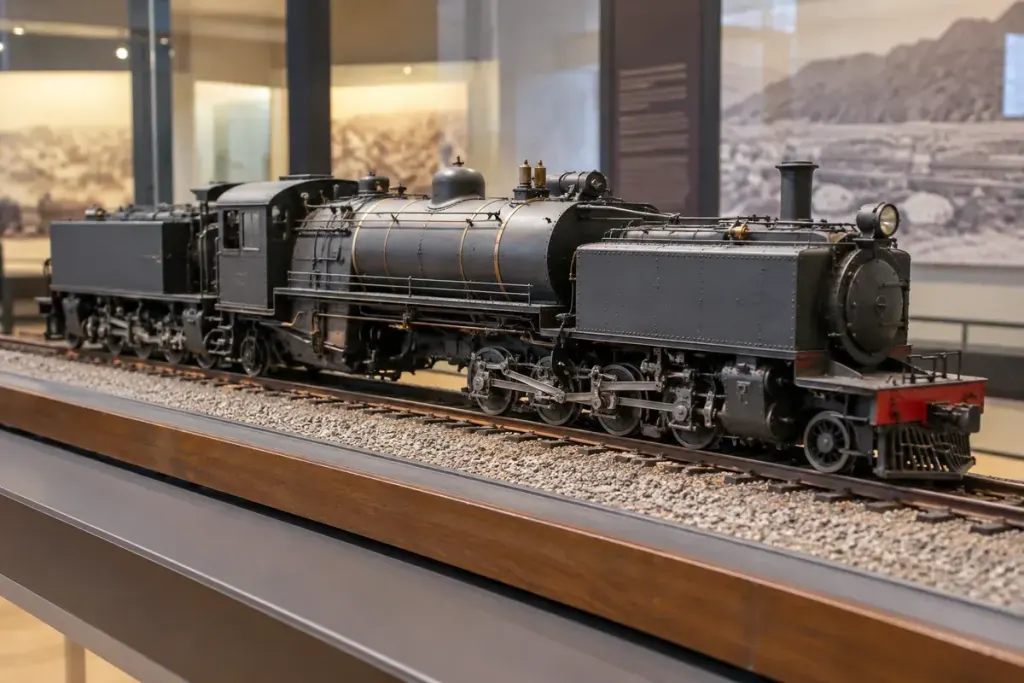
A Garratt steam locomotive can look unusual even to someone familiar with conventional steam engines. The boiler sits in a central structure between two powered units, rather than resting above one continuous set of driving wheels. Recognising that arrangement helps a reader make sense of photographs, drawings and museum descriptions.
The Science Museum Group’s record for Herbert William Garratt describes the centrally mounted boiler between driving bogies. The Ffestiniog and Welsh Highland Railways’ account of restoring locomotive 130 identifies major components including two power units and a boiler cradle. These sources describe a design and a documented restoration; they do not establish that Garratts operated on a particular Montana railroad.
Read the locomotive from the centre outward
Start with the boiler and cab, then locate the wheel groups at either end. Look for the separation between the central supporting structure and the powered units. A photograph from an oblique angle may hide one set of wheels, so compare it with another view or a labelled drawing before making a confident identification.
Do not identify every articulated locomotive as a Garratt. Several steam designs allow sections to move relative to one another, and a general resemblance is not enough. Check the caption, builder, wheel arrangement and archive catalogue together.
A useful research note has two columns: features visible in the image and facts supplied by the record. “Two separate powered units are visible” belongs in the first. A builder’s name, construction date or operating railway belongs in the second unless it can genuinely be read from the image.
This distinction is especially helpful when comparing international locomotive engineering with a regional railway collection. A design can provide valuable context without being presented as local operating history. If a photograph’s location is uncertain, preserve that uncertainty in the caption rather than filling the gap with a familiar railroad name.