
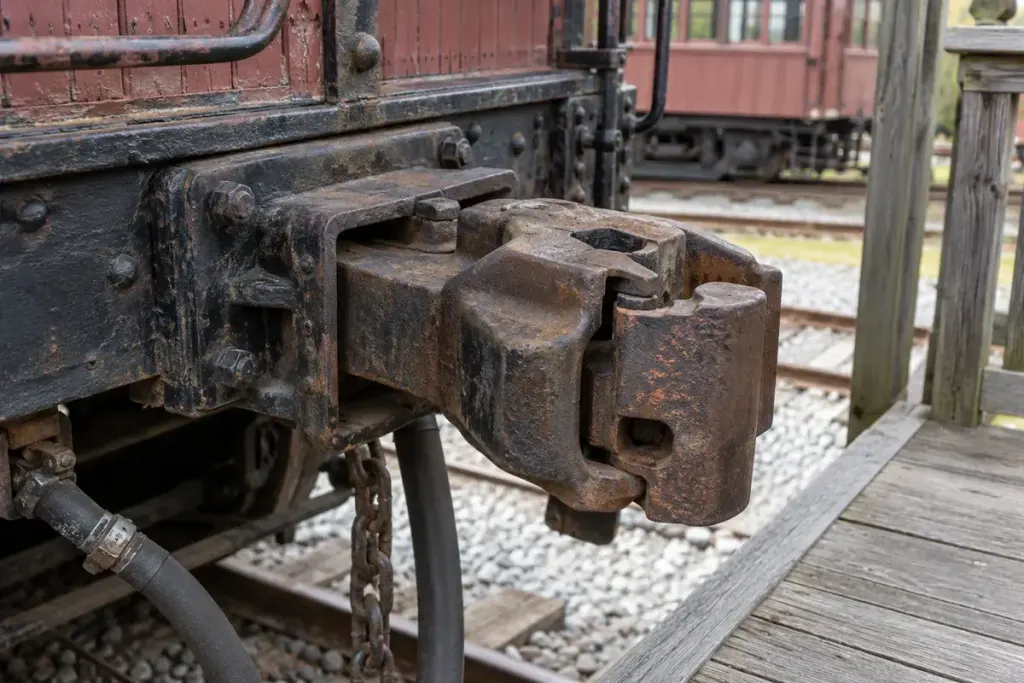
At a railway museum, visitors often look first at the locomotive. The coupling equipment between vehicles can tell an equally interesting story about how railway work changed. It connects the visible machine to the people who assembled and separated trains.
Start by describing what you can see from the permitted viewing area. Is there a knuckle-shaped head, a pin, a link or a visible operating lever? Record the museum’s label and the vehicle number before attaching a date or a technical name to the object.
Compare an object with a documented example
The National Museum of American History’s Janney coupler record provides a named collection object for comparison. Museum catalogues are useful because they separate the object from a general photograph circulating without context.
For a Montana-related vehicle, ask the local museum whether the coupler is original to the car’s working period, a later replacement or part of a restoration. Railway equipment could be modified during service. The date of the vehicle alone does not date every component now attached to it.
Then connect the hardware to work. Where would a worker stand? Which operation could be performed from the side? What other equipment, such as brake hoses, still needed attention? These questions help explain why a coupler belongs in a history of labour as well as engineering.
- Photograph only where permitted.
- Keep the label and object details together in your notes.
- Ask staff which changes are documented.
- Mark uncertain identifications as questions.
Never step between rail vehicles or operate a lever to test an idea, even when equipment appears stationary. Museums may have working stock and hazards that are not obvious to a visitor.
A strong historical caption might identify the vehicle, the visible coupling type and the source for that identification, while noting a replacement date if known. It need not invent a dramatic accident story to make the small piece of machinery worth noticing.