
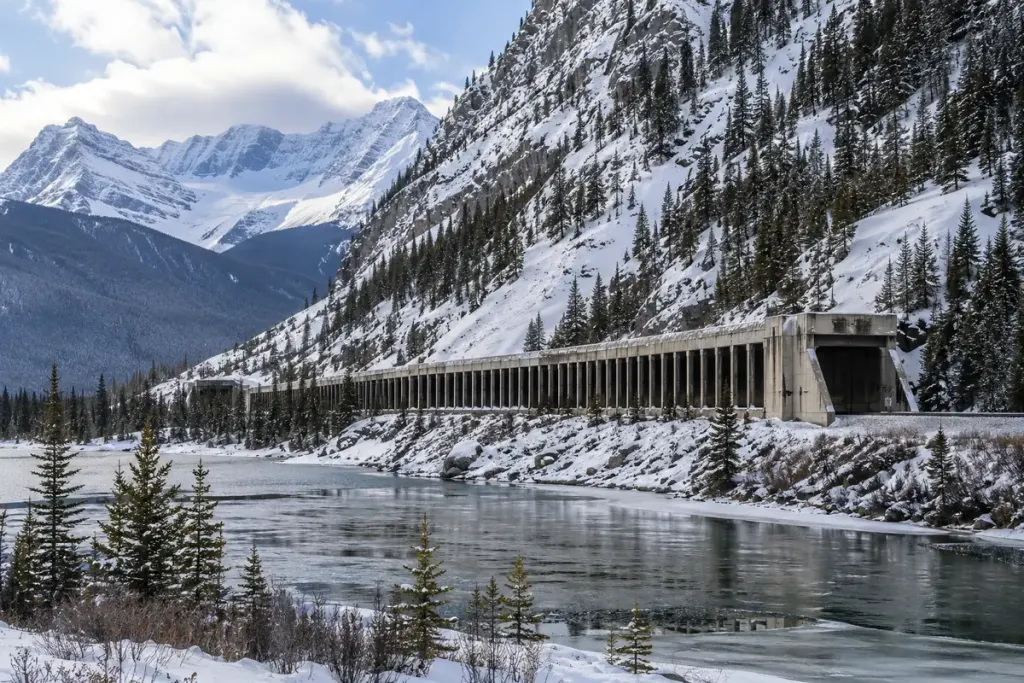
A cropped railway photograph may show what looks like a long roof over the rails. Widen the view and the mountain above it changes the story. A snow shed belongs to the relationship between a route and the slope that threatens it, not just to a catalogue of unusual railway buildings.
Begin a historical reading with the photograph’s date, location and caption. If those details are uncertain, record the uncertainty. A structure that resembles one in another valley is not enough to establish where the image was taken.
Read the landscape around the structure
Look for the direction of the slope, the covered section’s position and the exposed approaches. Note what the photograph does not show: the uphill terrain may continue beyond the frame, and an apparently short structure may extend around a curve.
A useful Montana reference is the National Park Service’s 2008 avalanche-hazard decision announcement for the BNSF railway near Glacier National Park. It records a recommendation for additional snow sheds and extensions in high-risk avalanche paths. That is evidence of a particular decision at a particular date, not a description of every structure visible today.
Separate the proposed work from the completed work
A planning document can explain the problem engineers and land managers were considering. It does not prove that each proposed structure was built. Compare it with later dated photographs, construction records or an authoritative site history before writing a caption about the final outcome.
For your own notes, keep three columns: what the image visibly shows, what a source identifies and what remains a question. “Covered track below a steep slope” is an observation. “Built in response to a particular avalanche” requires supporting evidence.
Use public viewpoints and archive collections for this study. Active tracks and avalanche terrain are not places to explore for a closer photograph. The rewarding discovery often comes from connecting an ordinary-looking roof to the documented effort of keeping a mountain railway open.