
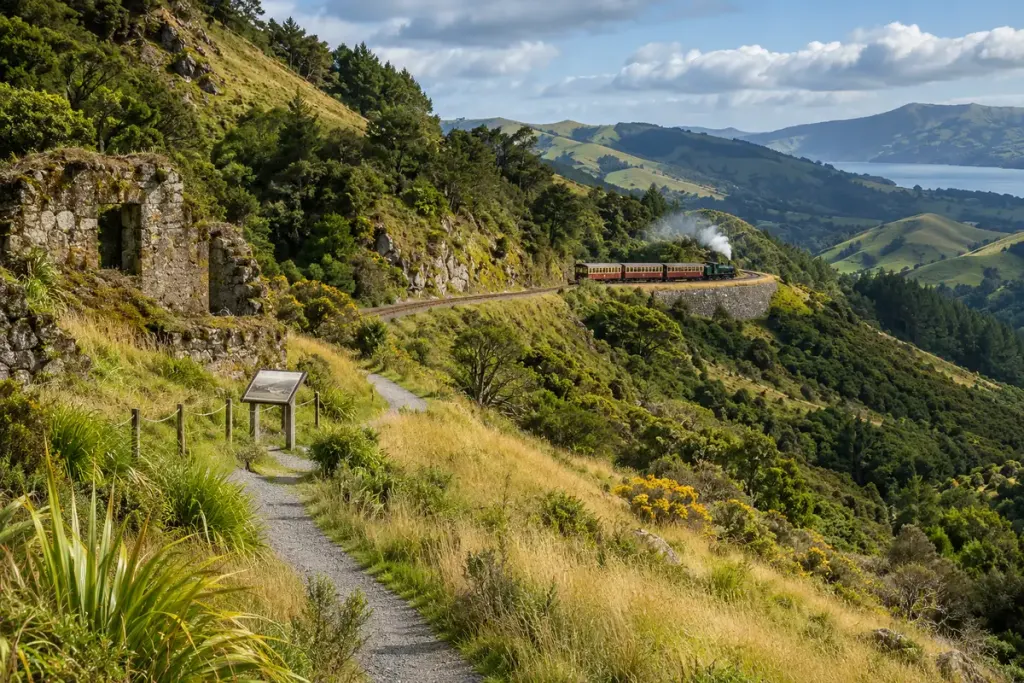
A third rail on a mountain railway does not always supply electricity or carry rack teeth. In the Fell system, a raised centre rail provided another surface for gripping and braking on steep gradients.
The Fell Locomotive Museum describes four horizontal wheels gripping that centre rail. Its surviving locomotive, H199, connects the mechanism with the history of New Zealand’s Rimutaka Incline. The system is easier to understand once you look for contact on the sides of the rail rather than imagining a toothed wheel climbing a rack.
Follow the direction of the contact
Ordinary running wheels bear on the two outer rails. The additional horizontal wheels act against the centre rail. In a drawing or model, identifying those different orientations is more useful than simply counting three rails.
This is also why a photograph of a rack railway should not be used as a mechanical illustration of the Fell system. The two approaches address steep railway operation differently. A centre structure with obvious teeth is an important clue that you are looking at another mechanism.
NZ History’s account of the Remutaka Incline explains the steep route and its use of Fell locomotives. The same history includes severe wind hazards. Extra traction solved a particular operating problem; it did not remove every risk created by terrain and weather.
A museum visit with one question
Before looking at every valve and pipe, ask: where did the additional gripping force act? Find the relevant wheels in the exhibit’s diagram, then locate the corresponding parts on the locomotive if they are visible. Keep a note of anything hidden from view instead of filling the gap from a different locomotive’s photograph.
A useful notebook sketch needs only the two running rails, the centre rail and arrows indicating the wheel orientations. Label it as your interpretation and compare it with the museum’s material before sharing it as an explanation.
Railway history often becomes clearer through this kind of small mechanical distinction. The Fell system is not merely “a train for a steep hill.” It is a specific answer to how a train could gain more grip from the track beneath it.