
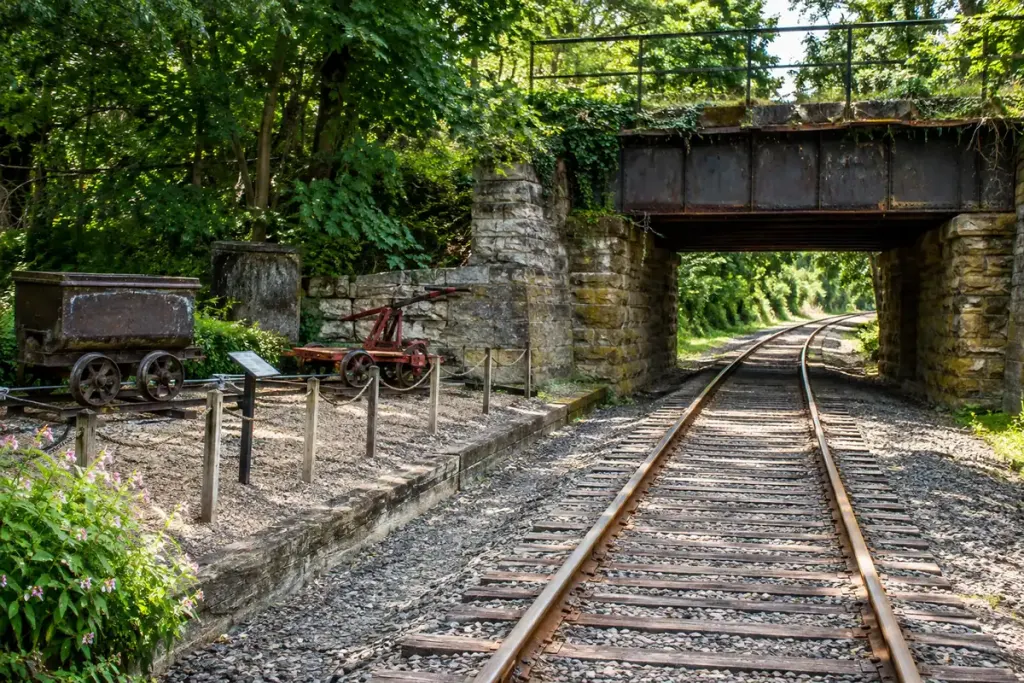
In an old railway photograph, a crossbar with dangling ropes can look like an unfinished gate. It may instead be a telltale: a warning positioned before an overhead obstruction for workers travelling on the tops of freight cars.
The object makes more sense when the worker is put back into the picture. Someone occupied on a car roof might not see an approaching low bridge soon enough. Hanging elements were intended to make physical contact in advance of the obstruction, prompting the worker to lower their body.
A patent explains the intended mechanism
Benjamin J. Hastings’s 1923 patent for a railroad bridge warning describes existing telltales with hanging wire members and ropes, then proposes improvements to their construction. The text is a primary source for the design problem and the inventor’s proposed solution.
Read it with a distinction in mind: a patent describes an invention and its claims. It does not, by itself, prove that the design was installed on a particular Montana railroad, how widely it was adopted or how reliably it prevented injuries.
That limit is useful rather than disappointing. It tells a researcher what additional evidence to seek, such as railway drawings, maintenance records, dated photographs or an identified surviving object.
Look at the approach, not just the bridge
When examining a photograph, trace the track towards the overhead structure. Is there a separate support before it? Are suspended elements visible, or might the image resolution conceal them? If the train could approach from either direction, look for evidence on both approaches without assuming that a missing feature was absent in reality.
Write a caption that separates certainty from interpretation. “Crossbar visible before bridge; hanging elements unclear” is more defensible than confidently identifying an exact model from a blurred shape.
Also check the photograph’s date and provenance. A modern heritage installation, a reconstructed display and an operating railway photograph answer different historical questions. A digital filename is not a reliable construction date.
Keep the worker’s experience in view
Telltales reveal a period when railway safety measures had to account for people working above moving cars. They should not be read as an invitation to reproduce that activity. Study railway infrastructure from permitted public locations or through museum collections.
A small rope curtain can therefore lead to a substantial historical question: what task placed a person in danger, and how did the railway try to warn them before the danger arrived?