
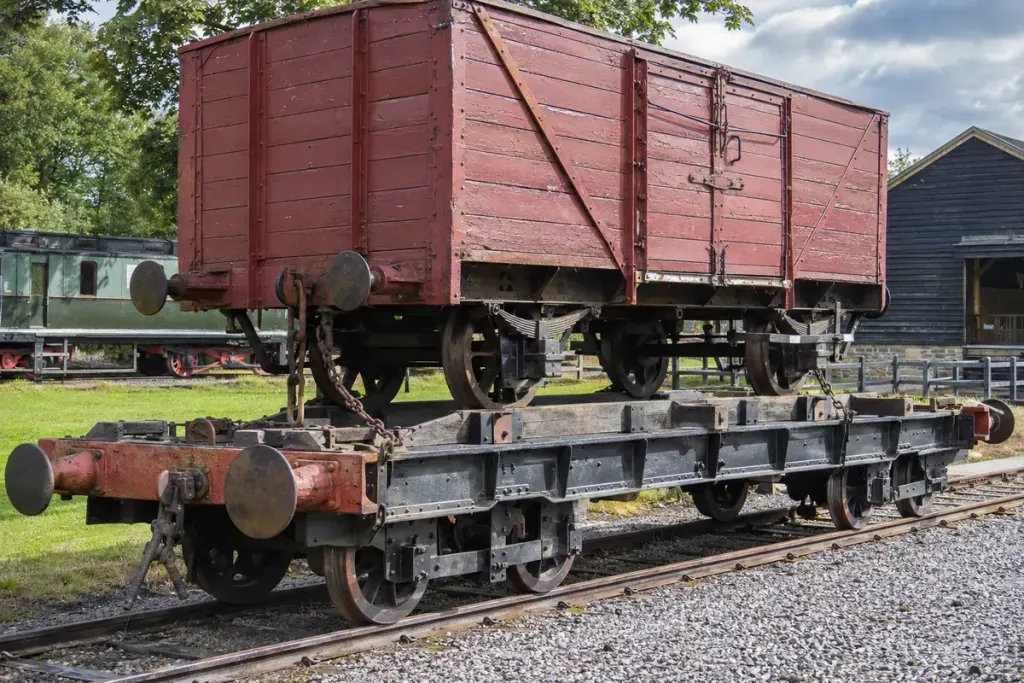
A photograph of a large freight wagon riding above a smaller railway vehicle can look like an awkward loading mistake. On a transporter system, that is the point: one vehicle carries another so that freight can continue beyond a break of gauge.
The Narrow Gauge Railway Museum’s account of the Leek and Manifold Valley Light Railway describes a line that carried standard-gauge wagons on transporters. The Staffordshire railway opened in 1904 and closed in 1934, connecting its valley traffic with the standard-gauge railway at Waterhouses.
Follow the wheels in the photograph
Begin with the rails beneath the train. Then identify the transporter’s running gear and the wheels of the wagon it carries. The upper wagon has not changed gauge simply because it is travelling over a narrow-gauge route. Another vehicle supports it.
This distinction separates a transporter wagon from a bogie exchange, in which the vehicle receives running gear suited to another gauge. It also separates the arrangement from unloading the goods into a different freight wagon. All three address a boundary between systems, but they do so in different ways.
For a museum notebook, draw a simple side-view sketch and label only what you can identify. Mark uncertain coupling or securing details as questions. An attractive historical photograph rarely provides enough information to reconstruct every operating procedure.
The cargo still had to fit the railway
Carrying a larger vehicle could avoid transferring its contents, but the route still had to accommodate the combined height, width, weight and operating arrangement. Track gauge alone does not describe the available clearance through a bridge or beside a platform.
When reading a caption, record the location, date, gauge and vehicle description separately. A modern model, a preserved display and a photograph of an operating train are different kinds of evidence. The most revealing question is often practical: which handling step did this system remove, and which constraints did it leave for railway staff to manage?